
Read the diagram as text
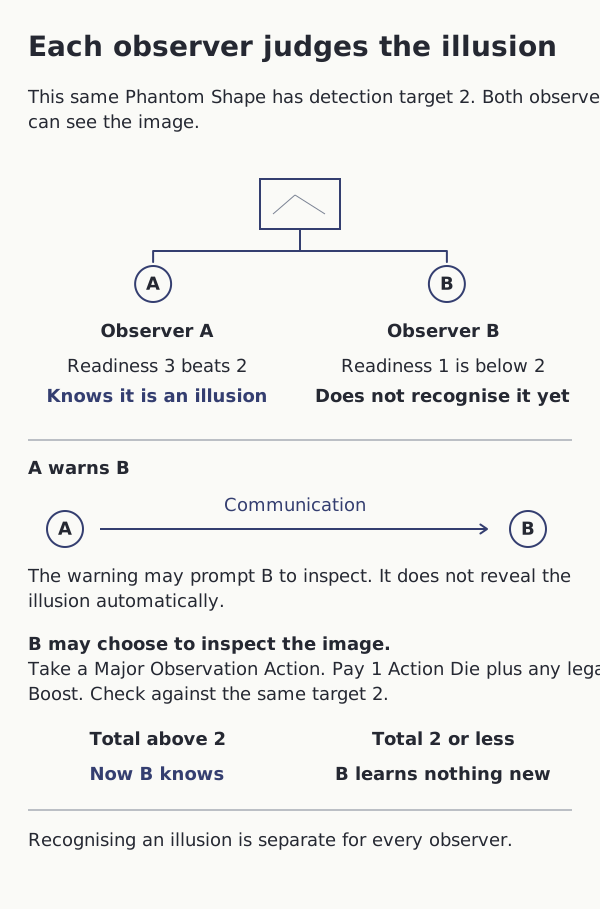
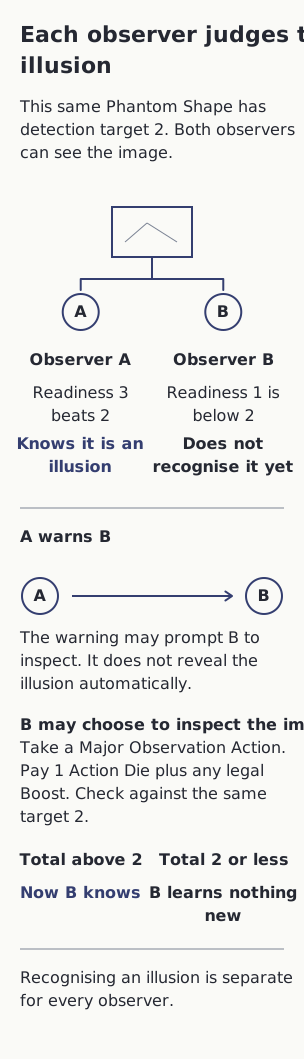
The same Phantom Shape has detection target 2. At their first meaningful view, the Guide privately compares each observer’s Observation Readiness with 2.
- The image’s detection target is 2. Compare each observer separately with the same image.
- Observer A has Observation Readiness 3. Three is higher than two, so A knows it is an illusion and can see through it.
- Observer B has Observation Readiness 1. One is not higher than two, so B does not recognise it as an illusion yet. B is not compelled to trust it.
- A’s warning is communication only. It can give B a reason to inspect; it does not automatically change B’s perception.
- If B chooses to inspect, B pays for a Major Observation Action: 1 Action Die and any legal Boost. A final total above 2 reveals the illusion to B. A tie or lower gives B no new information.
Result: A’s recognition and warning do not automatically reveal the illusion to B.
- A failed inspection cannot be repeated on the same evidence. A new clue or previously hidden view may permit another attempt.
- Physical contact reveals the lack of substance to the toucher without a detection roll. Pay movement or action costs normally.
- Recognition does not end the spell or reveal it to everyone. The image supplies no physical cover or force.
- Veiled Face uses this detection procedure with its own detection target.