
Read the diagram as text
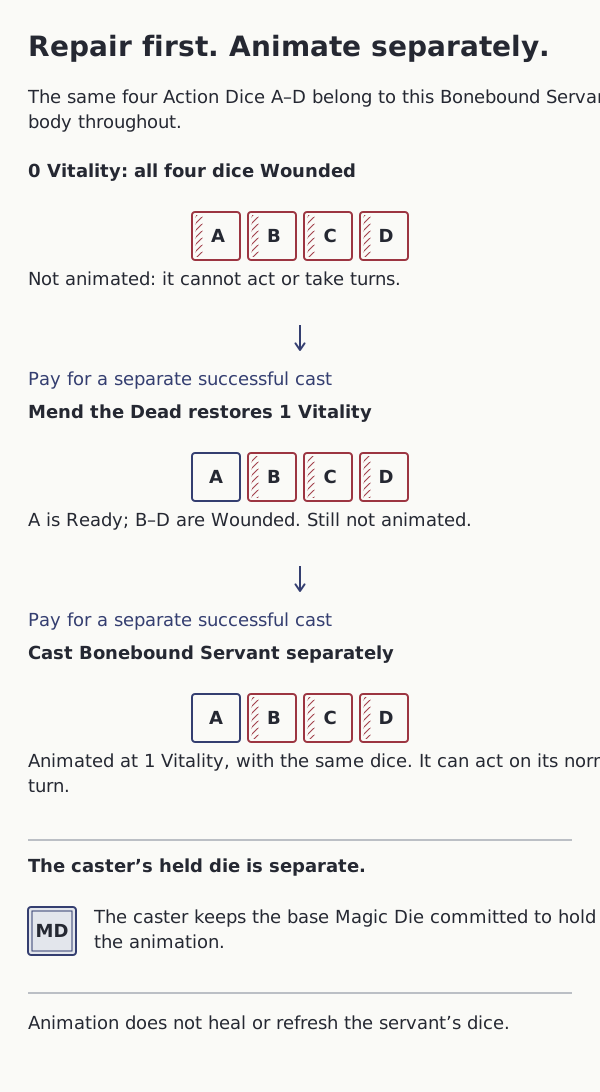
The same four Action Dice, labelled A–D, belong to this repairable Bonebound Servant body throughout. It begins at 0 Vitality with all four dice Wounded.
- At 0 Vitality, the Bonebound Servant body is inert: it is not animated, cannot act and takes no turns. Its four Action Dice A–D are Wounded.
- Pay for and successfully cast Mend the Dead to restore one Vitality. Die A returns to Ready; B, C and D remain Wounded.
- The repaired body remains inert. A separate successful Bonebound Servant casting, with its own payment, is required to animate it.
- After animation, the servant still has one Ready Action Die, three Wounded Action Dice and one Vitality. The caster holds the animation’s base Magic Die committed separately.
Result: Repair restores Vitality; animation lets the servant act. The second spell does not heal or refresh its dice.
- Any Used dice also keep their state when the body is reanimated.
- Allow one servant turn and one start-turn Refresh per Round, including across replacements. Animation grants neither an extra turn nor another Refresh in the same Round.
- Both spells retain their normal requirements and separate costs.
- This is a Bonebound Servant body, not revival of a Deceased character or a Necrokin healing example.