
Read the diagram as text
Mira wins a sword Clash against Rook. Work out the margin, then convert that margin to Wounds.
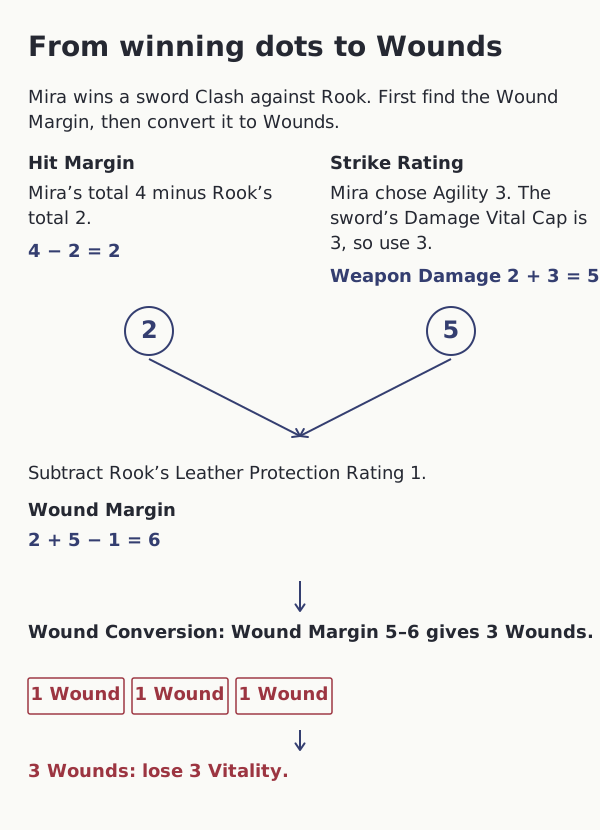
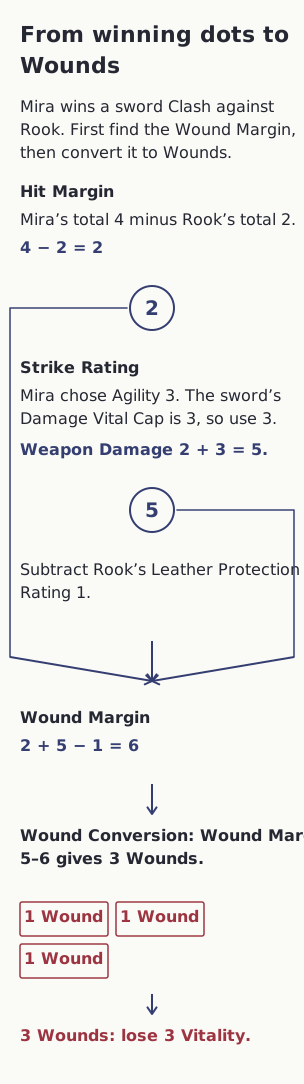
- Mira’s final total 4 minus Rook’s final total 2 gives Hit Margin 2.
- Mira chose Agility 3. The sword’s Damage Vital Cap is 3, so the contribution is 3. Add Weapon Damage 2 for Strike Rating 5.
- Subtract Rook’s Leather Protection Rating 1: Hit Margin 2 + Strike Rating 5 − Protection Rating 1 = Wound Margin 6.
- Use the separate Wound Conversion table. Its 5–6 row gives three Wounds, so Rook loses three Vitality, not six.
- Apply each Wound to an existing die, then resolve collapse before any required Continuation Check.
Result: Wound Margin 6 becomes 3 Wounds through the conversion table. The three identical marks each mean one Wound.
- Each Wound lowers VIT by one and moves one existing die to Wounded AD. Take Ready AD or MD first; only when neither remains may Used AD or committed MD be chosen. Wounding committed MD ends its effect.
- Damage Vital does not change the attack’s Skill or Boost limit. A Wound Margin of zero or below causes no Wound. A specific spell or effect may replace the ordinary weapon calculation.
- See Combat: Applying Wounds and Continuation Checks, and Death & Recovery: Collapse States, for the next procedure.