
On this page
Training becomes part of how you act.
Class traits are the techniques, tricks, spells and other abilities you learn through your Class. They give you particular ways to use your training. Your Skills still let you attempt ordinary actions, whether or not you have a trait that helps.
What you practise becomes the way you meet the world.
Reading a Trait
Start with the trait you have chosen. Read its three main parts:
| Part | What it tells you |
|---|---|
| Trigger | When you can use the trait and what you must do first. |
| Cost | What you spend or commit when you use it. |
| Effect | What changes when you use it. |
An Example shows the trait in use. Scene Modes explain any special distance handling.
Follow the normal rules unless the trait changes them. For example, a bonus to an attack changes its total; it does not create a second attack.
Paths and Training
A Path groups traits around a particular approach. You can choose traits from several Paths.
For ranked traits, train a Path's Skill to at least level 1 before investing in or using its traits. The Fighter's Warrior Path uses Melee; the Rogue's Phantom Path uses Stealth.
Use Character Development for Class levels and trait ranks.
Using Your Traits
Uses and Rest
A ranked trait gives you one use per rank between Rests. For example, rank 3 Parry lets you use Parry three times. Keep track of each trait separately.
You begin with all your uses available. See Rest for restoring spent uses. When you gain a rank, add one available use to that trait; previously spent uses stay spent until you Rest.
Paying the Cost
Say which trait you are using when its Trigger occurs, and pay its Cost then. A legal use stays spent if it fails, is interrupted or turns out to be unnecessary. If a declaration is ruled illegal before payment, spend nothing.
Pay the underlying Action and Boost normally, along with any additional cost of the trait. Pay each cost only once, including payments already given in the trait's instructions. Uses and AD are separate: spending a use does not pay an AD cost. Keep the uses of different traits and Classes separate.
AD costs shown in trait entries are base costs. Apply ordinary cost modifiers, such as Slowed. Apply any stated discount first; a cost reduced to 0 stays 0. Follow Paying Costs and Rolling Dice for the full payment, affordability and which dice to roll.
Boosted Rolls
When a trait requires a Boost, commit at least 1 of your own Boost AD to that roll, within the Skill's normal Boost limit. Base Cost dice, bonus dice, Magic Dice, AD paid only to cover an increased cost and another character's Boost do not count. When a trait names a companion check, the companion supplies the required Boost from its own AD under Companions.
Rolls and Timing
Resolve Edge and the roll's other applicable rerolls before adding a trait's fixed bonus to the final total. Add that bonus before comparing results. If another effect makes you recalculate the same check, include the already-declared bonus once.
A trait that rerolls a remaining Miss can select a die previously rerolled during Edge, unless another rule forbids it. Keep the replacement and do not reopen Edge. Follow any more specific timing in the trait.
A trait that changes your check or Exchange Response adds no separate Action or proactive Skill use. Take an Action or Reaction only when the trait calls for one. Use the normal Action and Reaction requirements and costs.
An effect that happens after an Exchange waits until its harm, state changes and any Continuation Check have finished.
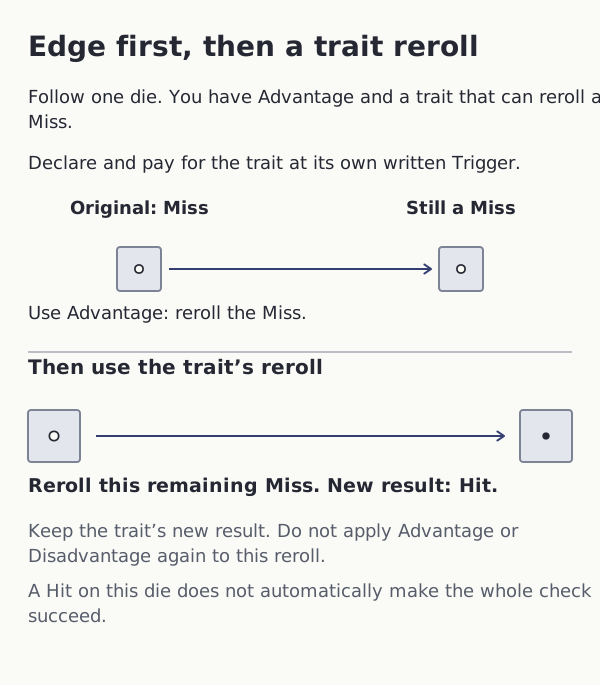
Read the diagram as text
This example follows one die. You have Advantage and a trait that can reroll a Miss.
- The followed die originally shows a Miss.
- Use Advantage during Edge to reroll that Miss. Here, it is still a Miss.
- A suitable trait can reroll this remaining Miss, even though Advantage already rerolled the same die. Here, the replacement is a Hit.
- Keep the trait’s new result. Do not apply Advantage or Disadvantage again to this reroll.
Result: The remaining Miss can be chosen by the trait. Keep its replacement without applying Edge again.
- Declare and pay at the trait’s own Trigger; some traits are declared before the roll and others afterwards. Follow its specific timing and any other applicable reroll rules.
- Other dice are outside this example. One Hit on this die does not automatically make the whole check succeed.
Movement
Movement granted by a trait follows the normal rules for routes, terrain, Slowed and opportunity attacks. Apply movement modifiers before converting metres into Spaces or Zones. See Distance & Range.
What Is an Event?
An Event is the exact moment named in a trait's Trigger. It might be declaring an attack, choosing a response or finding out how many Wounds a hit would cause.
The Trigger decides when to act. “Before rolling” means you commit before you know the result. “After you win” means you wait until the result is known.
One Trait per Event
Each participant may use one Class trait for the same Event. Choose one if several of your traits share that Trigger. You cannot spend several uses to repeat a trait at the same moment.
For traits that modify a spell's declaration, choosing its target and committing its casting dice are one Event. Choose one trait for that declaration. A later named result or reroll can be a separate Event.
Different Events in one Exchange can trigger different traits. For example, a Rogue may declare Ambush when committing an attack, then use Exact Cut when a winning hit's Wound Margin is known. Pay for each.
Applying a bonus you already declared is part of that use, not a new Trigger opportunity.
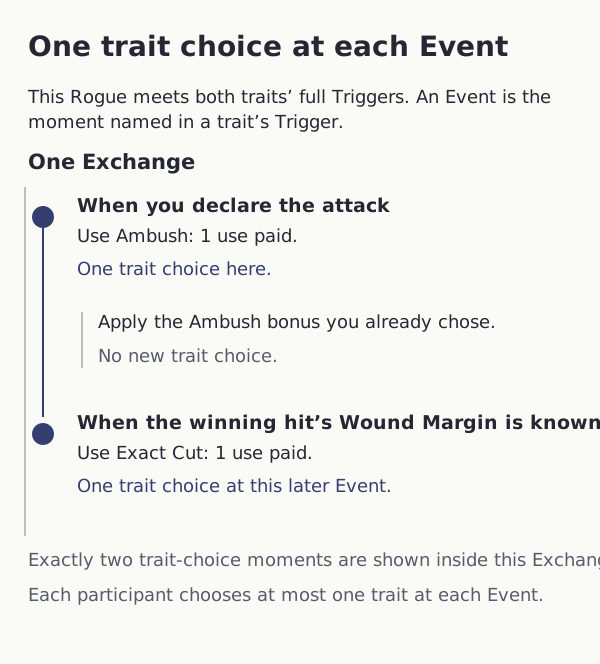
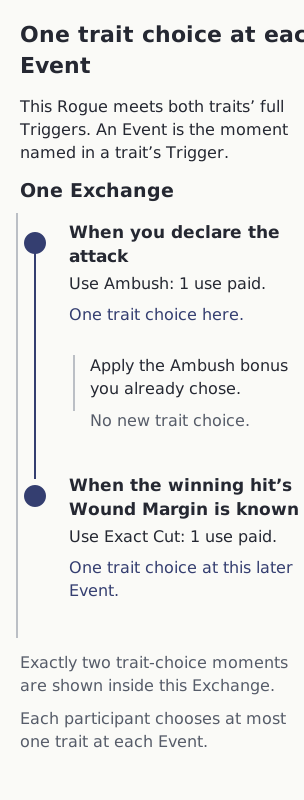

Read the diagram as text
This Rogue meets the full Triggers of both Ambush and Exact Cut. An Event is the moment named in a trait’s Trigger.
- When declaring the attack, choose Ambush and pay one Ambush use.
- Apply the Ambush bonus already chosen at its proper point. This is part of that use, not a fresh Event or trait choice.
- Later, when the winning hit’s normal Wound Margin is known and Exact Cut’s full Trigger is met, choose Exact Cut and pay one Exact Cut use.
Result: Applying Ambush’s existing bonus gives no new choice. Exact Cut is possible at its later Event because its own Trigger is met.
- For this example, the Rogue starts a Melee Dagger Exchange during their own Activation while hidden from the target. They Boost with at least one of their own Action Dice, declare Ambush before the target chooses a response, and stay hidden until rolling.
- Exact Cut needs the boosted Dagger attack to win with normal Wound Margin at least 1, against anatomy the Rogue can reach and understand. Declare it before Wound Conversion.
- Pay the underlying Action and Boost normally. Each selected trait spends its own use.
- For a trait modifying a spell declaration, choosing the target and committing casting dice form one Event, allowing one trait choice. A later named result or reroll may be a separate Event.
Resolving Traits Together
If one Event triggers traits belonging to several participants, identify their choices before resolving any of them. Each participant keeps their valid opportunity, even if another resolves first.
Resolve the chosen traits in this order:
- Active Character: the character whose Action, Exchange, spell, Activation or turn caused the Event.
- Direct Targets: characters directly affected, in table order if needed.
- Bystanders: anyone else with a valid Trigger, in table order if needed.
If a trait causes a new Event, finish the traits already chosen for the current Event first. Then resolve the new Event in the same order. Once an Event's Trigger chain is finished, do not return to it.
If a trait expressly allows only one use for a check or batch of harm, resolve competing offers in the participant order above. Only the first legal offer commits and pays; later offers pay nothing. This does not create a general non-stacking rule for other traits.
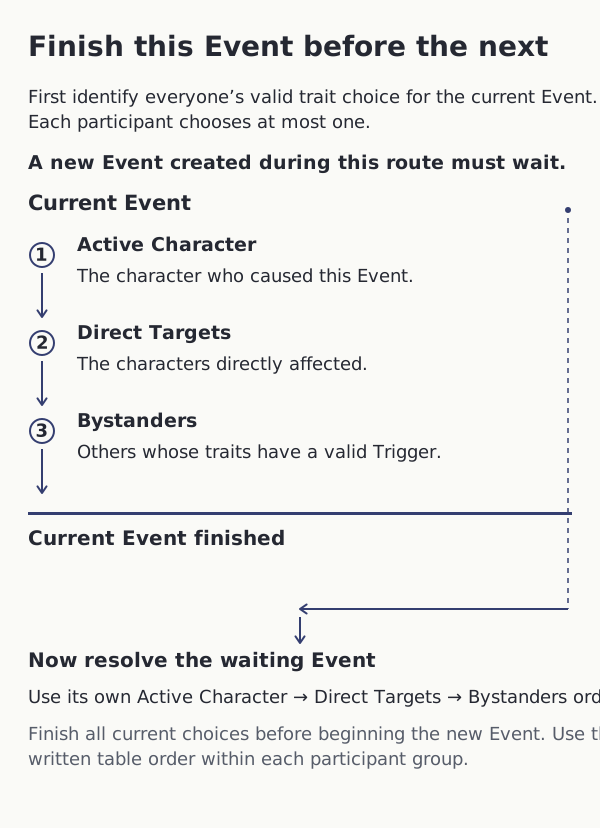

Read the diagram as text
First identify everyone’s valid trait choice for this Event. Each participant may choose at most one. Then resolve those chosen traits in order.
- Identify all participants’ chosen traits before resolving any. Each participant keeps their valid opportunity.
- Resolve the Active Character’s chosen trait first: this is the character whose Action, Exchange, spell, Activation or turn caused the Event.
- Resolve the Direct Targets next: the characters directly affected, using table order if needed.
- Resolve the Bystanders next: others with valid Triggers, using table order if needed.
- Finish the current Event. A new Event created by any of these traits has waited until this point.
- Now resolve the new Event in its own Active Character, Direct Targets, then Bystanders order. Do not return to a completed Event.
Result: A new Event cannot bypass the current Event’s Direct Targets or Bystanders. Finish the entire current route first.
- Table order is defined in Combat, under Effects at the Same Time; it does not decide the next turn.
- If a trait expressly allows only one use per check or batch of harm, competing offers follow participant order. Only the first legal offer commits and pays; later offers pay nothing. This is not a general non-stacking rule.
Summary
- Read the trait: Read the trait's Trigger, Cost and Effect. Follow the normal rules wherever the trait makes no change.
- Path training: Train a Path's Skill to at least level 1 before investing in or using its ranked traits. Follow Character Development for Class levels and trait ranks.
- Uses and Rest: A ranked trait has one use per rank between Rests. Track each trait separately. A gained rank adds one available use; Rest restores spent uses.
- Declaration and payment: Declare the trait and pay when its Trigger occurs. Pay the underlying Action, Boost and any additional trait cost once each. Spending a use does not pay an AD cost.
- Required Boost: A required Boost needs at least 1 of your own Boost AD, within the normal Skill limit. A named companion check uses the companion's own AD.
- Roll timing: Resolve Edge and applicable rerolls before adding fixed bonuses to the final total. Follow the trait's specific timing.
- One trait per Event: Each participant may use one Class trait for the same Event. Different Events can trigger different traits. Applying an already-declared bonus creates no new opportunity.
- Casting declaration: Choosing a spell's target and committing its casting dice are one declaration Event. Choose one trait for that declaration.
- Resolve together: Resolve participants in order: Active Character, Direct Targets, then Bystanders. Finish the current Event's chosen traits before resolving a new Event.
- Shared procedures: A trait that modifies a check or Exchange Response adds no separate Action or proactive Skill use. Follow the normal movement and Reaction rules unless the trait changes them.