
On this page
Still your mind. Shape the unseen.
Magic uses your own dice. Entering a Trance turns some of your Ready Action Dice into Magic Dice. You choose how much of your ordinary action capacity to commit. As you cast, those dice return to your Action Dice.
Your Class tells you which spells you know, which Skill each spell uses and how its traits can help. A spell spends casting dice. A trait also spends its own use when you choose to apply it.
To shape the unseen is to give your own strength a new form.
Your Magic Pool
You have one Magic Pool, even if you belong to several spellcasting Classes. It holds:
- Ready MD: Magic Dice available to cast or Boost.
- Committed MD: Magic Dice holding ongoing effects that require your Trance.
Both count towards your Magic Pool Limit and remain part of your dice body. Converting dice never creates more dice or changes your Vitality.
You are in Trance while you hold any MD. When none remain, your Trance ends.
Your limits
Magic Pool Limit = your highest qualifying magic Skill Level.
A trained Path Skill qualifies as a magic Skill once you know a spell from that Path. Your Class identifies its Path Skills. You cannot use a Path's spells while its Skill is untrained.
Trance uses per Rest = your highest spellcasting Class level.
Use one shared allowance. For example, a Mage 3 / Cleric 1 has three Trance uses per Rest. Record how many you spend. Each use lets you enter or deepen Trance; releasing your Trance does not restore a use.
The Magic Pool Limit and Trance allowance each have a maximum of 10. Apply the highest Skill or Class level named above; do not add levels from different Skills or Classes. Ready and committed MD share your existing AD/MD dice body, which cannot exceed 10 dice across all states.
Your Skill, Class and trait advancement follows Character Development.
Enter or deepen Trance
During your own Activation, entering or deepening Trance is a Minor Action costing 1 AD. You may do this once per Activation, combined.
- You must have a Trance use remaining, room in your Magic Pool and enough Ready AD to pay the full modified Action cost with at least one Ready AD left to convert. An illegal declaration spends nothing.
- Spend one Trance use and pay the 1 AD base cost after discounts and cost modifiers, moving the payment dice to Used AD. While Slowed, this costs 2 AD, still with only one Trance use. Dice spent on this cost cannot also be converted.
- Convert as many of your remaining Ready AD as you choose into Ready MD, one AD into one MD, from one die up to your remaining pool capacity. Count any committed MD when checking that capacity. Slowed does not change this conversion.
Example: With five Ready AD and a Magic Pool Limit of 3, pay one AD and convert three of the remaining dice. You have one Ready AD, one Used AD and three Ready MD. While Slowed, pay two AD and convert the remaining three: zero Ready AD, two Used AD and three Ready MD. With only two Ready AD while Slowed, you cannot enter or deepen Trance because none would remain to convert.
If you already hold MD, you deepen that Trance. Otherwise, you enter Trance. The procedure requires no Skill Check and spends no proactive Skill use.
When you play without turns, take the same deliberate moment. Entering or deepening is not a Reaction. When your Trance uses run out, you must complete a Rest before entering or deepening again. You can still spend any Ready MD you already hold.

Read the diagram as text
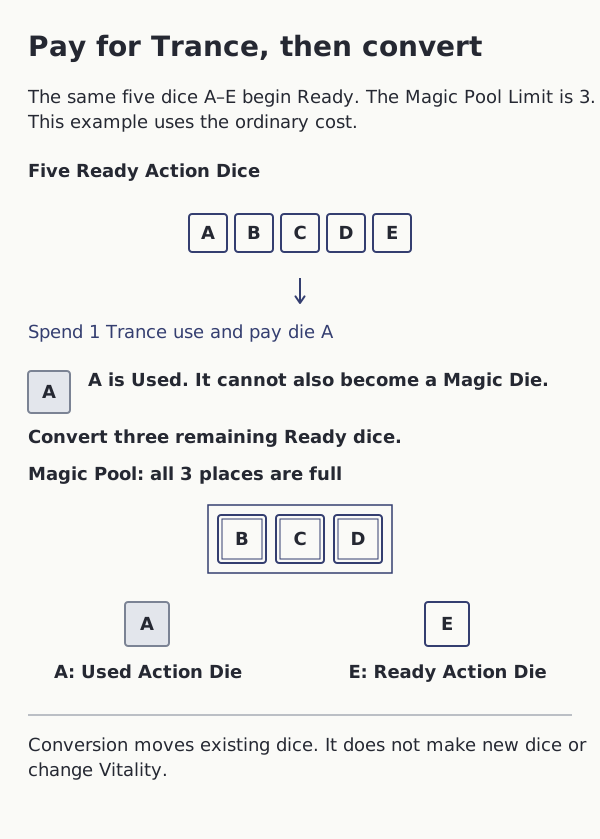
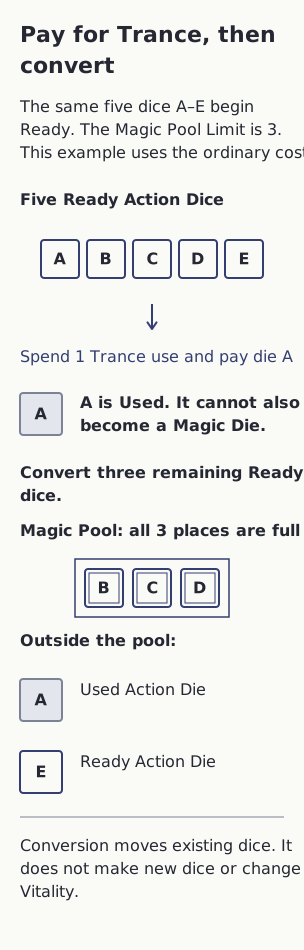
The same five dice A–E begin as Ready Action Dice. You have a Trance use available and Magic Pool Limit 3. This example has the ordinary, unmodified entry cost.
- Start with the same five Ready Action Dice A–E and a Magic Pool Limit of three.
- Spend one Trance use and pay one Ready Action Die for the ordinary Minor Action entry cost. Die A becomes Used and cannot also be converted.
- Turn three of the remaining Ready Action Dice, B, C and D, one-for-one into Ready Magic Dice. They fill the Magic Pool’s three places.
- Leave E as a Ready Action Die. The result is one Ready Action Die, one Used Action Die and three Ready Magic Dice: still the same five dice.
Result: The die paid for Trance is Used. Only the remaining Ready Action Dice can be converted.
- After paying the full modified cost, at least one Ready Action Die must remain to convert, with room in the pool. An illegal declaration spends nothing.
- Ready and committed Magic Dice both count towards Magic Pool capacity. Conversion creates no dice and changes no Vitality.
- Entering or deepening is allowed once per own turn, combined. It needs no Skill Check and spends no proactive Skill use.
- Slowed makes the ordinary entry payment two Action Dice, but conversion stays one-for-one and still spends one Trance use.
- Running out of Trance uses does not prevent spending Ready Magic Dice already held.
Cast a spell
Follow the spell's requirements, target and casting Skill. Casting is a Major Action unless the spell permits another procedure, such as a Reaction. Ordinary proactive Skill-use limits still apply. Every spell makes a casting Skill Check, which you can Boost.
- Declare your spell, target and intent.
- Choose one Ready MD for the base casting cost.
- If you can Boost, choose Ready AD, Ready MD or a mixture. The total number of genuine Boost dice cannot exceed the Skill Level used for this cast. Apply any other restrictions on Boost normally.
- Follow Paying Costs and Rolling Dice: apply discounts, then cost modifiers, confirm affordability and commit the full payment. Slowed doubles AD payments, including AD Boost and additional AD fees. MD costs, including MD Boost, stay unchanged; casting with MD alone gains no AD charge.
- Roll the base MD, genuine Boost dice and any explicitly granted bonus dice. Exclude AD paid only for an increased cost: they add no roll dice, are not Boost and cannot satisfy an AD Boost requirement. Resolve the ordinary Skill Check and the spell's effect.
- Move spent AD to Used AD. Move spent MD, including MD used for Boost, to Used AD too. A successful effect that requires ongoing Trance keeps its base MD as described below.
You spend the dice whether the check succeeds or fails. If a Wound or another part of the resolution has already moved a die, keep that result; never return the same die twice.
Class traits resolve when their written Trigger occurs. Follow Class Traits for timing. A trait requiring your own AD Boost still requires AD; MD do not satisfy that requirement. If a spell counts MD used for Boost, count only the extra MD, excluding its base casting die.
Resolve the spell before moving its spent dice. Casting with your last MD does not cancel the result you just produced.
Example: With Occult 4, you can cast using one MD and Boost with up to four more dice. One MD plus four AD spends one prepared MD. Three MD plus two AD rolls the same number of dice but spends three prepared MD.
Slowed example: A spell with a base cost of 1 MD and Boost 1 AD pays 1 MD + 2 AD, but rolls 1 MD + 1 AD. With one AD Boost and one MD Boost instead, it pays 2 AD + 2 MD, rolls three dice and has Boost 2. Payment-only AD never increase its Boost count.
Magic Conversion
Some spells convert a casting total or winning margin into healing, a bonus, a penalty or another effect. Use the input named by the spell in the table below. The spell tells you how to apply the converted value.
| Total or margin | Converted value |
|---|---|
| 0 or less | 0 |
| 1-2 | 1 |
| 3-4 | 2 |
| 5-6 | 3 |
| 7-8 | 5 |
| 9+ | 8 |
Ongoing effects
When a successful spell creates an ongoing effect that requires your Trance, keep its base MD committed while that effect continues. Spend its Boost dice normally.
A committed MD cannot cast, Boost or refresh. It still occupies one place in your Magic Pool. You remain in Trance even when all your remaining MD are committed, but you need a Ready MD to cast again.
A Scene Reset does not end a spell. Follow the spell's duration, ending conditions and limits on repeated copies. When its effect ends, the committed die becomes Used AD. If the die becomes Wounded or otherwise leaves your pool, its effect ends; keep the die's new state.
A replacement casting needs a new Ready MD. Where failure leaves the existing effect running, its committed die stays in place. A successful replacement ends the old effect and returns its die to Used AD.
If an effect expires at the start of your Activation, release its committed die before that Activation's ordinary AD refresh. An effect that lasts through a particular attack or refresh keeps its stated ending time.
Completed harm, healing and information remain resolved after Trance ends. An effect expressly written to continue without Trance follows its own duration and does not hold an MD merely because its result lasts.
Spell Timing
Follow the spell's Activation timing whenever the Scene uses turns. When you play without turns, count time in the story from when the spell succeeds. A Round is about ten seconds.
| Timing in the spell | Time without turns |
|---|---|
| Start of your next Activation, by your next Activation to begin a named action, or the target's next start-turn Refresh | One Round (about ten seconds) |
| End of your next Activation or start of your second Activation after casting | Two Rounds (about twenty seconds) |
If combat starts before one of these deadlines, any spell or action window that is still active carries into the new Combat Scene. Count to the first Activation in the fight of the character the spell names. A one-Round spell ends at the start of that Activation. A two-Round spell ends at its end. If the spell affects a Refresh, it lasts through that Refresh. If it gives you until that Activation to begin an action, you can begin it during that Activation.
Follow any other ending conditions the spell gives. Changing Mode or starting or stopping the turn tracker on its own does not restart a spell's duration.

Read the diagram as text
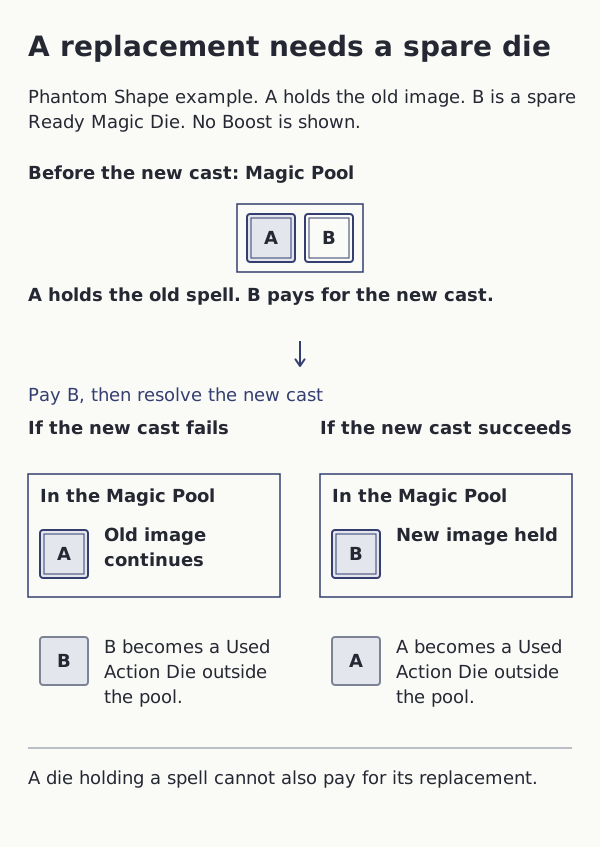
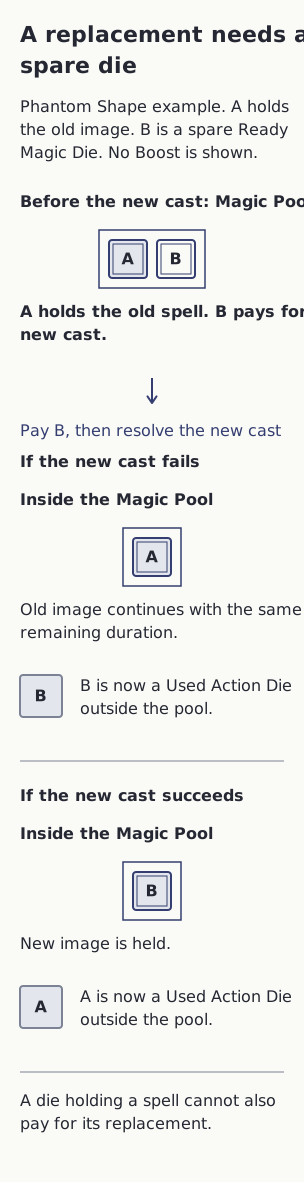
This example follows two selected dice from a larger body while replacing Phantom Shape. Die A holds the old image; die B is a spare Ready Magic Die. No Boost or other dice changes are shown.
- Apply Phantom Shape’s replacement rule. Follow two selected dice: A is committed to the old image, while B is a Ready Magic Die available for the new cast.
- Pay B for the replacement. A cannot cast, Boost or refresh while holding the old spell.
- If the new cast fails, the old spell continues for its unchanged remaining duration. A stays committed inside the pool, and B becomes a Used Action Die outside it.
- If the new cast succeeds, the old spell ends. A becomes a Used Action Die outside the pool, while B stays committed inside it to hold the new image.
Result: A committed die cannot pay for its own replacement. Use a spare Ready Magic Die; the failed new cast does not restart the old duration.
- Each branch retains one committed Magic Die and no Ready Magic Dice among these two selected dice. Other body dice are omitted.
- Trance continues while any committed Magic Dice remain. Normal requirements and costs still apply; any Boost is paid and spent normally.
- Follow each spell’s own replacement rule. The old effect’s continuation on failure is shown here for Phantom Shape.
- If resolution has already Wounded or otherwise moved a die, keep that state instead of moving it twice.
Refresh and Wounds
Used AD refresh under the ordinary rules, including impaired refresh when it applies. Dice that were previously MD refresh as AD. Preparing them as MD again requires another Trance use.
Wounds take Ready AD or Ready MD first. If neither remains, choose Used AD or a committed MD. The wounded die becomes Wounded AD. Wounding a committed MD ends its effect. Healing restores Wounded AD as AD.
End your Trance
Once on your own turn, you may release your whole Trance as a Trivial Action costing 0 AD. When you play without turns, you may release it during your own deliberate action.
- Return Ready MD to Ready AD.
- End the effects whose MD you hold and return those committed MD to Used AD.
Spent Trance uses remain spent. Voluntary release is not a Reaction and does not let you exchange a few MD for defensive AD outside your turn.
If another effect closes your Trance, return all remaining MD to Used AD and end the effects they hold. Follow any different dice movement expressly stated by that effect.
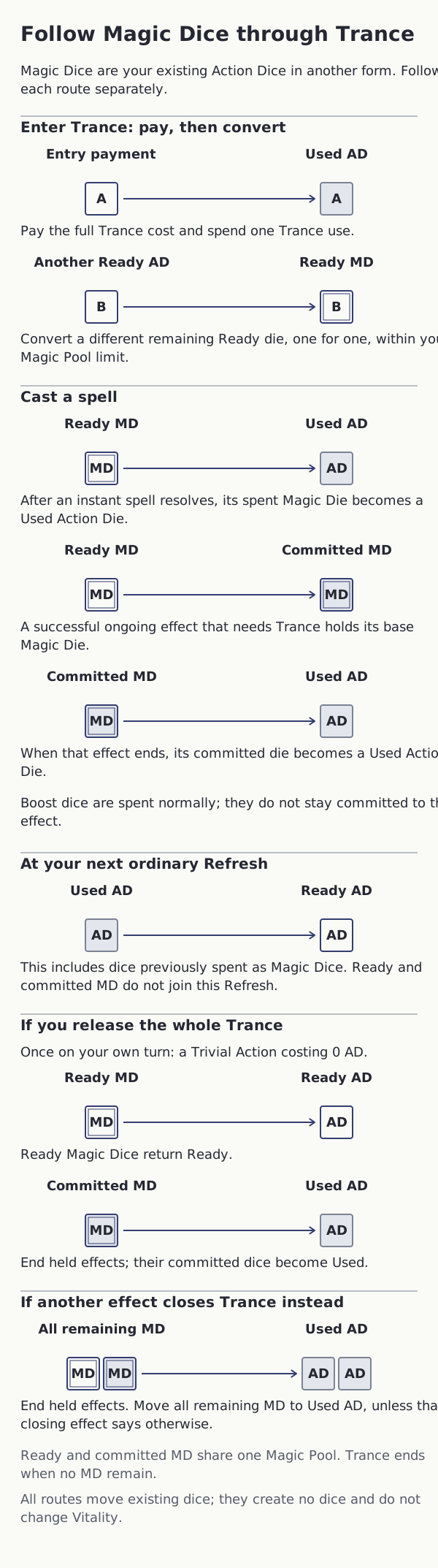


Read the diagram as text
Magic Dice (MD) are your existing Action Dice (AD) in a different form. Your one Magic Pool contains Ready and committed MD; both count towards its limit.
- During your own Activation, entering or deepening Trance is a Minor Action, once per Activation combined. Have a Trance use, pool room, and enough Ready AD to pay the full modified cost with at least one Ready AD left to convert.
- Spend one Trance use and pay the 1 AD base cost after discounts and cost modifiers. Slowed makes this payment 2 AD. Payment dice become Used AD and cannot be converted. An illegal declaration spends nothing.
- Convert remaining Ready AD one-for-one into Ready MD, from one die up to remaining pool capacity. Ready and committed MD share that capacity.
- For a spell, pay one Ready MD as its base casting die. Legal Boost can use Ready AD, Ready MD or both, within the casting Skill’s limit. Resolve the spell before moving its spent dice.
- Spent AD and MD become Used AD whether the casting succeeds or fails. A successful ongoing effect requiring Trance keeps only its base MD committed; spend its Boost dice normally.
- When that ongoing effect ends, move its committed die to Used AD. If the die is Wounded or otherwise leaves the pool, end its effect and keep the die’s new state.
- Ordinary Refresh returns Used AD as Ready AD, including dice previously spent as MD. Ready and committed MD do not join it. Prepare MD again through another Trance use.
- Once on your own turn, voluntarily release the whole Trance as a 0 AD Trivial Action. Ready MD become Ready AD. End held effects and move their committed MD to Used AD. This is not a Reaction.
- If another effect closes Trance, end held effects and move all remaining MD to Used AD, unless that effect expressly states another movement.
- For Wounds, choose Ready AD or Ready MD first. Only if neither remains choose Used AD or committed MD. The chosen die becomes Wounded AD; wounding a committed die ends its effect. Healing restores Wounded AD as AD.
Result: Every route moves existing dice. Trance ends when you hold no MD; spending or converting dice does not change Vitality.
- A replacement needs a new Ready MD. If failure preserves the old effect, keep its die committed. A successful replacement ends it and moves its die to Used AD.
- If your pool limit falls, release enough MD to fit: Ready MD become Ready AD; committed MD end their effects and become Used AD.
- An effect ending at the start of your Activation releases its die before ordinary Refresh. Otherwise, keep its stated ending time. Never move a die twice.
- End Trance before Rest and remain out of Trance throughout it. A completed Rest restores spent Trance uses but prepares no MD; an interrupted Rest restores none.
Rest
Follow Rest for the Trance boundary and recovering Trance uses after a completed Rest.
Changes to your limits
Recalculate the relevant limit when your qualifying magic Skills or spellcasting Class levels change. Keep the Trance uses already spent: your remaining uses equal the new allowance minus those spent, with a minimum of zero. Changing a limit does not prepare MD.
If a reduced Magic Pool Limit leaves you holding excess MD, choose enough to release to meet the new limit. Ready MD return to Ready AD. Releasing a committed MD ends its effect and returns it to Used AD.
Summary
- Your limits: You have one shared Magic Pool. Your highest qualifying magic Skill Level sets its limit; your highest spellcasting Class level sets your Trance uses per Rest.
- Enter Trance: Entering or deepening Trance has a base cost of 1 AD and one Trance use, once per Activation combined. Slowed makes the AD payment 2. Convert remaining Ready AD into MD one-for-one within your pool limit.
- Cast a spell: A spell normally costs one Ready MD and a Major Action. Make its casting Skill Check and follow any spell-specific procedure.
- Boost and Slowed: Boost with Ready AD, Ready MD or both, up to the Skill Level used for that cast. Slowed doubles only the AD payment, without adding roll dice or Boost. MD costs stay unchanged. A trait requiring your own AD still needs genuine AD Boost.
- Magic Conversion: If a spell calls for Magic Conversion, look up the casting total or winning margin it names and apply the converted value as instructed.
- Spent dice: Resolve the spell before moving its spent dice. Spent MD become Used AD whether the check succeeds or fails.
- Ongoing effects: An ongoing effect requiring Trance keeps its base MD committed until it ends, then returns that die to Used AD. Committed MD count towards your pool limit and cannot cast, Boost or refresh.
- Spell Timing: Use the Activation named by the spell when you take turns. When you play without turns, count time in the story. Short spells can carry into a fight.
- Trance and Refresh: Your Trance continues while you hold any Ready or committed MD. When none remain, it ends. Used AD refresh as AD; preparing MD again needs another Trance use.
- Release Trance: Once on your own turn, you may release your whole Trance as a Trivial Action costing 0 AD. Return Ready MD to Ready AD and end held effects, returning their committed MD to Used AD.
- Rest: Follow Rest to recover Trance uses and prepare for the next stretch of play.