
On this page
Same shape. Different voice. Every roll speaks.
Each Narateer die is a vessel of fate—an eight-sided interpreter of story, action, and consequence. The dice do not simply generate numbers. They translate intent into impact.
In Narateer, Action Dice are the heart of active play. When you act, push, defend, or risk yourself, you spend Action Dice. Your Skills shape how far you can push.
Through dice cast, your voice enters the world.
What Are Narateer Dice?
Your hands roll numbers—your choices roll fate.
Narateer Dice are custom eight-sided dice (D8s) used to resolve action, challenge, risk, and magic. All Narateer dice share the same faces, but their purpose depends on how they enter the story.
The main dice types are:
- Action Dice (AD) — Your effort, stamina, agency, and risk in the moment.
- Magic Dice (MD) — Channelled magical force used by spellcasters and supernatural effects.
Ask yourself:
- How much effort am I willing to spend?
- How hard can my character safely push this kind of action?
- What narrative weight does this roll carry?
Understanding Dice Faces
All Narateer dice follow the same face layout:
| Symbol | Per Die | Outcome | Value | Meaning |
|---|---|---|---|---|
| ⚫⚫ | x1 | Critical Hit | 2 | Great Success |
| ⚫ | x3 | Hit | 1 | Success |
| ⚪ | x4 | Miss | 0 | Failure |
Tip: Count the dots, then follow the procedure you are resolving. A Hit on one die does not automatically mean the whole action succeeds. For example, a Skill Check compares your final dots with its Difficulty Rating; a Recovery Roll uses its own outcome table.
DIY Tip: To make your own Narateer Dice, use the print-and-play template and instructions in the Downloads section. You may use a distinct colour for each dice type to easily identify them at the table.
Action Dice (AD)
Action Dice (AD) represent your effort, focus, stamina, and ability to shape the scene. They are tied directly to Vitality.
Your dice body = your Maximum VIT, up to 10 dice.
This limit counts Ready AD, Used AD, Ready MD, committed MD and Wounded AD together. Converting AD into MD moves existing dice within that body. Refreshing or healing returns existing dice to use.
A rule may grant bonus dice for a roll. Those dice do not join your AD or MD pools and cannot pay costs. The body limit does not limit how many dice a rule may let you roll, or how often you may spend a die after refreshing it. See Vitality.
Your Action Dice are both a resource and a risk. The more you spend, the more you can attempt. The more you hold back, the more you can react. When you are harmed, your Action Dice are wounded, reducing your ability to act.
Using Action Dice:
- Spend AD to perform meaningful actions.
- Spend AD to make Skill Checks.
- Spend extra AD to boost a Skill Check, up to the Skill Level.
- Hold AD back to defend, react, or respond later.
- Wounds take Ready AD or Ready MD first, then Used AD or committed MD only when neither kind of Ready die remains. The character taking the Wounds chooses which kind to take within that state. Each chosen die becomes Wounded AD.
- Move Used AD back to Ready at the start of your turn, unless your refresh is impaired.
Action Dice show what you are willing to spend in the moment.
Magic Dice (MD)
Magic Dice (MD) represent your ability to channel arcane force, divine will, primal resonance, or other supernatural power.
Magic Dice are not used for ordinary Skill Checks. They enter play when casting spells, invoking relics, entering Trance, or resolving magical effects.
Using Magic Dice:
- Spend MD when casting spells, invoking relics, or resolving magical effects.
- Boost a casting check with Ready AD, Ready MD or both, within the casting Skill's limit.
- Resolve the casting Skill Check, then move spent MD to Used AD.
- Keep a successful ongoing effect's base MD committed when that effect requires your Trance. It becomes Used AD when the effect ends.
Note: Magic Dice rules are explained fully in the Magic chapter.
Dice States
Track each die in one place:
- Ready AD or Ready MD — Available to spend now.
- Used AD — Spent dice awaiting ordinary refresh. Spent MD become Used AD too.
- Committed MD — Holding an ongoing effect that requires Trance. These dice cannot be spent or refreshed. When the effect ends, they become Used AD.
- Wounded AD — Lost to harm and unusable until healed.
Wounds take Ready AD or Ready MD first. If neither remains, choose Used AD or committed MD. Each chosen die becomes Wounded AD. Wounding a committed MD ends the effect it holds. See Applying Wounds.
Dice committed to a payment, including AD paid only for an increased cost, are unavailable for further spending during resolution. They need no separate tracked state. After resolution, move spent dice to Used AD or keep base MD committed as required by Magic. If Wounds or another part of resolution already moved a die, keep that result; never return it twice.
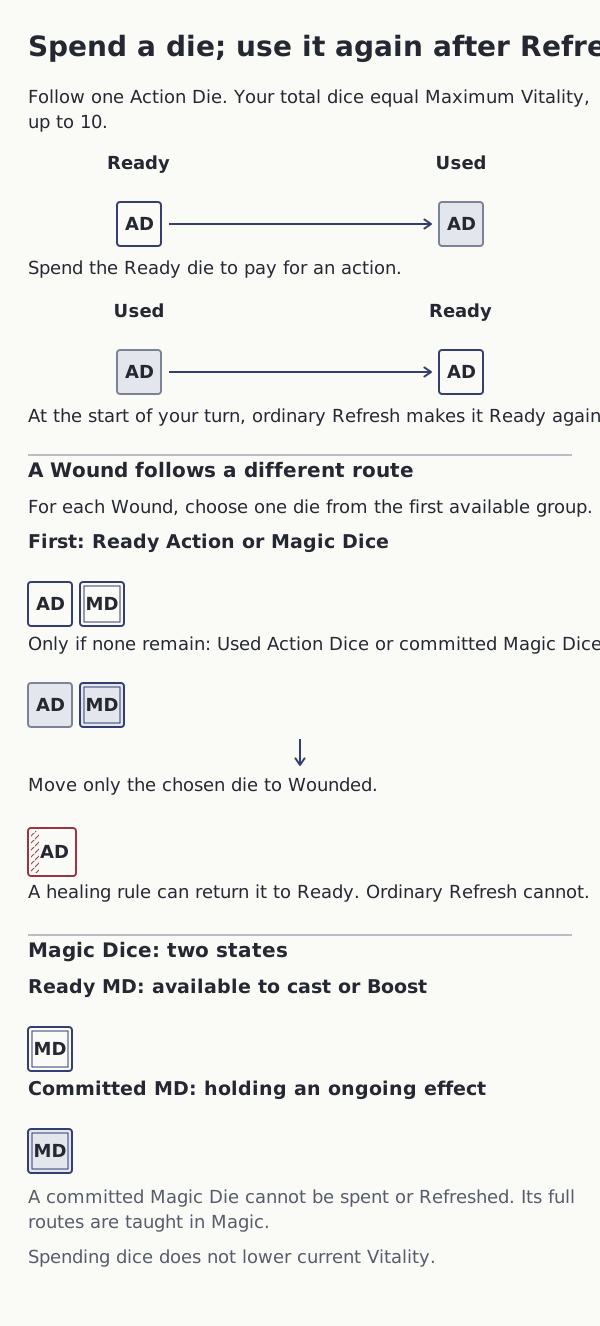


Read the diagram as text
Your total number of dice equals your Maximum Vitality (VIT). You can have at most 10. First, follow one Action Die (AD).
- Spend one Ready Action Die. It becomes Used.
- At the start of your turn, ordinary Refresh makes the Used die Ready again.
- For each Wound, choose Ready Action Dice or Ready Magic Dice first. Only when neither remains may you choose Used Action Dice or committed Magic Dice. The chosen die becomes Wounded.
- Follow the healing rule to return a Wounded die; it normally returns as a Ready Action Die.
- Magic Dice can be Ready to spend or committed to an ongoing effect. Their full routes are taught in Magic.
Result: A spent Action Die is Used. You normally regain it at the start of your turn; a Wounded die needs healing.
- If Refresh is impaired, roll the Used Action Dice instead of returning them automatically.
- Ready and committed Magic Dice do not join ordinary Action Dice Refresh.
- Wounding a committed Magic Die ends the effect it holds. Keep the die Wounded.
- All five states share the same dice body. Converting Action Dice into Magic Dice creates no extra dice.
Refreshing Dice
At the start of your turn, move all Used AD back to Ready AD. This includes dice previously spent as MD. Preparing them as MD again requires another Trance use.
This represents catching your breath, resetting your stance, reclaiming your focus, finding your timing, or seeing the next opening.
Ready MD remain ready; committed MD keep holding their effects. Neither joins AD refresh. Wounded AD remain Wounded until healed.
Impaired Refresh
Do not roll to refresh unless the fiction is actively resisting recovery.
Some conditions, hazards, injuries, magical effects, or environmental pressures may impair your refresh. The Weakened condition imposes Impaired Refresh while it lasts. When your refresh is impaired, roll your Used Action Dice instead of returning them automatically.
- Each ⚫⚫ or ⚫ returns 1 Used die to Ready.
- Each ⚪ remains Used.
- Wounded AD are not rolled.
The fiction should always explain why your refresh is impaired: choking smoke, panic, stunning force, dragging magic, poison, exhaustion, crushing restraint, unstable footing, or another active pressure.
If nothing is actively interfering with recovery, do not roll. Refresh automatically.
Advantage or Disadvantage on Refresh rolls does not turn automatic Refresh into a roll. Weakened or another effect must first impair it. Inspired then grants Advantage; Stunned grants Disadvantage. If both apply, resolve an ordinary Impaired Refresh roll: Hits and Criticals return their dice, and Misses stay Used. A Skill Check penalty alone does not affect Refresh.
Check the effect's ending time before refreshing. An effect ending at the start of your turn has ended before Refresh. One lasting through your next Refresh applies to that Refresh and ends afterwards. See Condition timing.
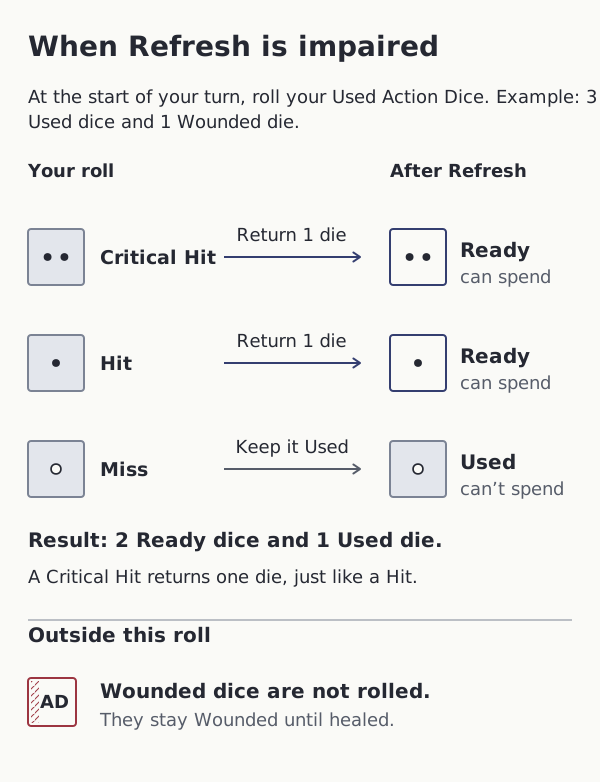
Read the diagram as text
At the start of your turn, Refresh is impaired. Roll these three Used Action Dice; keep the Wounded die outside the roll.
- Roll only the three Used Action Dice. Do not roll the Wounded die.
- Resolve any applicable rerolls before moving dice according to their final faces.
- The Critical Hit makes its own die Ready. The Hit also makes its own die Ready.
- The Miss stays Used, and the Wounded die stays Wounded.
Result: You have two Ready dice, one Used die and the same Wounded die. A Critical Hit does not return two dice.
- Ordinary Refresh makes all Used Action Dice Ready automatically. Roll only when Refresh is impaired.
The Core Rhythm
Narateer’s dice rhythm is simple:
- Choose the attempt and any legal Boost, then pay its full modified cost.
- If the attempt calls for a roll, roll only its required dice, genuine Boost dice and explicitly granted bonus dice.
- Apply Edge or other explicit reroll rules.
- Count dots.
- Face the consequence.
Spending AD does not always produce a roll. Movement and loading can cost AD without rolling. An increased payment, such as Slowed, grants no extra roll dice. See Paying Costs and Rolling Dice.
The fiction decides when a roll matters. The dice decide how the moment turns.
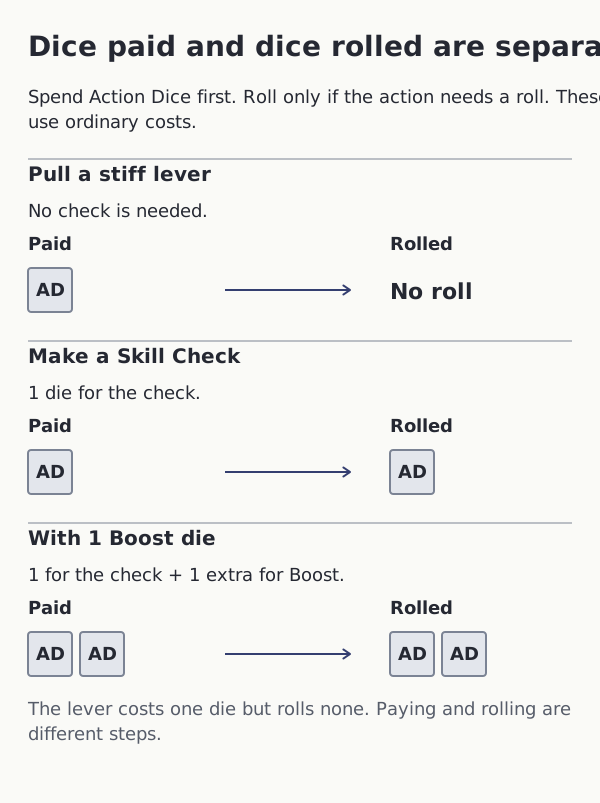

Read the diagram as text
Spend the Action Dice (AD) first. Roll only if the action needs a roll. These three examples use ordinary costs and no bonus dice.
- Pulling this stiff lever needs no check. Pay one Action Die and roll no dice.
- The ordinary Skill Check costs one Action Die: one die for the check. Pay one and roll one.
- With one Boost die, pay two Action Dice: one for the check plus one extra for Boost. Roll both dice.
Result: The three examples pay one, one and two Action Dice, while rolling zero, one and two dice.
- A roll uses the dice required by the action, genuine Boost dice and any explicitly granted bonus dice.
Summary
- Dice faces: All Narateer dice are D8s with fixed faces: 1x ⚫⚫, 3x ⚫, and 4x ⚪.
- Action Dice: Action Dice (AD) are the main active dice of play. Your AD/MD body equals Maximum VIT and cannot exceed 10 dice, counting all dice states.
- What AD represent: Action Dice represent effort, stamina, agency, risk, defence, and wounds.
- Magic Dice: Magic Dice (MD) are used for spells, relics, Trance, and magical effects.
- Dice states: Track Ready AD, Used AD, Ready MD, committed MD and Wounded AD.
- Spent and committed MD: Spent MD become Used AD. MD holding ongoing effects remain committed until those effects end.
- Ordinary Refresh: Used AD normally return to Ready AD at the start of your turn.
- Impaired Refresh: If your refresh is impaired, roll Used AD: Hits and Criticals return to Ready; Misses remain Used.
- Wounded AD: Wounded Action Dice do not refresh this way; they remain Wounded until healed.
- Taking Wounds: Wounds take Ready AD or Ready MD first, then Used AD or committed MD only when neither kind of Ready die remains. The character taking the Wounds chooses which kind to take within that state. Each chosen die becomes Wounded AD.
- Payment and rolling: Pay the modified cost. Roll only when the attempt calls for it, using its required dice, genuine Boost dice and explicit bonus dice. Extra payment grants no roll dice. Then resolve Edge, count dots and face the consequence.