
On this page
Speed changes position. Position changes what happens next.
Movement determines how far you can deliberately reposition during a scene. Every character has a Base Movement, measured in metres. During your Activation, choose whether to Walk, Run, or Sprint, then use the current Scene Mode to represent that movement.
Most movement does not require a roll.
Movement is normally automatic. Roll when an obstacle, hazard, or opponent makes the route meaningfully uncertain—not to discover whether your character remembered how to run.
Base Movement
Your Base Movement (BM) represents your normal movement in metres.
BM = 8 + Strength + Agility
Record BM on your Character Sheet. If Strength or Agility changes, recalculate BM.
Example: Base Movement
Kael has Strength 2 and Agility 4.
BM = 8 + 2 + 4 = 14 m
Kael can Walk up to 14 m during his Activation before terrain, Conditions, or other effects change that movement.
Movement Modes
During your Activation, choose one movement mode for your normal movement that turn.
| Mode | Cost | Movement | Skill | Roll |
|---|---|---|---|---|
| Walk | 0 AD | BM | — | None |
| Run | 1 AD | BM × 2 | — | None |
| Sprint | 2 AD | (BM × 3) + 2 m per Sprint Skill Level | Athletics or Acrobatics | None |
The table gives base costs. Apply discounts and cost modifiers through Paying Costs and Rolling Dice. Pay the movement mode's modified cost once, even if you divide your movement around other Actions. No payment adds a movement roll.
You may move less than your full allowance.
Walk
Walking is ordinary controlled movement.
Walk costs no AD and allows movement up to your BM.
Walking is normally available whenever you are capable of moving unless another rule says otherwise.
Run
Running is fast, reliable movement.
Run has a base cost of 1 AD before discounts and modifiers. Move up to twice your modified BM.
Run Distance = BM × 2
Running does not require a Skill Check and does not use Athletics or Acrobatics.
Sprint
Sprinting is an all-out burst of trained movement.
Sprint has a base cost of 2 AD before discounts and modifiers. Choose Athletics or Acrobatics as the Skill governing the Sprint.
Sprint Distance = (BM × 3) + (Sprint Skill Level × 2 m)
Sprint is a Major Action, but it does not require a Skill Check and cannot be Boosted normally because no roll is being made.
A Sprint counts as one proactive use of the Skill governing it.
Because Narateer uses Action costs rather than fixed Action slots, Sprinting does not prevent you from taking other legal Actions during the same Activation if you still have the resources and opportunity to do so.
Choosing the Sprint Skill
Choose the Skill that matches how the character is moving.
- Athletics normally governs direct, forceful, sustained, or straightforward sprinting.
- Acrobatics governs sprinting where balance, rapid redirection, vaulting, tumbling, unstable footing, or similar agile control defines the movement.
Do not choose between Athletics and Acrobatics only because one Skill Level is higher. The declared method and route determine which Skill applies.
A specific rule or Class trait may require an Athletics Sprint or an Acrobatics Sprint. In that case, use the named Skill.
Example: Sprinting straight across an open courtyard normally uses Athletics. Sprinting along a narrow wall, bounding between market stalls, or moving through an acrobatic route may use Acrobatics.
Example: Sprinting
Arlen has Strength 4 and Agility 3.
BM = 8 + 4 + 3 = 15 m
Arlen has Athletics SL 4 and sprints directly across open ground.
Sprint Distance = (15 × 3) + (4 × 2) Sprint Distance = 45 + 8 = 53 m
Arlen spends 2 AD and may move up to 53 m.
No Sprint roll is required.
Movement Sequence
Resolve normal movement in this order:
- Declare your route and aim. Establish the destination, known barriers, terrain costs and any known hazard. The Guide confirms what is possible before you pay.
- Determine BM. Apply explicit Base Movement effects, including halving BM for Slowed, then your current Encumbrance state. Keep fractional metres until conversion.
- Choose Walk, Run or Sprint. For Sprint, choose the governing Skill from the route and method. Check its remaining proactive uses and calculate the complete allowance, including its Skill bonus.
- Confirm the costs and route. Apply discounts first, then AD cost modifiers, and use the current Scene Mode. Check the resources and Skill uses needed for known risky manoeuvres too. Revise an impossible or unaffordable plan before committing.
- Pay the movement mode's cost once. If Sprinting, spend one proactive use of its governing Skill. Record the allowance.
- Move along the legal route. Deduct terrain and other movement costs as you travel. At a hazard, follow Skill Checks During Movement. Resolve newly encountered danger when it arises.
- Keep the remainder. You may divide movement around other Actions, but receive no fresh allowance or refund for movement already used.
Choose only one normal movement mode during your Activation. A newly revealed obstacle can change your route or stop you; it does not undo legal movement or its payment.
Dividing Movement
You may divide your normal movement around your other Actions if the fiction and route allow it.
For example, you might:
- Run 8 m, attack, then use your remaining Run movement;
- Sprint to cover, interact with an object, then continue moving;
- Walk around an obstacle, act, then reposition again.
You do not pay the movement mode's cost again when continuing the same movement allowance.
Your total normal movement during the Activation cannot exceed the allowance produced by your chosen movement mode.
Opportunity Attacks
Moving from one Space within an opponent’s melee reach to another Space within their reach can trigger an Opportunity Attack. Complete the step, then resolve the Reaction before continuing. Entering or leaving their reach does not trigger this Reaction. See Combat — Opportunity Attacks.
Additional Movement
Some Class traits, spells, Reactions, equipment, or other rules grant additional movement.
Additional movement is separate from your normal movement allowance unless the rule explicitly says otherwise.
It does not inherit your Walk, Run, or Sprint multiplier.
If a rule tells you to continue your Sprint, use whatever Sprint movement remains.
If a rule instead grants a specific amount of additional movement, use that amount exactly as written.
Rule Principle: A movement mode determines your normal movement. A specific rule determines its own additional movement.
Skill Checks During Movement
Walking, Running, and Sprinting do not normally require Skill Checks.
A Skill Check may still be required when something about the route is risky, contested, or meaningfully uncertain.
Examples include:
- leaping a dangerous gap;
- balancing across a collapsing beam;
- climbing an unstable wall under pressure;
- swimming through violent water;
- vaulting a hazardous obstacle;
- maintaining footing on shifting ground;
- forcing through physical resistance;
- escaping something that is actively contesting your movement.
Resolve that challenge using the Skill that matches the method.
Athletics usually covers force, endurance, climbing, swimming, powerful leaps, and overcoming physical resistance.
Acrobatics usually covers balance, tumbling, agile traversal, controlled landings, rapid redirection, and similar precision movement.
Failure affects the obstacle or route, not whether the character was capable of Running or Sprinting in the first place.
The Guide establishes the stakes before dice are committed.
Possible consequences might include:
- movement stopping at the obstacle;
- losing part or all of the remaining movement;
- falling Prone;
- ending in a worse position;
- suffering Harm;
- being forced onto another route.
Paying for a Risky Manoeuvre
A risky leap, climb or similar attempt along a route is a separate Major Action, unless a specific rule supplies another procedure. It costs 1 AD plus any legal Boost and uses one proactive use of the Skill tested. Roll one required die plus the chosen Boost and any explicitly granted bonus dice. Apply ordinary payment modifiers; extra payment alone adds no dice. See Skill Checks.
Walk and Run spend no proactive Skill use themselves. Sprint already spends one use of its governing Skill; a separate manoeuvre spends another use of the Skill that actually resolves that obstacle. The two Skills can differ. Sprint's two-AD base payment is spent on movement and supplies no dice for the separate check.
Each distinct risky manoeuvre has its own cost and Skill use. Do not repeat a check for harmless steps or parts of the same resolved obstacle. With no Ready AD or no remaining proactive use of the needed Skill, you cannot voluntarily begin that attempt. Stop before the obstacle or choose a legal route around it. The Guide must state known checks and consequences before commitment.
A newly appearing hazard does not grant free dice. If you can stop safely, stop before choosing whether to attempt it. If danger catches you and stopping is impossible, follow any specific Reaction or resistance rule; otherwise resolve the established consequence. Never demand payment of AD the character does not have.
Failure does not refund the movement mode or change Sprint into Run. Keep movement already spent and apply the stated consequence to the remaining route.
Example: Sprinting Through a Hazard
Mira has BM 14 and Acrobatics SL 4. She sprints through a collapsing market route where rapid vaults and changes of direction define her movement.
Sprint Distance = (14 × 3) + (4 × 2) = 50 m
Mira spends 2 AD and one proactive Acrobatics use to begin a Sprint with 50 m of movement. Acrobatics SL 4 gives her five proactive uses in the Activation; four remain.
Partway through the route, a falling stall blocks the street. Clearing it safely is genuinely uncertain, so the Guide calls for an Acrobatics Skill Check and establishes the consequence of failure.
Mira has enough Ready AD and an Acrobatics use left. She pays another 1 AD and chooses 1 Boost AD, rolling two dice. That separate attempt spends one more Acrobatics use. She has now paid 4 AD in total and used Acrobatics twice. The check resolves whether she clears the obstacle.
It does not determine her Sprint distance and cannot turn her Sprint into a Run.
If she succeeds, she continues with whatever Sprint movement remains. If she fails, resolve the established consequence.
Untrained example: At Acrobatics SL 0, you have one proactive Acrobatics use and cannot Boost. An Acrobatics Sprint spends that use, so you cannot also initiate an Acrobatics obstacle check that Activation. Walking or Running leaves the use available. An Athletics Sprint leaves it available too, if that is the Skill your route actually uses.
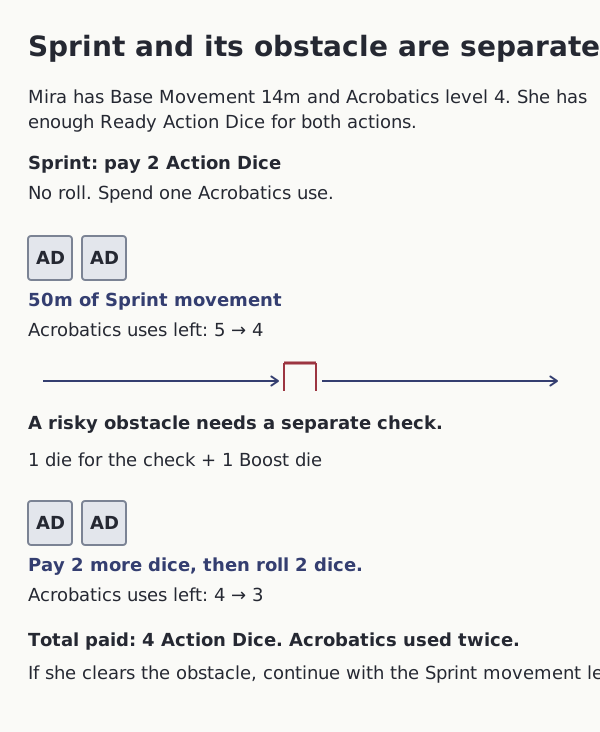
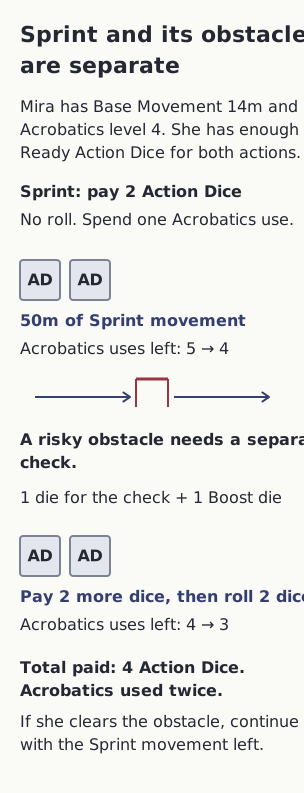

Read the diagram as text
Mira has Base Movement 14m and Acrobatics level 4. She has enough Ready AD to pay for both actions. This agile route uses Acrobatics for Sprint.
- Calculate Sprint using Base Movement 14 and Acrobatics level 4: (14 × 3) + (4 × 2) = 50m.
- Pay 2 AD and spend one proactive Acrobatics use to Sprint. Do not roll. Five Acrobatics uses become four.
- At the genuinely uncertain obstacle, hear the Guide’s stakes before committing. Pay one AD for the check plus one legal Boost AD: two more AD, rolling two dice.
- Spend another Acrobatics use, leaving three. This obstacle roll decides whether Mira clears it, not her Sprint distance.
- On success, continue with the Sprint movement still left. Failure applies the established consequence without a refund or a new allowance.
Result: Sprint’s payment does not pay for the obstacle roll. The two actions have separate costs and separate Skill uses.
- Apply normal discounts and payment modifiers. A voluntary risky manoeuvre needs Ready AD and a remaining proactive use of the Skill it tests; it is a Major Action unless a specific rule says otherwise.
- The Sprint Skill and obstacle Skill can differ when the methods differ. Each uses its own remaining-use count. Walk and Run do not themselves spend a proactive Skill use.
- Failure may stop movement or cause the established consequence. It does not refund Sprint, turn it into Run or grant fresh movement.
Terrain and Route Costs
Terrain changes how quickly movement allowance is spent.
Difficult Terrain
Moving through Difficult terrain costs twice as much movement.
1 m travelled through Difficult terrain costs 2 m of movement allowance.
Several ordinary reasons for terrain being difficult do not multiply the cost repeatedly. Apply the Difficult terrain cost once unless a specific rule explicitly creates an additional or stacking cost.
Examples may include:
- dense rubble;
- deep mud;
- thick undergrowth;
- steep unstable ground;
- crowded spaces where speed is restricted;
- waist-deep water;
- other terrain that materially slows progress.
Terrain is Difficult because of what the route demands, not merely because it is unfamiliar.
Moving While Hidden
Hide allows concealed Walk or Run movement at twice its normal movement cost. Apply terrain costs too: 1 m through Difficult terrain costs 4 m of movement while hidden. Ordinary Sprint movement cannot preserve hiding.
Climbing and Swimming
Climbing or swimming does not automatically require a Skill Check.
If the movement is possible and no meaningful uncertainty exists, resolve it normally and apply an appropriate movement cost if the route is slower than ordinary ground.
If danger, pressure, instability, exhaustion, or another meaningful risk makes success uncertain, call for the appropriate Skill Check.
Athletics normally governs swimming and forceful climbing. Acrobatics may govern routes where balance, precision, agile traversal, or controlled movement is the defining challenge.
Obstacles
An ordinary obstacle that does not meaningfully threaten success simply changes the route or movement cost.
Call for a Skill Check only when both success and failure would materially change the scene.
Conditions and Movement
Conditions are defined in Combat. Apply their written effects before calculating or resolving movement.
Movement does not redefine those Conditions.
In particular:
- a Condition that reduces Base Movement changes BM before applying a movement mode;
- a Condition that prevents movement prevents normal movement;
- a Condition that prevents Sprinting prevents Sprint;
- a Condition that restricts direction or positioning still applies while moving;
- standing from Prone costs the AD stated by that Condition before movement continues.
While Slowed, ordinary Walk costs 0 AD, Run costs 2 AD and Sprint costs 4 AD. Apply discounts first: Fleet Foot can still make Run free, but movement remains reduced.
Halve BM before calculating Walk, Run or Sprint; do not halve the finished allowance again. Keep Sprint's separate Skill bonus. With BM 12 and Sprint Skill Level 3, normal Walk, Run and Sprint allow 12 m, 24 m and 42 m. While Slowed, they allow 6 m, 12 m and 24 m: Sprint is (6 × 3) + (3 × 2) = 24 m. None requires a normal movement roll.
Follow the Condition itself whenever its wording is more specific than the general movement rules.
Moving While Prone
On your turn, you may drop Prone as a Trivial Action costing 0 AD. A rule that knocks you Prone applies at its own timing and does not make you pay to fall. Dropping voluntarily is not a Reaction.
Standing has a base cost of 1 AD. Apply discounts and cost modifiers normally; Slowed makes an undiscounted stand cost 2 AD. Stand on your turn unless a specific rule allows another timing. You must be physically able to stand. Standing does not choose a movement mode, consume a proactive Skill use or restore movement already spent.
While Prone, crawl instead of moving upright. Each metre crawled costs 2m of your movement allowance; Difficult terrain makes it 4m. If you have not chosen a movement mode, choose Walk. You cannot Run or Sprint while Prone. If you fell after already choosing Run or Sprint, you may crawl using that mode's remaining allowance at the same increased route cost; you cannot buy another mode. Crawling is not Sprint movement and grants no Sprint protection against ranged attacks.
Standing lets you continue the movement you already chose, using what remains. Neither falling nor standing refreshes its allowance. Prone does not stop movement granted by an effect that expressly works while you are on the ground.
Example: Mira has 12m of Walk movement and drops Prone. Crawling 3m uses 6m of her allowance. She pays 1 AD to stand and can then Walk the remaining 6m. Dropping and standing did not give her a second movement allowance.
Encumbrance and Movement
Carried Bulk can reduce or prevent movement.
Apply the character's current Encumbrance state through Bulk & Encumbrance to Base Movement, after other BM modifiers and before calculating Walk, Run, or Sprint. Add the governing Skill bonus after tripling the reduced BM for Sprint.
Encumbrance owns its movement penalties. Do not apply a second separate penalty from this chapter.
A character who cannot Sprint because of their Encumbrance state cannot choose Sprint as their movement mode.
Movement and Class Traits
Follow the trait's Trigger, Cost and Effect. Class Traits owns shared uses, payments and Event timing.
For example, the Ranger's Fleet Foot reduces a Run's base cost to 0. It does not grant extra distance. Tireless Stride changes how Difficult terrain spends movement for its stated duration. Use the actual trait for its requirements and limits.
Additional movement follows Additional Movement. A trait changes only what its Effect says. A cost or bonus die does not increase Sprint distance unless that effect expressly changes the allowance.
Work With Scene Modes
Movement is calculated in metres first, then represented through concrete relationships in Story Mode, Zones in Cinematic Mode, or Spaces in Tactical Mode.
Distance & Range owns those conversions. For example, its Tactical conversion makes a 25 m allowance 12 Spaces; Movement does not introduce a second conversion rule.
Story Mode
Track meaningful spatial relationships rather than counting exact units.
Movement allowance determines how ambitious a reposition can reasonably be. A faster character or a Sprint should permit materially greater repositioning than a Walk or Run.
Preserve established terrain, barriers, routes, cover, elevation, and other important relationships.
Cinematic Mode
Calculate the complete allowance in metres, then use Zone Snapping. Keep the resulting Zone allowance and subtract each part you spend. Do not round the remainder again.
- Crossing from your current Zone into a connected adjacent Zone costs 1 Zone of movement on an ordinary route. You arrive at the agreed entry position; reaching another local position can cost more.
- Within a Zone, agree the distance of a reposition before moving. Each metre costs one tenth of a Zone. This is local accounting, not a change to Zone boundaries or weapon Range. The Guide can estimate short distances; use Tactical Mode when exact placement matters.
- Apply route costs to the part travelled. Difficult terrain doubles that part's cost. Moving while hidden doubles it again when the Hide rules allow it. Pay for each route segment once.
- Being in the same Zone never grants free repositioning or automatically puts you in melee reach. Walls, hazards, elevation, reach and Opportunity Attacks still apply.
If a positive allowance snaps to 0 Zones, you can still reposition inside your current Zone using the original metre allowance and ordinary terrain costs. You cannot cross into another Zone with that allowance. An allowance of 0 metres permits no movement.
Local movement: A 10m Walk gives 1 Zone. Approaching an opponent 3m away in the same Zone costs 0.3 Zones, leaving 0.7. Taking an Action does not restore it. Moving 3m back costs another 0.3, leaving 0.4.
Mixed terrain: A 26m Run snaps to 3 Zones. Crossing one Difficult Zone connection costs 2; crossing an ordinary connection costs the last 1. A local 2m reposition through Difficult terrain while hidden costs 0.8 Zones instead of 0.2.
Zero Zones: BM 10, halved by Slowed and then halved by Heavy Encumbrance, gives a 2.5m Walk. It snaps to 0 Zones. You can move 2.5m on ordinary ground inside your Zone, or 1.25m through Difficult terrain. You cannot reach someone 3m away or cross a Zone boundary with that Walk.
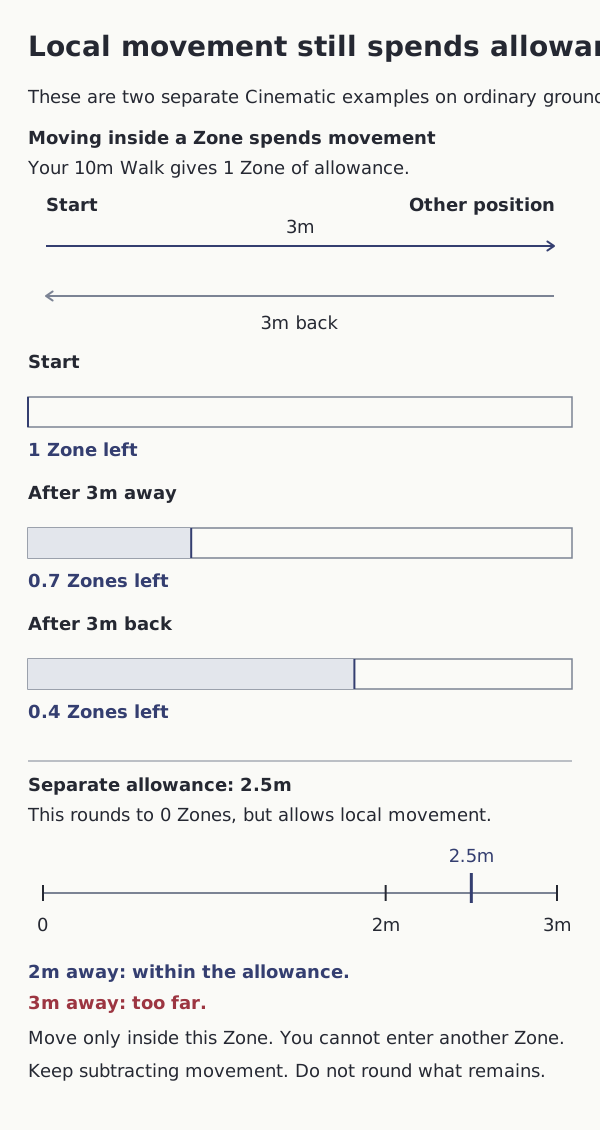
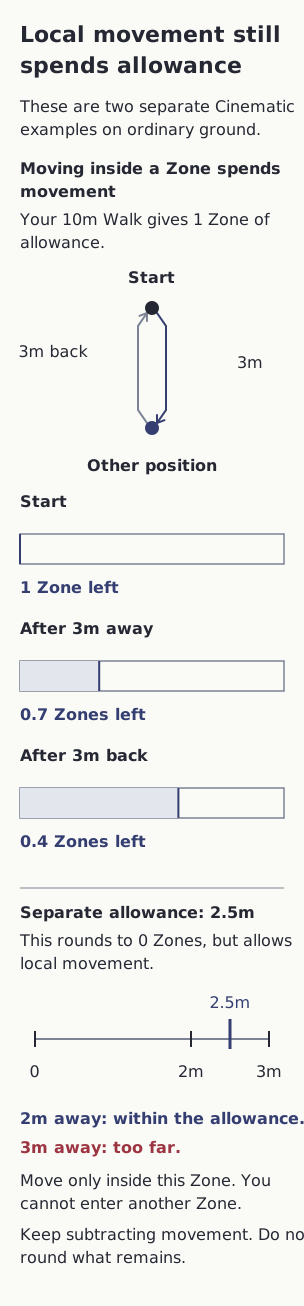

Read the diagram as text
These are two separate Cinematic examples on ordinary ground. In the first, a 10m Walk has already become one Zone of movement.
- First example: record the one-Zone allowance. Moving 3m within this Zone costs 0.3 Zones, leaving 0.7.
- Returning 3m costs another 0.3 Zones. Record 0.4 Zones left; do not round it again. An intervening Action does not restore movement.
- Second example: a separately calculated 2.5m allowance rounds to zero Zones. Keep its original metres for local movement inside the current Zone.
- On ordinary ground, a point 2m away is reachable and a point 3m away is not. This allowance cannot enter another Zone.
Result: The out-and-back leaves 0.4 Zones. The separate 2.5m allowance allows local movement only, without crossing a Zone boundary.
- An actual zero-metre allowance permits no movement. A positive allowance rounded to zero Zones is different.
- Terrain, hidden movement, hazards, barriers, reach and Opportunity Attacks still apply to the route. Spend each segment’s cost once.
Changing Mode During Movement
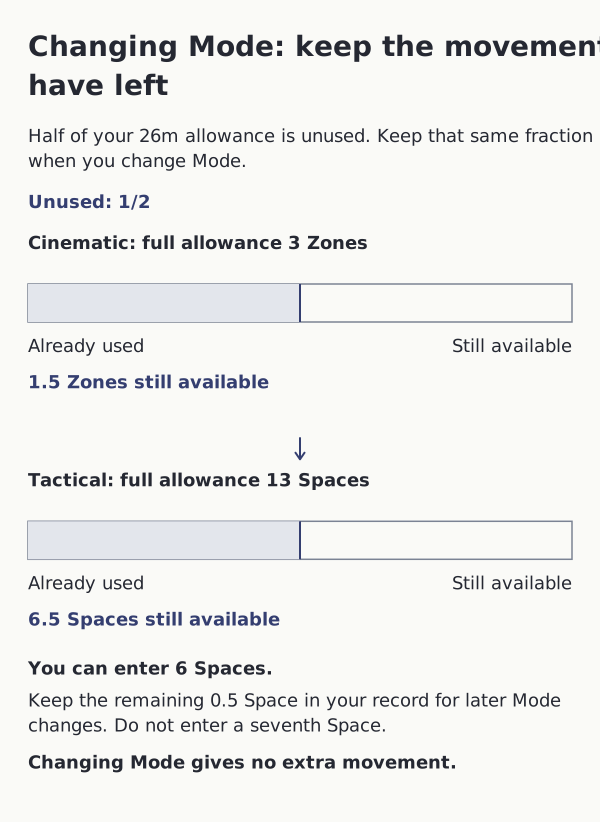
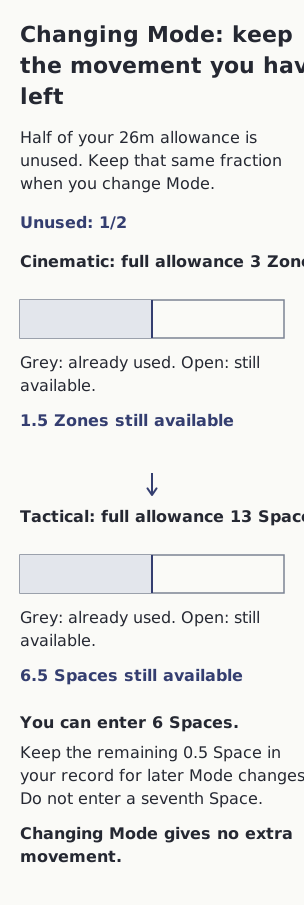
Record the fraction of the allowance still unused before changing Mode. Keep that fraction when representing the same allowance in the new Mode; do not grant a new full allowance or snap the remainder up. If half remains, only half of the new Mode's full allowance remains. For a zero-Zone local allowance, use the original metres to determine the fraction.
Keep that fraction through further shifts, subtracting any new movement normally. Only complete Spaces can be entered in Tactical Mode. Preserve established positions, routes and resolved consequences under Shifting Scene Modes.

Read the diagram as text
You have used half of your 26m movement. Half remains. These bars show the same allowance, not two moves.
- Record the fraction of the allowance still unused: one half.
- Convert the full 26m allowance for Cinematic Mode: 26m rounds to 30m, or three Zones. One half leaves 1.5 Zones.
- Convert the full 26m allowance for Tactical Mode: 26 ÷ 2 = thirteen Spaces. Preserve the same unused half, leaving 6.5 Spaces.
- Only complete Spaces can be entered, so at most six fit before extra route costs. Do not round 6.5 up to seven.
- Keep the fraction in the record for later Mode changes. Convert the full allowance and retain its unused share; do not independently round the remaining metres. Subtract any new movement normally.
Result: Six complete Spaces fit. The remaining fraction is retained for later shifts, rather than discarded or rounded into an extra Space.
- With no movement between shifts, changing back preserves the same half. It does not refresh the allowance, refund AD or grant another normal movement mode.
- Established positions, routes and resolved consequences stay the same. For a zero-Zone local allowance, find the unused fraction from its original metres.
Tactical Mode
Convert movement to 2 m Spaces through the normal Tactical Mode rules.
Movement follows a legal route through the map. Terrain costs movement according to the Spaces actually crossed.
A character cannot enter or cross a blocked or otherwise illegal Space unless a rule permits it.
Example: Difficult Terrain
Dorn has BM 13 and Runs.
Run Distance = 13 × 2 = 26 m
A pillar is 16 m away.
The route contains:
- 9 m of Difficult rubble;
- 7 m of ordinary ground.
The rubble costs:
9 m × 2 = 18 m of movement
The ordinary ground costs another 7 m.
Total route cost = 18 + 7 = 25 m
Dorn has 26 m of Run movement, so he can reach the pillar with 1 m of movement remaining.
No Athletics or Acrobatics check is required unless something about crossing the rubble makes success meaningfully uncertain.
Summary
- Base Movement: Base Movement = 8 + Strength + Agility.
- Distance: Movement is measured in metres before being represented through the current Scene Mode.
- Choose a mode: Choose one normal movement mode during your Activation.
- Walk: Walk: 0 AD, move BM.
- Run: Run: 1 AD, move BM × 2.
- Sprint and Slowed: Sprint: base 2 AD, move (BM × 3) + 2 m per Sprint Skill Level. Apply payment modifiers: Slowed Walk/Run/Sprint cost 0/2/4 AD without discounts. Halve BM before mode calculation; keep the separate Sprint Skill bonus.
- Sprint Skill: Sprint uses Athletics or Acrobatics according to the declared method and route.
- Sprint procedure: Sprint is a Major Action and one proactive use of its governing Skill, but does not require a Skill Check.
- Normal speed: Do not roll merely to determine normal movement speed.
- Uncertain routes: Roll only when an obstacle, hazard, contest, or other meaningful uncertainty makes the route itself uncertain.
- Difficult terrain: Difficult terrain costs 2 m of movement allowance per 1 m travelled.
- Divide movement: You may divide normal movement around other Actions without paying its movement cost again.
- Additional movement: Additional movement from traits and other rules is separate unless the rule says otherwise.
- Conditions and load: Conditions are governed by Combat. Encumbrance is governed by Bulk & Encumbrance.
- Class traits: Follow each Class trait’s Trigger, Cost and Effect; shared use rules belong to Class Traits.
- Scene Modes: Distance & Range owns Story, Cinematic, and Tactical representation and conversion.