
On this page
Every hard-won change leaves its mark.
Characters do not remain fixed after creation. What they survive can deepen their Core Vitals. What they practise can strengthen their Skills. What they commit themselves to can advance a Class or open an entirely new one.
Story Points measure that lasting growth. This chapter explains how characters earn, save, and spend Story Points to increase Core Vitals, Skill Levels, and Class Levels after character creation.
What you endure becomes capacity. What you practise becomes skill. What you commit to becomes identity.
How Character Development Works
Character development follows the story. At Story Checkpoints and the resolution of Story Milestones, each player character earns Story Points (SP). You may spend those SP on any increase for which your character meets the requirements, or save them for later.
The three forms of development are:
- Core Vital development: increase a character's underlying capacity.
- Skill development: increase training in a particular discipline.
- Class development: deepen an existing Class or gain Level 1 in a new Class.
The chapters for Core Vitals, Character Skills, and Character Classes explain what those traits do. This chapter governs how they increase after character creation.
Story Milestones and Checkpoints
Story Milestones provide the structure for significant campaign progress. A Story Milestone is a major objective, transformation, discovery, or turning point. The Guide defines it broadly enough that play can change how it is reached or resolved.
Story Checkpoints
A Story Checkpoint is significant, non-repeatable progress toward a Story Milestone. The Guide may identify likely Story Checkpoints when planning or recognise equivalent progress that emerges during play. The players do not need to follow a planned route.
A setback, failure, or compromise can be a Story Checkpoint if it materially changes the situation and advances the story.
- Award a Story Checkpoint when the characters make significant progress toward the Story Milestone.
- Do not award the same Story Checkpoint more than once.
- Let the number of Story Checkpoints reflect the length and scope of the Story Milestone, not the number of sessions played.
- Resolve the Story Milestone when its central situation reaches a meaningful conclusion through success, failure, compromise, or an unexpected course.
Story Checkpoints and resolved Story Milestones award Story Points. See Story Points for the award values and the rules for saving and spending them.
Story Points
Story Points represent lasting character growth earned through meaningful progress in the story. They are awarded at Story Checkpoints and when Story Milestones are resolved.
See Story Milestones and Checkpoints for the complete rules for defining and resolving them.
Story Point awards recognise progress, not a judgement of player performance. Do not increase or reduce an award based on how well the players rolled, how efficiently they acted, or whether the Guide approved of their decisions.
- At each Story Checkpoint, each player character gains 2 SP.
- When the Story Milestone is resolved, each player character gains an additional 3 SP.
These awards are cumulative. A Story Milestone with one Story Checkpoint awards 5 SP to each player character in total. One with two Story Checkpoints awards 7 SP to each player character in total.
Saving Story Points
You do not need to spend Story Points as soon as you earn them. Record your unspent SP on your Character Sheet and save them across Story Checkpoints and Story Milestones until you can pay the full cost of the development you want.
When Story Points are spent on character development, deduct them only when the increase is completed. You cannot make partial payments toward an increase. Other rules may allow Story Points to be spent for another purpose, such as creating Synergy.
Development Costs
The cost of an increase is based on the new Score or Level being gained. This is its Target Score or Target Level.
| Increase | Advancement Cost |
|---|---|
| Core Vital | Target Score × 2 SP |
| Skill Level | Target SL × 1 SP |
| Class Level | Target Class Level × 1 SP |
Development Limits
These are absolute limits:
| Character value | Maximum |
|---|---|
| Each Core Vital | Score 10 |
| Each Skill | SL 10, and no higher than its Linked Vital |
| Each Class | Level 10, applied separately to each Class |
| Maximum VIT and the AD/MD dice body | 10 VIT and 10 dice in total across all states |
Use the Vitality table to determine Maximum VIT. Once it reaches 10, further Core Vital increases do not add VIT or body dice. Converting AD into MD, refreshing dice or healing Wounds does not enlarge that body.
Each increase follows the same chain:
| Increase | Requirement |
|---|---|
| Raise a Core Vital to a new Score | You must be Active. |
| Raise a Skill to a new level | Its Linked Vital must already have that score or higher. |
| Raise a Class to a new level | At least one of that Class's three core Skills must already be at that level or higher. |
| Raise a trait to a new rank | Its Class must already be at that level or higher. |
Use the core Skills of the Class you are advancing and the Class that owns the trait. Levels in another Class do not raise that trait's ceiling. You must also have legal spell and trait choices for the advance.
Training Exchange can reduce the cost of a qualifying Skill Level or Class Level increase, but never a Core Vital increase.
Core Vital Scores, Skill Levels and Class Levels increase one step at a time. Pay separately for each new Score or Level gained. Trait ranks have no separate SP cost; follow Ranked Class Traits.
Example: Raising Acrobatics from SL 2 to SL 4 costs 3 SP for SL 3 and another 4 SP for SL 4, for a total of 7 SP.
Resolving Development
When developing your character:
- Choose the increase. Name the Core Vital, Skill, or Class you want to increase and the new Score or Level you are gaining.
- Check the requirements. Confirm that the increase is within its maximum and that every prerequisite is already met.
- Resolve enabling increases first. A Core Vital increase may make a linked Skill increase legal. A Skill increase may unlock a Path or allow a Class increase. Record a Class increase before assigning the trait rank it grants.
- Calculate the cost. Use the new Score or Level to determine the full SP cost.
- Apply Training Exchange if relevant. A qualifying Training Exchange can reduce the cost of a Skill Level or Class Level increase, but never a Core Vital increase.
- Spend the Story Points. Deduct the complete cost from your unspent SP.
- Record the result. Update the character's Score or Level and any affected values, learned spells or trait choices.
When a Training Exchange is used, follow its simultaneous payment and increase rules instead of applying the two increases separately.
Tip: When you develop your character, describe what changed. The numbers record the growth; the story shows how it happened.
Increasing a Core Vital
Core Vitals measure the capacities on which the rest of a character is built. Increasing one can raise linked Skill limits, affect derived traits when a rule calls for that Vital, and increase maximum Vitality when the character's combined Vital total reaches a new threshold.
To increase a Core Vital:
- You must be Active.
- Spend SP equal to twice the new Core Vital Score.
- Increase the Core Vital by 1.
- Do not increase a Core Vital above 10.
- Recalculate the character's total Core Vitals and check the Vitality table.
- If maximum VIT increases, add the same amount to current VIT and add that many Ready AD. Keep existing Wounds and all existing dice in their states.
- Update any Linked Vital limits or derived traits affected by the increase.
Advancement Cost = Target Score × 2 SP
Training Exchange cannot reduce the cost of increasing a Core Vital.
Example: Increasing Strength
Graynor wants to increase their Strength from 3 to 4. After earning Story Points through story progress, they spend 8 SP (i.e., 4 × 2) and increase their Strength to 4.
Increasing Strength may now allow Graynor to train Strength-linked Skills to a higher level. It also raises Graynor's combined Vital total; if that total reaches a new threshold on the Vitality table, Graynor's maximum Vitality increases. If Graynor was at 3/5 VIT and maximum VIT rises to 6, they become 4/6 VIT and add 1 Ready AD. Their two existing Wounded AD remain Wounded.
Increasing a Skill Level
Skills represent learned capability developed through instruction, practice, and experience. Every Skill has a Linked Vital that limits how far that Skill can develop.
To increase a Skill Level:
- The Skill's Linked Vital must be equal to or higher than the new Skill Level.
- Spend SP equal to the new Skill Level.
- Increase the Skill Level by 1.
- Do not increase a Skill above SL 10.
Advancement Cost = Target SL × 1 SP
Increasing a Skill may change its Readiness Score, Boost limit, proactive-use limit, and eligibility for Skill-based effects. See Character Skills for those rules.
Example: Increasing Acrobatics
Nyra wants to raise Acrobatics from SL 2 to SL 3. Her Agility (AGI) is 3, so she qualifies. She spends 3 SP and increases Acrobatics to SL 3.
Nyra may now Boost Acrobatics Skill Checks with up to 3 extra Action Dice.
Tip: Invest in Skills that define your role. Mastery shapes scenes—scattered points rarely make an impact.
Developing a Class
Your Class level shows how far you have developed that Class. Each Class can reach level 10. Pay Story Points equal to the new level, one level at a time. A qualifying Training Exchange can reduce that cost.
To raise a Class to a new level, at least one of its three core Skills must already be at that level or higher. For example, with Melee 3, going from Fighter level 1 to level 3 costs 2 Story Points for level 2, then 3 for level 3: 5 Story Points altogether.
Each new level grants the following:
| Class | What you gain |
|---|---|
| Fighter, Ranger or Rogue | One rank in one eligible trait. Start a new trait at rank 1 or improve one you have. |
| Primant, Cleric or Mage | One new spell and one rank in an eligible trait, chosen independently. Each choice requires its Path Skill at level 1 or higher; they can come from different Paths. |
Advancing an existing Class gives no extra general Skill Levels, starting money or equipment.
Ranked Class Traits
For every Class, your chosen trait ranks add up to your level in that Class. A level 3 Fighter might have Parry at rank 3, or Parry, Breach and Footwork each at rank 1.
Before choosing a trait, train its Path's Skill to at least level 1. You can choose traits from several Paths.
To raise a trait to a new rank, its Class must already be at that level or higher. A Class 4 character can have one trait at rank 4, two traits at rank 2, or four traits at rank 1. The ceiling grants no additional ranks.
The three core Skills are Melee, Ranged and Athletics for Fighter; Beastcraft, Survival and Athletics for Ranger; Acrobatics, Stealth and Finesse for Rogue; Influence, Insight and Survival for Primant; Medicine, Occult and Influence for Cleric; and Occult, Observation and Performance for Mage.
The Path Skill needs only one level; a trait can have a higher rank than that Skill. Its owning Class level sets the rank ceiling, so no trait can exceed rank 10.
Choose where the new rank will go before paying for the Class advance. Check that the choice will be legal at the resulting Class level. Record the new Class level first, then assign its granted rank. You may start an eligible trait at rank 1 or raise one you have by one rank. The rank has no separate SP cost.
If you have no legal choice, improve or restore the training you need first. Assign each rank as you gain it; you cannot save it for later or freely move old ranks between traits.
Read Class Traits for the uses each rank gives you and how they recover.
Example: Following the Chain
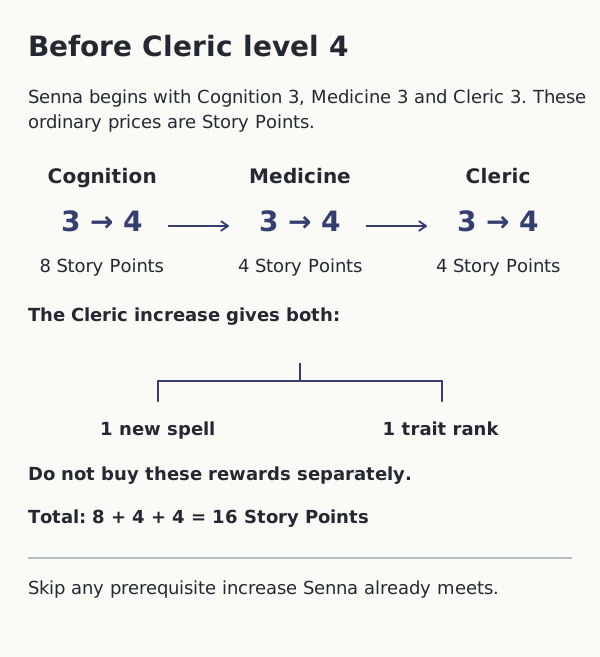
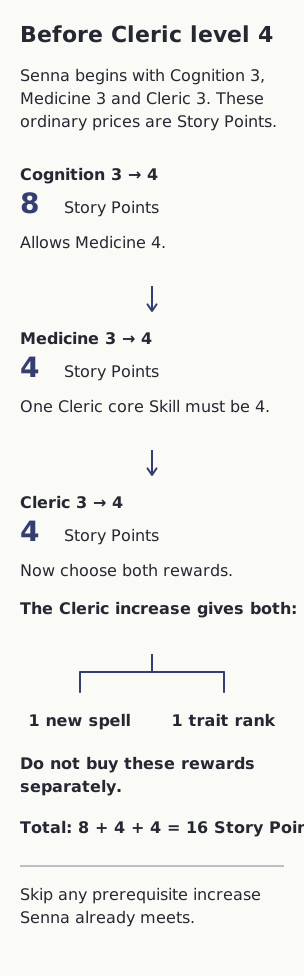
Senna has Cognition 3, Medicine 3 and Cleric 3, with all three of her Cleric trait ranks assigned to Restoring Grace. To advance each to 4:
- Raise Cognition to 4, paying 8 SP.
- Raise Medicine to 4, paying 4 SP. Its Linked Vital now supports that level.
- Raise Cleric to 4, paying 4 SP. Medicine is one of Cleric's core Skills and now supports Class level 4.
- Choose her new spell and assign the trait rank granted by Cleric 4. She can raise Restoring Grace to rank 4, or put the rank into another eligible trait.
The Class advance provides the trait rank; it has no separate SP cost. If Cognition or Medicine were already high enough, Senna would not need to raise them again.

Read the diagram as text
Senna is Active and has Cognition 3, Medicine 3 and Cleric 3. Her three Cleric trait ranks are in Restoring Grace. This example uses ordinary costs in Story Points (SP), without a Training Exchange discount.
- Raise Cognition from 3 to 4 for 8 Story Points. Medicine cannot exceed its Linked Vital, Cognition.
- Raise Medicine from 3 to 4 for 4 Story Points. Medicine is one of Cleric’s core Skills; only one qualifying core Skill needs to meet the new Class level.
- Raise Cleric from 3 to 4 for 4 Story Points.
- As part of the Class increase, choose one new spell and one trait rank independently. Senna may raise Restoring Grace to rank 4 or choose another trait she is allowed to choose. Neither reward has a separate Story Point price.
- The three paid increases total 16 Story Points. Skip any prerequisite increase already met.
Result: Cleric level 4 grants the new spell and trait rank. The example costs 16 SP, with no separate purchase for either reward.
- Choose legal spell and rank allocations before paying. Record the Class increase first, then add the new trait rank to your chosen trait.
- A chosen trait’s Path Skill needs level 1; the owning Class sets its rank ceiling. A higher ceiling grants no extra ranks.
- Trait ranks in a Class add up to its Class level. Existing ranks are not freely reassigned.
- Vitals, Skills and Classes each stop at 10. This advance gives no starting Skill Levels, money or gear again.
Keeping Your Training
These are requirements for increases. Use recorded Scores and Levels, not temporary roll penalties or changes to Ready dice.
Keep earned Class levels and trait ranks if training is later lost. If a Path Skill falls to level 0, stop using that Path's spells and traits until the training returns. Restoring training does not restore spent uses. New advances must meet their requirements when taken.
Gaining a New Class
After character creation, you can enter another Class when you:
- have at least 3 total levels across its three core Skills;
- have trained at least two of those Skills;
- complete an achievement or training scene that reflects your new direction; and
- spend 1 Story Point.
Begin the new Class at level 1. For Fighter, Ranger or Rogue, choose one eligible trait at rank 1. For Primant, Cleric or Mage, choose one new spell and one eligible trait at rank 1 independently, with each Path Skill trained to at least level 1. Entering a later Class does not repeat the creation Skill grant or 120 Dritch.
Keep each Class's levels, trait ranks and uses separate. Rangers and Rogues cannot buy a second mechanically equivalent trait through another Class. Different traits can work together when their Triggers and costs allow it; see One Trait per Event.
Example: Entering a New Class
Sera, a Fighter, trains with an Ember Creed priest. She raises the Cleric's core Skills until she has three levels across them, with at least one level in two of them. After defending a shrine, she spends 1 Story Point to become a level 1 Cleric. With Influence trained, she learns Brand of Flame and chooses Kindled Judgement at rank 1. These are separate choices; neither teaches the other.
Training Exchange
For the reciprocal training procedure and worked example, see Training Exchange. Use this chapter’s advancement costs and prerequisites when choosing the increases.
Summary
- Earn Story Points: Story Checkpoints and resolved Story Milestones award Story Points for significant progress rather than player performance.
- Save Story Points: Unspent SP may be saved across Story Checkpoints and Story Milestones.
- Development limits: Each Core Vital, Skill and Class stops at 10. Maximum VIT and the entire AD/MD body also stop at 10; each Class has its own level limit.
- Raise a Vital: You must be Active. Increasing a Core Vital costs twice the new Score. Core Vitals cannot exceed 10 and cannot benefit from Training Exchange.
- Raise a Skill: Increasing a Skill costs SP equal to the new SL. The Linked Vital must equal or exceed the new SL, and no Skill can exceed SL 10.
- Raise a Class: Increasing a Class costs SP equal to the new Class Level, grants the choices listed for that Class, and cannot raise that Class above Level 10.
- Class prerequisite: To raise a Class, at least one of its three core Skills must already equal or exceed the new level.
- Trait prerequisite: To raise a trait rank, its owning Class must already equal or exceed the new rank. Record the Class increase before assigning the rank it grants.
- Assign ranks: Each Class level grants one trait rank. The ranks assigned in a Class add up to that Class's level.
- Learn another Class: Gaining a new Class requires its core-Skill prerequisites, an in-world achievement or training scene, and 1 SP.
- Train together: A qualifying Training Exchange reduces one Skill or Class Level increase for each participating character by 1 SP, to a minimum of 1 SP.