
On this page
An ember carried through darkness. A meaning hidden in a dream. A word the world remembers.
You are a traveller in the old mysteries. You tend a flame, study the signs around you and learn the words that give a rite its strength. That knowledge goes with you: down a ruined stair, across a haunted battlefield or into the chamber where something ancient has begun to wake.
Mages inherit traditions of learning and sacred practice. Some were taught beside a temple fire; others followed a wandering teacher or pieced together a lost art. Your place among the Magi comes from what you learn and do. Every road offers another mystery worth understanding.
Narrative Prompt: “Who first taught you the old words, and what mystery still pulls you onward?”
Mage Paths
Each Path offers six spells to learn and three traits that improve your casting. Choose them separately as you develop your Mage.
Flamekeeper · Occult
Carry a living light, strike with sacred fire, cleanse harmful traces and shelter your companions behind a ward of ash.
- Spells: Living Ember, Sacred Flame, Purifying Smoke, Unravel Spell, Ember Shield, Ashen Barrier.
- Traits: Steady Ember, Pure Flame, Far Ember.
Diviner · Observation
Find your bearings beneath a buried city, look beyond a sealed door, witness an echo of the past and recognise the moment when a companion must act.
- Spells: Star Compass, Starlit Sight, Dream of the Past, Far Dream, Forewarning, Read the Opening.
- Traits: Favourable Moment, Inward Sight, Read Again.
Invoker · Performance
Give your voice the force to strike, carry words through stone, speak across unfamiliar tongues and draw strength from a freely given promise.
- Spells: Resounding Word, Carrying Voice, Words Understood, Word of Binding, Sworn Effort, Renewed Vow.
- Traits: Resonant Verse, Exact Address, Kept Word.
Learning Your Magic
Each Mage level, including level 1, gives you one new spell and one rank in a trait. Make these two choices independently. Each choice must come from a Path whose Skill you have trained to at least level 1. You may learn a spell from one Path and take a trait from another.
Learn a spell you do not already know. For the trait, choose a new one at rank 1 or increase a trait you have, within your rank limit. At Mage level 4, you know four spells and have four ranks across your traits.
Once learned, a spell stays in your repertoire. Casting spends dice. A trait adds its own limited use when you choose to improve a cast. Each Mage trait can improve every spell in its Path. When your trait uses run out, you can still cast your learned spells.
A trained Path Skill counts as a Mage magic Skill once you know a spell from that Path. If it falls to level 0, keep that Path's spells and trait ranks, but stop using them until the training returns. Follow Magic when qualifying Skills change.
Read Class Traits for trait uses, recovery and Events, and Character Development for advancement costs and rank limits.

Read the diagram as text
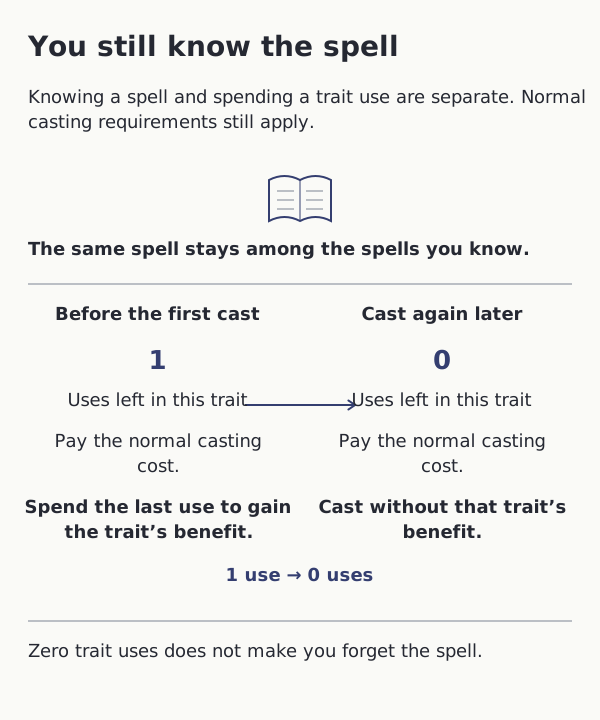
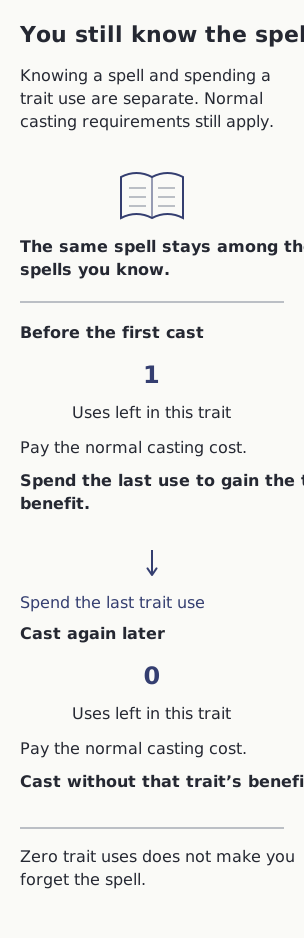
You know a spell and have a trait that can help it. You meet both sets of requirements and have one trait use left. Knowing the spell and using the trait are separate.
- Keep the learned spell written among the spells you know. Record one use left in the trait that helps it.
- On the first cast, pay the normal casting dice and spend one trait use at its Trigger. This cast gets the trait’s benefit; the trait now has zero uses left.
- Keep the learned-spell entry unchanged. On a later cast, pay the normal casting dice again. You can cast the spell without the exhausted trait’s benefit.
Result: Zero uses left in a trait does not make you forget a learned spell.
- A trait use does not pay an Action Die or Magic Die cost.
- Trance, trained Path Skill, targeting and all other casting requirements apply to both casts.
- This shared example applies to Primant, Cleric and Mage. Advancement and trait ranks follow Character Development.
Casting Your Magic
You must be in Trance to cast a Mage spell. Follow Magic for the casting cost, Boost and movement of dice. Trance Actions explains entry and deepening.
Casting requires an audible invocation or a visible hand sign. One is enough. You need no purchased focus, incense or fuel. A spell that uses an object still needs that object to exist.
Cast as a Major Action, using one proactive use of the Path Skill, unless the spell expressly allows a Reaction or Exchange Response. Every spell makes a casting check. A tie or lower total fails; apply the normal casting costs on success or failure.
You must see your target and have a clear line of effect unless the entry says otherwise. Touch requires contact. A spell's range is the distance from you to its target. Use Distance & Range to convert its complete distance into Spaces or Zones. A change of Scene Mode preserves positions, elapsed time and existing effects.
Effects That Last
You can maintain one casting of each ongoing Mage spell. A failed cast leaves your existing effect running for its remaining duration. A successful new cast ends your previous casting of that spell before applying the new one.
A creature can have only one ongoing copy of each Mage spell. A willing recipient chooses whether your successful cast replaces an existing copy from another Mage. Keeping the old effect does not extend it. A creature may refuse a beneficial spell or end one affecting it at any time, without an action.
Each entry states its duration and any early ending. See Spell Timing for how short spells use turns and carry into a fight. Calculate an ongoing spell's distances and duration using your Skill Level when you cast it; later changes do not alter those recorded values. A duration runs from the successful cast; repeated casts and Scene Mode changes do not pause it. You can end one of your ongoing effects without an action. Losing the required Path training ends its ongoing effects. Instant harm, cleansing, information and returned dice are already resolved and are not undone when your Trance ends.
Starting Kit
- Begin at Mage level 1.
- Share 3 Skill Levels between Occult, Observation and Performance. Give at least one level to two of them.
- Add your Origin's training, then check Skill caps. Occult and Observation cannot exceed Cognition; Performance cannot exceed Presence.
- Choose one spell and one trait at rank 1 independently. Each choice needs its Path Skill at level 1 or higher. Begin with one use of your chosen trait.
- Take 120 Dritch for equipment. Add your Origin's money and owned gear separately.
Quick Starts
- Flamekeeper — bring fire into the fight. Take Occult 2 and Observation 1. Learn Sacred Flame and choose Steady Ember at rank 1. Buy Leather for 40 Dritch, a Quarterstaff for 5 and a Dagger for 5, leaving 70 Dritch of Class money. Keep a Ready AD for Boost beside your casting dice. Steady Ember adds one dot to that boosted cast.
- Diviner — discover what lies beyond. Take Observation 2 and Performance 1. Learn Far Dream and choose Favourable Moment at rank 1. The Leather, Quarterstaff and Dagger kit leaves 70 Dritch. Boost your first look through a sealed door and use Favourable Moment to make the casting check with Advantage.
- Invoker — make your words carry weight. Take Performance 2 and Occult 1. Learn Resounding Word and choose Exact Address at rank 1. The same equipment costs 50 Dritch, leaving 70 Dritch. Exact Address adds one dot to a boosted attack, including a legal Clash response.
Combine a recipe with your Origin before checking Skill caps. Change the allocation if necessary; do not buy an item you already own. Equipment prices and weapon profiles are in Equipment. Your staff and dagger remain ordinary tools and weapons when you are outside Trance.
Path of the FlamekeeperSpellsLiving EmberSacred FlamePurifying SmokeUnravel SpellEmber ShieldAshen BarrierTraitsSteady EmberPure FlameFar Ember
6 spells · 3 traits
Path Skill: Occult. You carry a carefully tended fire into places where light and shelter are scarce. Its flame can strike a monster, its smoke can draw out harm and its ash can mark a boundary that will hold.
Flamekeeper spells that name a range reach 6m per Occult level.
Flamekeeper Spells
Living Ember
Spell · Illumination. Choose a point in range, or an unattended object in range that you could lift in one hand. You may instead choose such an object held by a willing creature. Make an Occult casting check at Difficulty 1.
On success, a small flame appears there. It sheds clear light in a 6m radius, stopped by opaque barriers. It stays at its point or travels with its chosen object. It burns without fuel, even underwater, and neither heats nor ignites what it touches.
The ember lasts one hour per Occult level, including after your Trance ends, you leave range or a Scene Reset occurs. Covering it blocks its light. You may touch it to move it to another point or suitable object within your reach as a Minor Action costing no AD, once per Activation. That transfer changes neither its remaining duration nor its light radius.
Example: With Occult 1, you roll a total of 2, beating Difficulty 1, and kindle your staff. It lights the flooded passage for an hour while leaving your hands free to climb.
Sacred Flame
Spell · Attack. Choose one creature in range. Initiate a Ranged Exchange using an Occult casting check. You may also cast this as your Clash response to a Melee or Ranged attack when its attacker is in range. Pay the casting cost in place of a weapon attack's cost.
Resolve the Exchange through Combat. The defender may use a legal Clash response, Acrobatics Full Guard or No Response. Apply normal cover, engagement and targeting rules. In a Clash, only the winner can hit; a tie hits neither creature.
Your Strike Rating is 2 + your full Cognition, with no Damage Vital Cap. A hit causes Elemental (Fire) harm. Apply Protection, Wound Conversion and any Continuation Check normally. This attack does not leave an additional burning effect.
Example: Your attack total is 4 against defence 2. With Cognition 3, Strike Rating 5 and the defender's Protection 1, the Wound Margin is 2 + 5 − 1 = 6: three Wounds.
Purifying Smoke
Spell · Cleansing. Choose yourself or one willing creature in range, or a creature unable to consent that has not refused your aid. Name one source of Lingering Harm affecting it. Make an Occult casting check against a Difficulty equal to that source's next tick of Wounds, with a minimum of 1.
On success, pale smoke draws out that source of harm and ends it. The source may be venom, continuing bleeding, fire or magical residue. Wounds already suffered remain. An external cause can impose the harm again: move your companion out of the flames as well as cleansing them.
Example: An ally across the room is bleeding for one Wound at each tick. Your total of 2 beats Difficulty 1 and ends that bleeding. Their existing Wounds remain.
Unravel Spell
Spell · Dispelling. Choose one ongoing spell in range whose presence you have established by observation or other evidence. Target its affected creature or object, or the origin of a placed area. You must see that target and have a clear line of effect to it; the magic itself need not be visible. A valid spell has a stated finite duration or is maintained by held Magic Dice.
Make an Occult casting check against the spell's original final casting total. If its rule created it without a casting total, use Difficulty 3. The Guide keeps a concealed total concealed, but identifies whether your declared target is eligible before you pay.
On success, end that one casting, including its linked targets and any dice held to maintain it. Those committed MD return to Used AD unless another effect has already moved them. This does not undo instant harm, healing or information, or remove a creature's Trance, innate ability or a permanent enchantment. When several spells overlap, name which one you are trying to end.
Example: An Ashen Barrier was cast with total 3. Your total of 4 unravels it and returns its caster's held MD to Used AD. Another ward elsewhere in the room remains.
Ember Shield
Spell · Protection. Cast as a Reaction when you or another creature in range is hit by an attack. You must be aware of the hit and able to react. Act after the hit is settled but before its Protection and Wound Conversion. Make an Occult casting check at Difficulty 1. The recipient must accept your aid, or be unable to consent without having refused it.
On success, look up your casting total in Magic Conversion. Add that result to the recipient's Protection against this attack. Use the greater bonus if another spell adds Protection; they do not add together. If the attack is recalculated, keep this bonus once. It does not alter the hit or reduce harm that bypasses Protection.
Only one Ember Shield may be attempted against the same hit. Resolve competing offers in the participant order from Resolving Traits Together; only the first legal offer pays. The shield ends when that attack resolves.
Example: A hit would have Wound Margin 7. Your casting total of 3 gives +2 Protection, lowering the margin to 5. Your companion suffers three Wounds instead of five.
Ashen Barrier
Spell · Ward. Choose a visible point on solid ground in range. Make an Occult casting check at Difficulty 1. On success, a transparent panel traced in ash rises from that point: 2m wide and 2m high, with negligible thickness. Choose its vertical orientation. Its whole area must be empty; it cannot cut through a creature or an object.
The panel blocks creatures, carried objects, projectiles and spell line of effect in either direction. It allows sight, light, air and water through. It cannot serve as a floor or bridge. Creatures can go around or over it if a legal route exists.
Record your casting total as its strength. A creature within reach may spend a Major Action and 1 AD on an Athletics check to break it. Alternatively, it may make one legal weapon or spell attack against it, paying that attack's usual cost and using its usual Skill. In either case, compare the final check total with the strength: a higher total breaks the panel; a tie or lower leaves it intact. The panel makes no response. Do not calculate Wounds against it or carry an attack through it to another target.
Keep the casting's base MD committed in your Magic Pool under Ongoing Effects. It cannot refresh or pay another cost. The barrier lasts up to ten minutes, ending sooner if that die becomes Wounded or leaves your Magic Pool, your Trance ends or you leave range. On ending, return the held die to Used AD unless another effect has already moved it.
In Tactical Mode, choose one ground-level edge of a Space; the panel fills that 2m edge and rises one Space. In Cinematic Mode, preserve the same local 2m panel even though its extent rounds to zero Zones. It does not fill the whole Zone.
Example: Your total of 3 seals a narrow doorway. A pursuing beast rolls Athletics 3 and fails to break it. Your companions retreat while you keep the MD held; ending your Trance releases the barrier.
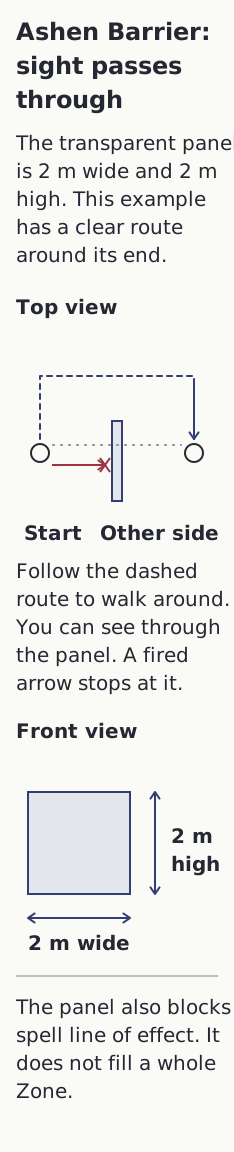
Read the diagram as text
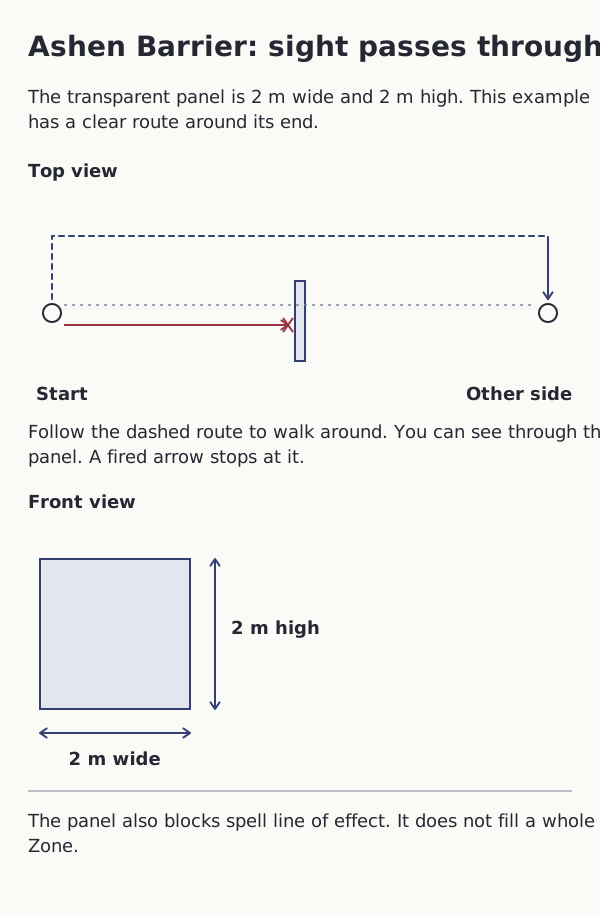
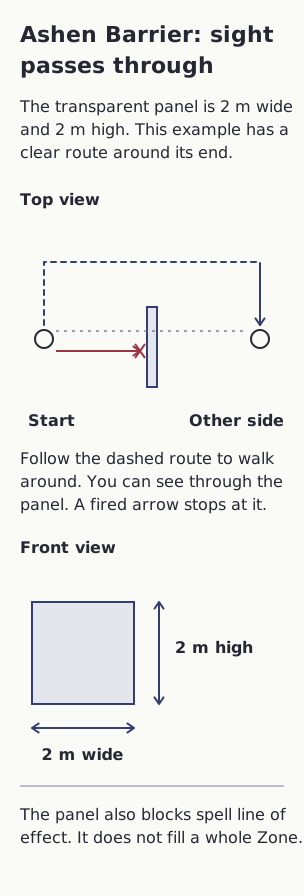
An Ashen Barrier is a transparent upright panel, 2 m wide and 2 m high. In this open-ground example, a clear route exists around one end.
- Place the transparent vertical panel in empty space on solid ground, with its full area clear. It is 2 m wide and 2 m high.
- From Start, sight and light pass through to Other side. A projectile or spell line of effect stops at the panel.
- Use the clear route around its endpoint to reach Other side, paying normal movement costs. Going around or over it requires a legal route.
- The front view shows that the same panel is upright, with a horizontal 2 m width and vertical 2 m height.
Result: You can see a creature through Ashen Barrier, but cannot shoot a projectile straight through it.
- It blocks creatures, carried objects, projectiles and spell line of effect in both directions, while allowing sight, light, air and water.
- It cannot serve as a floor or bridge.
- In Tactical Mode it fills one ground-level 2 m Space edge and rises one Space. In Cinematic Mode it remains a local 2 m panel; it does not fill the Zone.
- Normal casting, committed Magic Die, range, duration, ending and strength-based breaking rules still apply. Follow any spell’s explicit exceptions.
Flamekeeper Traits
Steady Ember
Trigger: Declare a Flamekeeper spell, before paying, and commit at least one of your own AD to Boost its casting check.
Cost: One use of Steady Ember.
Effect: Add +1 to the final casting total after all rerolls.
Example: You cast Purifying Smoke against Difficulty 2. Your dice finish at 2; Steady Ember raises the total to 3 and the cleansing succeeds.
Pure Flame
Trigger: Declare a Flamekeeper spell, before paying, and commit at least one of your own AD to Boost its casting check.
Cost: One use of Pure Flame.
Effect: After Edge and any other applicable rerolls, reroll one remaining Miss in the casting check. Keep its new result. If no Miss remains, no die is rerolled.
Example: Your boosted Living Ember check ends with three Misses. Pure Flame lets you reroll one. It becomes a Critical Hit, taking your total to 2, beating Difficulty 1 and lighting the ember.
Far Ember
Trigger: Declare a Flamekeeper spell, before choosing its targets and paying.
Cost: One use of Far Ember.
Effect: Add 6m to its target range for this cast and to any range you must maintain for its ongoing effect. Its area and other distances stay the same.
Example: With Occult 1, you can cast Ember Shield on an ally 10m away: Far Ember extends your 6m range to 12m.
Path of the DivinerSpellsStar CompassStarlit SightDream of the PastFar DreamForewarningRead the OpeningTraitsFavourable MomentInward SightRead Again
6 spells · 3 traits
Path Skill: Observation. You learn to read a world full of signs. The stars give a language to distance and direction; dreams open a window beyond the present moment. You can call on both while awake beneath the earth.
Diviner spells that name a range reach 6m per Observation level. Their magic grants the particular perception described; ordinary searching, navigation and interpretation still use their usual Skills.
Diviner Spells
Star Compass
Spell · Guidance. Choose yourself or one willing creature in range. Name a fixed place you have personally visited, or one object you have personally touched and could recognise again. Make an Observation casting check at Difficulty 1.
On success, the recipient senses the straight-line direction to that destination whenever it is within 1km per Observation level of the recipient. Walls and darkness do not block the bearing. An object that moves changes the direction. Beyond that distance, or if the destination no longer exists, the recipient senses no bearing and learns no reason for its absence.
The compass lasts one hour per Observation level, including after your Trance ends, you leave the recipient or a Scene Reset occurs. It gives no distance, safe route or knowledge of obstacles. Following it through a maze still means choosing passages and finding ways around barriers.
Example: Before entering a ruin, you name its entrance. Underground, the compass tells your companion which direction leads back towards it, even after the stairs collapse.
Starlit Sight
Spell · Perception. Choose yourself or one willing creature in range. Make an Observation casting check at Difficulty 1.
On success, the recipient sees within 6m per Observation level as clearly as in ordinary daylight, ignoring darkness, fog and smoke within that distance. This changes no other creature's vision. Solid objects, magical concealment and the recipient's own inability to see still apply. Hidden creatures and objects still require ordinary detection; the spell removes only those three obstacles to sight.
The sight lasts ten minutes per Observation level, including after your Trance ends, the recipient leaves casting range or a Scene Reset occurs.
Example: With Observation 2, you give the scout clear sight for 12m through a smoke-filled hall. They can see the far doorway, but must still notice the guard hiding behind it.
Dream of the Past
Spell · Divination. Touch one object you could lift in two hands. Make an Observation casting check at Difficulty 1. You remain awake.
On success, witness the final ten seconds of the last creature's contact with the object, or all of that contact if it was shorter. If the contact continues, witness its most recent ten seconds. Ignore contact made solely to cast this spell. There is no limit on how long ago the contact occurred; if no creature has touched the object, you learn that instead.
The image gives ordinary sight and sound from the object's position. Choose which direction to look during those ten seconds. It cannot see through coverings, read thoughts, supply unknown names or translate speech. Explicit magic that conceals traces still applies. Your body remains in place, and the vision ends with the casting.
Further casts on the same contact repeat that account, including the chosen view. Another caster, another object from the same contact or a different question does not reveal additional details. New contact, or independent evidence that changes what you can identify, permits a fresh reading.
Example: You touch a fallen key. The dream shows a gloved figure dropping it while fleeing a bell's sound. You have a direction and a clue; you have not learned the figure's name.
Far Dream
Spell · Remote Perception. Name one point in range and a direction to face. You may choose a point you cannot see, and solid barriers do not block this casting. Remain awake and make an Observation casting check at Difficulty 1.
On success, you see and hear a single moment from that point as if you were there. Ordinary light, coverings and barriers at the viewpoint still matter. If the point is inside solid matter, you receive no usable view. You learn that the view is blocked, not what lies beyond it.
If you declare that you are looking for a concealed creature or detail, use the higher of Difficulty 1 and the ordinary Observation target for finding it. Resolve detection with this same casting check. The Guide sets that target before the roll without revealing concealed information.
The view ends with the casting. It creates no creature or ongoing observer, and cannot supply sight or line of effect for another spell or attack. Repeating the same search under unchanged circumstances repeats its information or failed search; new positioning, a changed scene or independent evidence can justify another attempt under Skill Checks.
Example: With Observation 1, you choose a point 4m away on the other side of a stone door. Your total of 2 gives a momentary view of the lit room and the visible monster waiting inside.
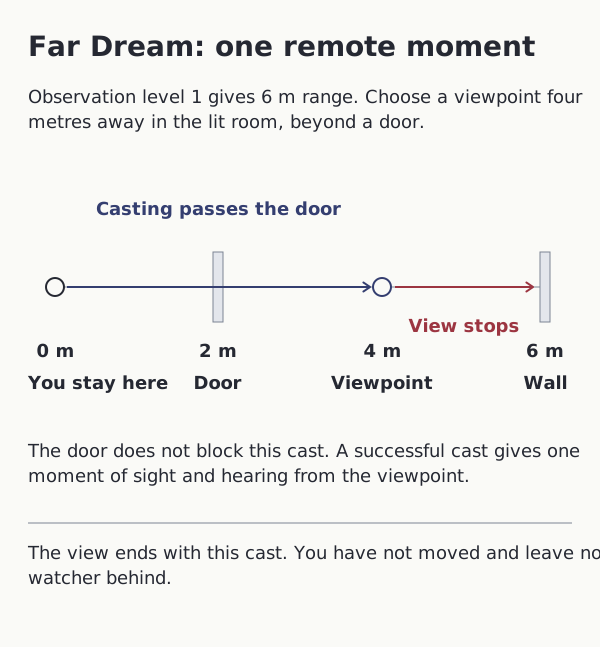
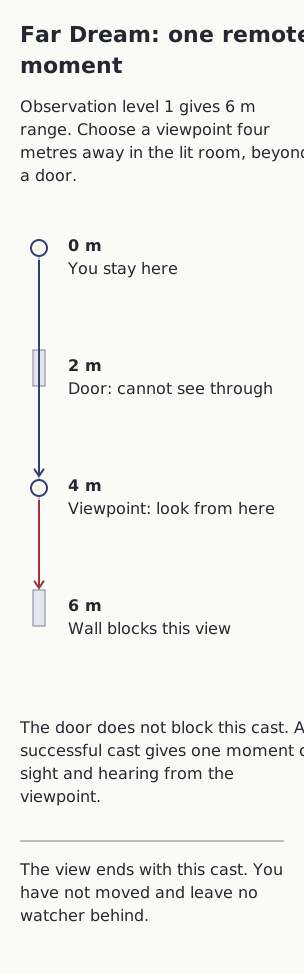

Read the diagram as text
Your Observation Skill Level is 1, so Far Dream has a range of 6 m. Choose a viewpoint 4 m away and a direction to face. The room beyond the door is lit.
- With Observation Skill Level 1, choose a point 4 m away within Far Dream’s 6 m range, and a direction to face. You remain at your original position.
- The door you cannot see through is 2 m from you. It does not block this spell’s casting to the unseen point beyond it.
- A casting total of 2 beats Difficulty 1. See and hear one moment from the viewpoint as if you stood there.
- Ordinary light and barriers at that viewpoint apply. The lit room is visible, but the further wall blocks the view beyond it.
- The view ends with the cast. You have not moved, and there is no creature or ongoing watcher at the point.
Result: Far Dream grants one moment of remote sight and hearing, with no movement and no continuing scout.
- This brief view cannot supply sight or line of effect for another spell or attack.
- A viewpoint inside solid matter gives no usable view. You learn only that the view is blocked.
- Concealed creatures or details use the higher of Difficulty 1 and their ordinary Observation target, resolved by this same casting check.
- Repeating an unchanged search gives no fresh information. No fixed viewing cone is implied.
Forewarning
Spell · Protection. Choose yourself or one willing creature in range. Make an Observation casting check at Difficulty 1. On success, look up your casting total in Magic Conversion; that result is the warning's bonus.
Add the bonus to the recipient's next rolled Skill Check to defend against an attack or resist a harmful effect. This includes a rolled Full Guard, a Clash response and a permitted resistance Reaction. Apply it after rerolls, then end the warning. It does not alter fixed Readiness, a Continuation Check or a proactive attack.
Use the greater bonus if another spell adds a bonus to that check's total. All effects triggered by that check are consumed normally. Forewarning ends after one minute, or sooner if used, your Trance ends or the recipient leaves range.
Example: Your casting total of 3 gives a +2 bonus. The recipient's next Acrobatics Full Guard rolls 2; the warning raises its final total to 4 before comparison with the incoming attack.
Read the Opening
Spell · Foresight. Choose yourself or one willing creature, and one foe. Both must be visible and in range. Make an Observation casting check at Difficulty 1.
On success, the recipient gains Advantage on its next attack against that foe, whether a weapon attack, spell attack or Clash response. The reading is spent when that attack is rolled, even if the attack fails. The foe makes no resistance check against this aid to your companion; it defends against the actual attack normally.
The opening lasts one minute, ending sooner if used, your Trance ends or either creature leaves range. It reveals no secret statistics and guarantees no future choice or roll.
Example: You read the rhythm of a hulking guardian and signal your fighter. Their next Melee attack against it has Advantage, even if that attack is a Clash response to its charge.
Diviner Traits
Favourable Moment
Trigger: Declare a Diviner spell, before paying, and commit at least one of your own AD to Boost its casting check.
Cost: One use of Favourable Moment.
Effect: You have Advantage on that casting check.
Example: Your boosted Far Dream cast rolls Hit, Miss, Miss. Advantage rerolls the two Misses once. They become a Hit and a Miss, giving total 2 and beating Difficulty 1.
Inward Sight
Trigger: Declare a Diviner spell, before paying.
Cost: One use of Inward Sight.
Effect: Cast without an audible invocation or visible hand sign. The spell retains its other requirements and effects.
Example: While hiding from a patrol, you cast Forewarning on yourself without a sound or gesture. You still pay the casting cost and make its check.
Read Again
Trigger: A Diviner casting check you Boosted with at least one of your own AD fails and has a Miss remaining after Edge and other rerolls. Act before resolving that failure.
Cost: One use of Read Again.
Effect: Reroll one remaining Miss. Keep its new result. Recalculate the outcome once. Read Again cannot trigger again on that recalculation.
Example: You already have Advantage from another source when casting Dream of the Past. After Edge, a Miss remains. Read Again rerolls that die once; a Hit takes total 1 to 2, revealing the dream.
Path of the InvokerSpellsResounding WordCarrying VoiceWords UnderstoodWord of BindingSworn EffortRenewed VowTraitsResonant VerseExact AddressKept Word
6 spells · 3 traits
Path Skill: Performance. You speak, sing or sign the forms that make an invocation whole. You can address a stranger, bind a charging beast or give a companion the strength to fulfil a promise made a moment ago.
Invoker spells that name a range reach 6m per Performance level. A true name is unnecessary: a clear address such as “you at the door” is enough. Your hand sign can carry that address when you cast without speaking.
Invoker Spells
Resounding Word
Spell · Attack. Choose one creature in range. Initiate a Ranged Exchange using a Performance casting check. You may also cast this as your Clash response to a Melee or Ranged attack when its attacker is in range. Pay the casting cost in place of a weapon attack's cost.
Resolve the Exchange through Combat, including legal Clash, Acrobatics Full Guard or No Response, cover and engagement. In a Clash, only the winner can hit; a tie hits neither creature.
Your Strike Rating is 2 + your full Presence, with no Damage Vital Cap. A hit causes Physical (Impact) harm as the invocation strikes with tangible force. Hearing or understanding you is unnecessary. Apply Protection, Wound Conversion and any Continuation Check normally.
Example: With Presence 3, your Strike Rating is 5. You win a Clash by 1 against Protection 2: Wound Margin 1 + 5 − 2 = 4, causing two Wounds.
Carrying Voice
Spell · Communication. Choose one willing creature in range. Make a Performance casting check at Difficulty 1.
On success, you and the recipient can send each other words heard only in the other's mind. Sending a brief message takes no action, using the ordinary opportunity to speak. It reveals only words deliberately sent; it reads no thoughts, supplies no senses and translates no language. Neither creature needs to speak aloud or hear with its ears.
The link lasts ten minutes per Performance level. Once established, it works through barriers while you remain within 60m per Performance level of each other. It ends if you exceed that separation, either participant ends it or your Trance ends. Resonant Verse adds 6m to both the initial targeting range and this maintained separation.
Example: With Performance 1, you link with the scout before they turn a corner. From 40m away, they silently send “Two guards, coming back.” You receive no image of the guards.
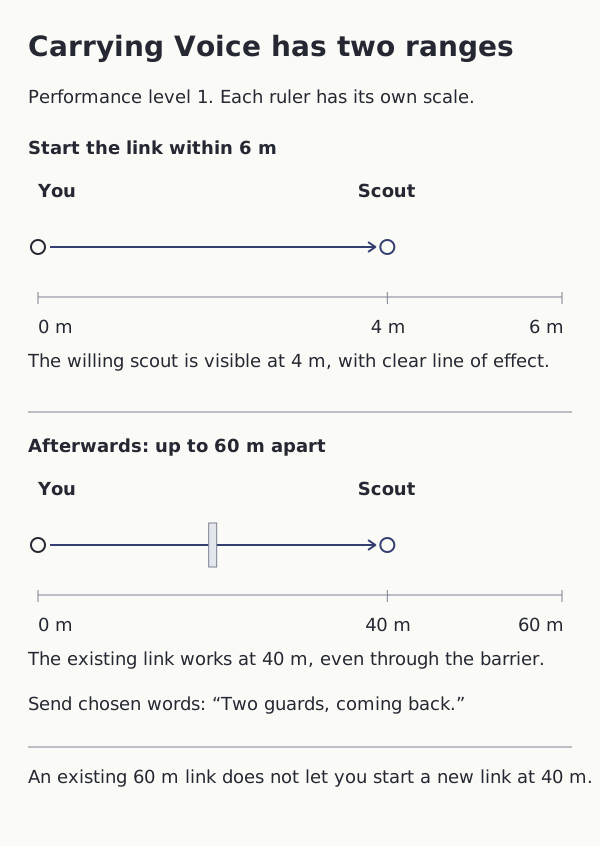
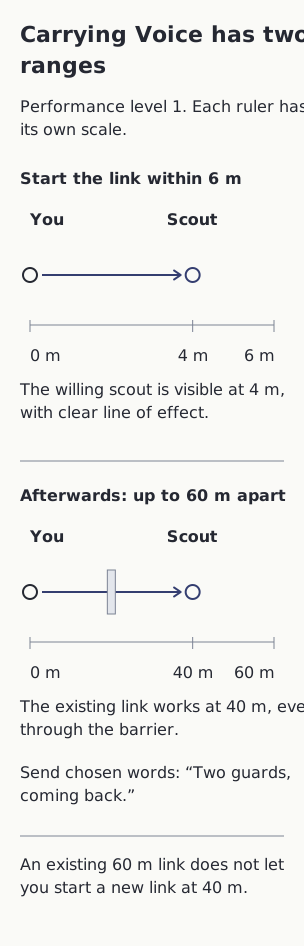

Read the diagram as text
Example: your Performance Skill Level is 1. These two rulers use separate scales in metres: 0–6 m for the new cast and 0–60 m for the existing link.
- Use the first ruler’s 0–6 m scale. Choose the willing, visible scout 4 m away with clear line of effect.
- Pay normally and succeed on the Performance casting check against Difficulty 1 to establish the link.
- Use the second ruler’s separate 0–60 m scale. The participants are now 40 m apart, with a barrier between them; their existing link still works.
- Either participant may deliberately send words during an ordinary opportunity to speak, with no action and no need to speak aloud.
Result: At Performance 1, initial targeting is within 6 m. After a legal successful cast, the link can work up to 60 m apart.
- The link reads no thoughts, supplies no senses or images and translates no language.
- It lasts up to ten minutes at Performance 1, ending sooner if separation exceeds 60 m, either participant ends it, Trance ends or a Scene Reset occurs.
- With Resonant Verse, add 6 m to each range. Start the link within 12 m; afterwards, you can be up to 66 m apart. Do not multiply the bonus by ten.
- Normal casting requirements and costs still apply.
Words Understood
Spell · Understanding. Choose yourself or one willing creature in range. Make a Performance casting check at Difficulty 1.
On success, the recipient understands ordinary spoken languages it hears and can answer in the language of the speaker it is addressing. It must still hear the words and be able to speak. The magic conveys their ordinary meaning; it grants no knowledge of secret codes, hidden intentions, specialised facts or written language, and does not make a creature without language conversational.
The effect lasts ten minutes per Performance level, including after your Trance ends, the recipient leaves range or a Scene Reset occurs. Persuasion, deception and interpretation still use their ordinary Skills.
Example: You understand the captive's unfamiliar speech well enough to ask about an escape route. Their willingness to help remains a matter for the conversation.
Word of Binding
Spell · Restraint. Choose one creature in range. Address it by name or a clear description and make a Performance casting check against its Athletics Readiness. Hearing, language and willingness are unnecessary.
An aware target that can react may replace that fixed resistance with an Athletics Reaction, paying 1 AD and adding any legal Boost. It chooses before either roll. A casting total equal to or below its final resistance fails.
On success, its Base Movement becomes 0 and it cannot voluntarily leave its current Space or local position. It may still act, attack, defend and use its other abilities. Forced movement works normally; moving it by force ends the binding. An ability that expressly transports it without ordinary movement also ends the binding when it moves. The binding imposes no other penalties from the Restrained Condition.
It ends at the start of your next Activation, or sooner if your Trance ends or the creature leaves range. A creature can have only one Word of Binding. If another is successfully cast on it, retain the one with the earlier expiry; if tied, retain the existing one. Your previous casting still ends under Effects That Last.
Example: A beast has Athletics 3 and Readiness 2. It has no Ready AD to react. Your total of 3 binds it in place while your ally moves away; the beast can still attack anyone within reach.
Sworn Effort
Spell · Encouragement. Choose yourself or one willing creature in range. Before you pay, the recipient freely promises one immediate task and names the Skill it will use, such as “I will lift that gate with Athletics.” You must understand the promise. Make a Performance casting check at Difficulty 1.
On success, look up your casting total in Magic Conversion. Add that bonus to the recipient's next check with the named Skill to attempt that task, after rerolls, then end the effect. It can aid an ordinary action, attack, casting check or permitted Reaction. It cannot improve a casting that grants a bonus to a check's total. It grants neither the action nor permission to attempt something otherwise impossible.
Use the greater bonus if another spell adds to that check's total; all effects triggered by the check are consumed normally. The promise ends at the start of your next Activation, or sooner if used or abandoned, your Trance ends or the recipient leaves range. Changing one's mind has no punishment.
Example: Your total of 3 gives +2. Your companion's Athletics total of 2 becomes 4 when lifting the gate. That beats Difficulty 3 and fulfils the promise.
Renewed Vow
Spell · Renewal. Choose another willing creature in range with at least one Used AD. It states an immediate intention, such as “I will keep fighting” or “I will get us out.” You must understand it. Make a Performance casting check at Difficulty 1.
On success, return one of its Used AD to Ready. This creates no die, heals no Wound and returns no MD. It grants no extra Activation, action or proactive Skill use. The recipient decides how to spend its refreshed die under the ordinary rules; the intention does not compel it.
You cannot target yourself. If the target has no Used AD when the cast resolves, none is returned. The effect is immediate.
Example: Your companion has four Used AD and no Ready AD. Your total of 2 beats Difficulty 1 and returns one Used AD to Ready, allowing a later defence if its normal requirements are met.
Invoker Traits
Resonant Verse
Trigger: Declare an Invoker spell, before choosing its targets and paying.
Cost: One use of Resonant Verse.
Effect: Add 6m to its target range for this cast and to any range you must maintain for its ongoing effect. Its other distances stay the same.
Example: With Performance 1, you can use Renewed Vow on a companion 10m away. Resonant Verse extends your 6m range to 12m.
Exact Address
Trigger: Declare an Invoker spell, before paying, and commit at least one of your own AD to Boost its casting check.
Cost: One use of Exact Address.
Effect: Add +1 to the final casting total after all rerolls.
Example: Word of Binding faces resistance 2. Your dice finish at 2; Exact Address raises your total to 3 and the binding succeeds.
Kept Word
Trigger: Finish resolving an Invoker spell whose casting check you Boosted with at least one of your own AD, after its costs, effects, harm and any Continuation Check. You must be able to use a trait and have a Used AD.
Cost: One use of Kept Word.
Effect: Return one of your Used AD to Ready. The casting need not succeed. This returns no MD or Wounded AD and does not undo a payment.
Example: You successfully cast Carrying Voice with one MD and Boost with one AD. After the cast, Kept Word returns the Used AD to Ready. The MD stays committed while the link continues.