
On this page
Steel is not strength. Strength is what remains when the steel breaks—and you keep fighting.
You train for the moment when someone stands in your way and words have run out. A Fighter develops weapon technique, ranged precision and physical resolve. You might hold a doorway with a blade, place a careful shot across a crossing, or withstand the blow that would stop someone else.
Narrative Prompt: “What did you once fail to protect, and what do you fight for now?”
Fighter Paths
Warrior · Melee
Meet an attack, break through a guard and reach a better position.
Marksman · Ranged
Prepare a shot, keep your weapon ready and restrict an enemy's movement.
- Traits: Steady Aim, Quickload, Covering Fire.
Titan · Athletics
Withstand harm, strengthen a strike and recover spent effort.
- Traits: Brace, Power Attack, Second Wind.
Read Class Traits to learn how to use your traits. To gain Class levels and trait ranks after creation, see Character Development.
Starting Kit
When you start as a Fighter:
- Begin at Fighter level 1.
- Share 3 Skill Levels between Melee, Ranged and Athletics. Put at least one level into two of these Skills.
- Add the Skill Levels from your Origin. Your final Melee and Ranged levels cannot exceed your Agility. Athletics cannot exceed your Strength. Check the Linked Vitals of any other Skills your Origin grants too.
- Choose one trait at rank 1 from a Path whose Skill you have trained. You start with one use of that trait.
- Take 120 Dritch and buy your equipment. Add any money or equipment from your Origin separately.
Quick Starts
- Warrior — guard the way. Take two levels in Melee and one in Athletics. Choose Parry at rank 1. A Mace costs 15 Dritch, Leather 40, a Buckler 10 and a Javelin 8. You spend 73 Dritch, leaving 47. When an enemy attacks you, declare Parry with your boosted Full Guard before rolling.
- Marksman — make the shot count. Take two levels in Ranged and one in Athletics. Choose Steady Aim at rank 1. Three Javelins cost 24 Dritch, Leather 40 and a Dagger 5. You spend 69 Dritch, leaving 51. Stay still, declare Steady Aim and Boost your throw. After the other rerolls, you can reroll one Miss.
- Titan — hold the gate. Take two levels in Athletics and one in Melee. Choose Brace at rank 1. A Mace costs 15 Dritch, Studded Leather 50, a Targe 25 and a Javelin 8. You spend 98 Dritch, leaving 22. Keep 2 AD Ready so you can Brace against a Physical Wound.
These are starting suggestions. Change them to suit your character. Add your Origin's training before checking your Skill limits: two Melee levels from Fighter and one from your Origin need Agility 3. Find other purchases in Equipment.
Path of the Warrior
Path Skill: Melee. Meet an attack, challenge an enemy's guard and turn a fight into a chance to move.
Warrior traitsParryBreachFootwork
3 traits
Parry
Trigger: When an enemy starts a Melee Exchange against you, choose Melee Full Guard and Boost it with at least 1 AD. Declare Parry as you commit your response, before rolling.
Cost: One use of Parry.
Effect: Add +1 to your Full Guard total.
Example: You roll a total of 2. Parry raises it to 3, enough to stop an attack with a total of 3.
Breach
Trigger: Start a Melee Exchange and Boost your attack with at least 1 AD. If the target chooses Full Guard, declare Breach before either of you rolls.
Cost: One use of Breach.
Effect: Add +1 to your attack total against that Full Guard.
Example: You roll 2 and the defender rolls 2. Breach raises your total to 3, so you win by 1. If the defender had rolled 3, your attack would still be stopped.
Footwork
Trigger: Once during your Activation, after a Melee Exchange you started has fully resolved. You must have Boosted your attack with at least 1 AD.
Cost: One use of Footwork and a 0-AD Reaction.
Effect: Move up to 6m without jumping, Sprinting or using your normal movement allowance. You can use Footwork whether you won or lost the Exchange.
Example: A doorway is 3m away when your sword Exchange ends. Use Footwork to reach it and save your normal movement for later in the Activation.
Path of the Marksman
Path Skill: Ranged. Make a prepared shot count, ready your weapon and make an enemy's next movement harder.
Marksman traitsSteady AimQuickloadCovering Fire
3 traits
Steady Aim
Trigger: During your Activation, start a Ranged Exchange before you have moved voluntarily. Boost your attack with at least 1 AD and declare Steady Aim before the target chooses a response.
Cost: One use of Steady Aim. You commit to staying still for the rest of this Activation, including movement offered by other traits.
Effect: After Edge and all other applicable rerolls, you may reroll one of your dice still showing a Miss. Keep its new result.
If you are moved before the attack roll, you lose the reroll. Your use stays spent and your promise to stay still lasts until the Activation ends, even if you reroll no die.
Example: You have a Hit and a Miss after Edge. Reroll the Miss. A Hit raises your total from 1 to 2; a Critical raises it to 3. Another Miss leaves it at 1.
Quickload
Trigger: Immediately after a Ranged Exchange in which you fired a Loading weapon has fully resolved. You must have Boosted your attack with at least 1 AD. Keep hold of the unloaded weapon and be ready to begin loading it now. Your shot may have started the Exchange or been a Clash response.
Cost: One use of Quickload, plus the reduced loading cost below.
Effect: Reduce one loading Action's base cost by 1 AD, to a minimum of 0.
- If the weapon normally loads with one Minor Action, you may load it immediately as a Reaction.
- For a longer load, the discount applies to one loading Action you can legally begin now. Complete the rest of the weapon's loading procedure as usual.
Pay any remaining AD when the loading Action begins. Taking another Action or Reaction, or passing up this opportunity, loses the discount. You may use Quickload only once for this reload.
Example: Your bow normally takes a 1-AD Minor Action to load. After your boosted shot, Quickload lets you reload as a 0-AD Reaction.
Covering Fire
Trigger: When you commit a Ranged attack against a creature, Boost it with at least 1 AD and declare Covering Fire before rolling. You may use it when starting an Exchange or making a Clash response.
Cost: One use of Covering Fire.
Effect: If you win this Exchange, halve the target's Base Movement during its next scheduled Activation. Apply this only if it remains Active after harm and its Continuation Check.
The effect starts and ends with that Activation, even if the target cannot act. It leaves an Activation already in progress unchanged.
Apply the reduction before calculating movement. It does not stack with another Base Movement halving, including Slowed or encumbrance: use the lowest result once. Further uses aimed at the same Activation do not extend or repeat it. A successful use during the affected Activation can reduce the next one.
Example: A target with Base Movement 14 has Base Movement 7 during its next Activation. If you shoot it during its current Activation, its current movement is unchanged.
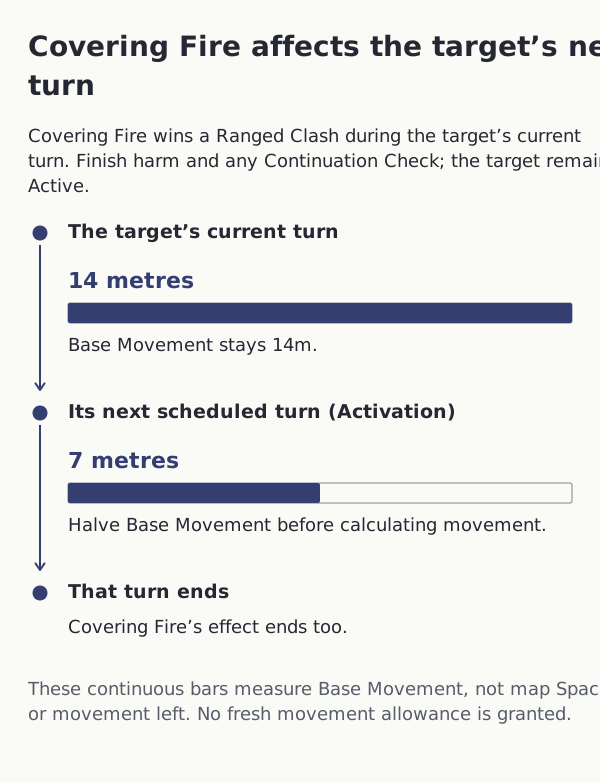
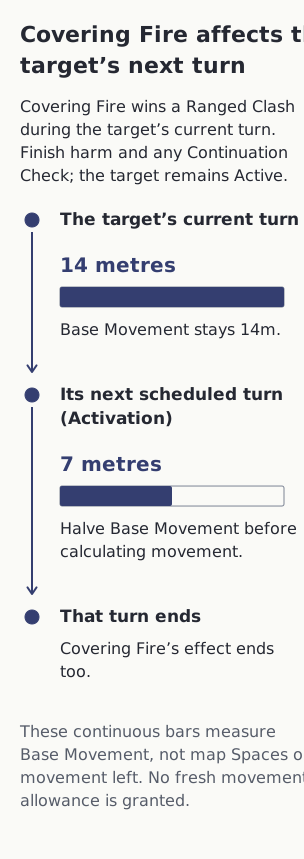

Read the diagram as text
During the target’s current turn, the Fighter wins a Ranged Clash with Covering Fire. Finish harm and any Continuation Check; the target must remain Active. Its normal Base Movement is 14 m.
- Resolve the successful Covering Fire Exchange, including harm and any Continuation Check. The target must remain Active.
- Its current turn stays unchanged: Base Movement remains 14 m.
- During its next scheduled turn, called its Activation, Base Movement becomes 7 m. Apply that reduction before calculating movement.
- That Activation ends, and so does this Covering Fire effect, even if the target could not act.
Result: Covering Fire does not reduce Base Movement immediately. It halves Base Movement during the target’s next scheduled Activation.
- Declare Covering Fire before rolling a Ranged attack, including a Clash response. Boost with at least one of your own Action Dice, pay normal attack and Boost costs, and spend one Covering Fire use.
- This changes Base Movement, not movement remaining. Later Activations use ordinary Base Movement unless another effect applies.
- If several such effects would halve Base Movement, use the lowest single result once. Further uses aimed at the same Activation do not extend or repeat it.
- A successful use during the affected Activation can reduce the next one.
Path of the Titan
Path Skill: Athletics. Brace against harm, put force through a strike and recover spent Action Dice.
Titan traitsBracePower AttackSecond Wind
3 traits
Brace
Trigger: After Wound Conversion, one source of Physical harm would deal at least 1 Wound to you. Declare Brace before applying those Wounds.
Cost: One use of Brace and 2 AD as a Reaction.
Effect: Prevent 1 Wound from that source. Use Brace only once for that batch of Wounds.
Example: A blow would deal 2 Physical Wounds. Spend 2 AD and one use of Brace. You take 1 Wound instead.
Power Attack
Trigger: Commit a Physical Melee attack that uses Strength for damage, and Boost it with at least 1 AD. Declare Power Attack before rolling. When you start the Exchange, declare it before the target chooses a response.
Cost: One use of Power Attack.
Effect: If you win this Exchange, add +2 to the Strike Rating of that Strength-based hit against your declared target.
Example: Your attack has a Strike Rating of 5. Power Attack raises it to 7 when you win the Exchange.
Second Wind
Trigger: Once during your Activation, take a Minor Action while you already have at least one Used AD.
Cost: One use of Second Wind, 1 AD and one proactive Athletics use.
Effect: Refresh up to 2 Used AD automatically. You may refresh the die you just spent on Second Wind. This refresh works even while your refresh is impaired.
Example: You have two Ready AD and three Used AD. Spend one Ready AD, then refresh two Used AD. You finish with three Ready AD and two Used AD.
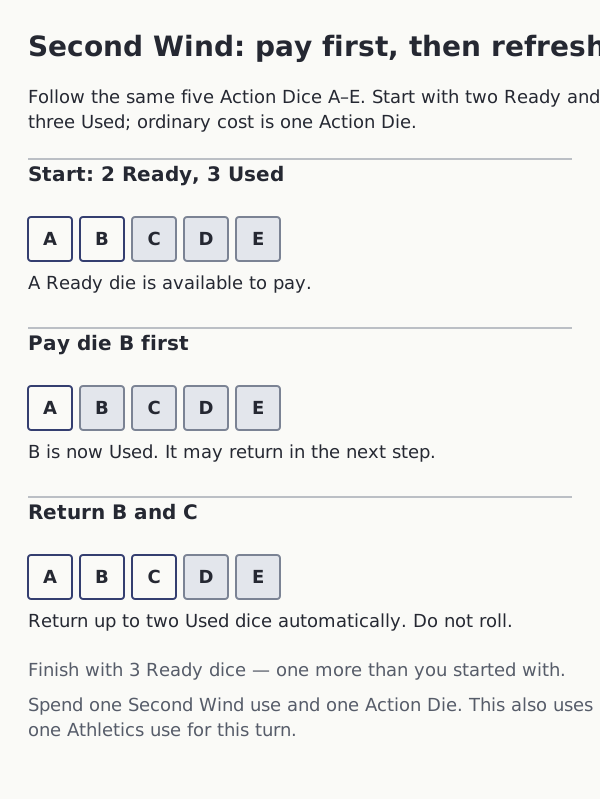
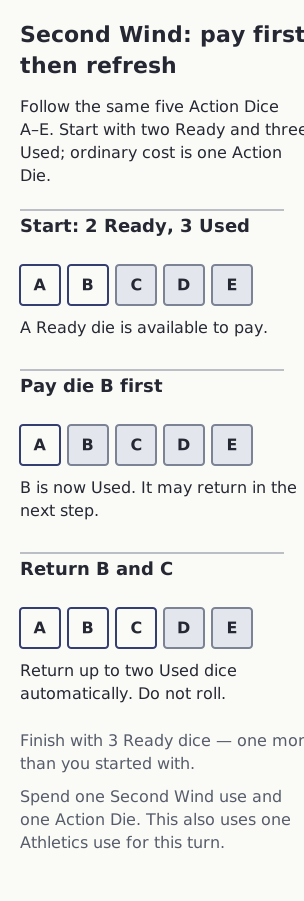

Read the diagram as text
You have two Ready Action Dice and three Used Action Dice. This example uses the ordinary 1 Action Die cost of Second Wind. Letters track the same five dice.
- Begin with two Ready dice, A and B, and three Used dice, C, D and E. The requirement to already have a Used die is met.
- Spend Ready die B to pay the ordinary Action Die cost. You now have one Ready and four Used dice.
- In the next step of Second Wind, return up to two Used dice automatically, without rolling. Here, choose B, the just-paid die, and C.
- Finish with three Ready dice, A, B and C, and two Used dice, D and E.
Result: You finish with three Ready dice—one more than you started with. Pay first; the later refresh cannot fund the earlier payment.
- Spend one use of Second Wind and one Action Die. This also uses one of your Athletics uses for this turn.
- Take its Minor Action once during your Activation, while you already have at least one Used Action Die.
- Second Wind returns up to two Used dice automatically even while Refresh is impaired. You do not roll.
- Your total dice body and current Vitality stay unchanged.