
On this page
Know the trail. Choose the moment. Bring everyone home.
A Ranger learns how creatures live, where they travel and what it takes to follow them. You might work beside a trusted beast, pick a telling shot across a clearing or keep moving when the ground turns against you. Your training connects the hunt, the journey and the creature at your side.
Narrative Prompt: “Whose trail did you first follow, and who are you bringing home?”
Ranger Paths
Beastmaster · Beastcraft
Coordinate a companion's attack, warn it away from harm and call it back to you.
- Traits: Pack Strike, Warning Call, Heel.
Hunter · Survival
Read a trail, find a route and place a precise shot.
- Traits: Trail Eye, Wayfinder, Vital Shot.
Strider · Athletics
Climb with confidence, cover ground quickly and keep your pace through rough country.
- Traits: Sure Grip, Fleet Foot, Tireless Stride.
Read Class Traits to learn how to use your traits. See Character Development for Class levels, trait ranks and Skill ceilings.
Working with a Companion
With Beastcraft training, you can form a bond under the Companion rules. Your companion has its own AD, Skills and Activation. It follows familiar tasks and can act or defend itself while you are elsewhere.
The animal pays for its own actions and Boost. You spend your trait uses when you help it through a named trait. Those traits need communication within 6m per Beastcraft level; ordinary tasks can continue beyond that range. The Companion rules explain instructions, turn order and both creatures' separate resources.
Starting Kit
- Begin at Ranger level 1.
- Share 3 Skill Levels between Beastcraft, Survival and Athletics. Put at least one level into two of them.
- Add your Origin's training. Beastcraft cannot exceed Presence, Survival cannot exceed Cognition, and Athletics cannot exceed Strength. Check any other granted Skills against their Linked Vitals too.
- Choose one trait at rank 1 from a Path whose Skill you have trained. Begin with one use of it.
- Take 120 Dritch and buy your equipment. Add your Origin's money and equipment separately.
- If you want a companion at creation, buy one of the 50-Dritch trained companions from this budget. Include its bond in your background.
Quick Starts
- Beastmaster — work as a pair. Take one level each in Beastcraft, Survival and Athletics. Choose Pack Strike. A Hound costs 50 Dritch, Leather 40 and a Dagger 5, leaving 25 Dritch of your Class money. Your companion has Melee level 1 and four AD, so it can pay for its own boosted Bite. Choose an Origin for your own training, then add its grants before checking your Vital caps.
- Hunter — make the first shot count. Take Survival 2 and Athletics 1. Choose Vital Shot. A Hidden Grove Watcher begins with Ranged training, a Bow, 20 arrows and Leather. Three Javelins cost 24 Dritch and a Dagger 5, leaving 91 Dritch of your Class money. You need Cognition 2 for Survival 2 and trained Ranged for the required Boost. Use Agility for the declared shot's damage.
- Strider — keep moving. Take Athletics 2 and Survival 1. Choose Fleet Foot. A Mace costs 15 Dritch and Leather 40, leaving 65 Dritch of your Class money. Strength must be at least 2. Use Fleet Foot when you need to Run and keep AD for another task.
These are starting suggestions. Pick one approach, add your Origin and change the purchases to suit your character. Find equipment profiles in Equipment.
Path of the Beastmaster
Path Skill: Beastcraft. Practise the timing, signals and trust that let you work beside one creature.
Beastmaster traitsPack StrikeWarning CallHeel
3 traits
Pack Strike
Trigger: As your companion commits to a Melee attack, declare Pack Strike before either combatant rolls. The companion must Boost that attack with at least 1 of its own AD. When it starts the Exchange, declare the trait before the target chooses a response.
Cost: One use of Pack Strike.
Effect: Add +1 to your companion's attack total. You may use this for an initiating attack or a Clash response.
Example: Your companion rolls 2 against Full Guard 2. Pack Strike raises its total to 3, so the attack gets through by 1.
Warning Call
Trigger: After Wound Conversion, one source of Physical harm would deal at least 1 Wound to your companion. Call a warning before applying those Wounds.
Cost: One use of Warning Call and 2 of your AD as your Reaction.
Effect: Prevent 1 Wound to your companion from that source. It must be aware of the danger and able to take Reactions. Use Warning Call only once for that batch of Wounds.
Example: A blow would deal 2 Physical Wounds to your hound. Spend 2 of your AD and a use of Warning Call. Your companion spends no AD for the trait and takes 1 Wound instead.
Heel
Trigger: Once during your companion's Activation, after a Melee Exchange it started has fully resolved. It must have Boosted its attack with at least 1 of its own AD.
Cost: One use of Heel and a 0-AD Reaction by your companion.
Effect: Your companion moves up to 6m towards you, ending closer to you. Use its Walk, Swim or Fly movement as its profile allows. This is additional movement and can follow a win or a loss.
Example: Your hound finishes an Exchange 6m from you. Heel lets it move 4m along a clear route towards you, ending 2m away.
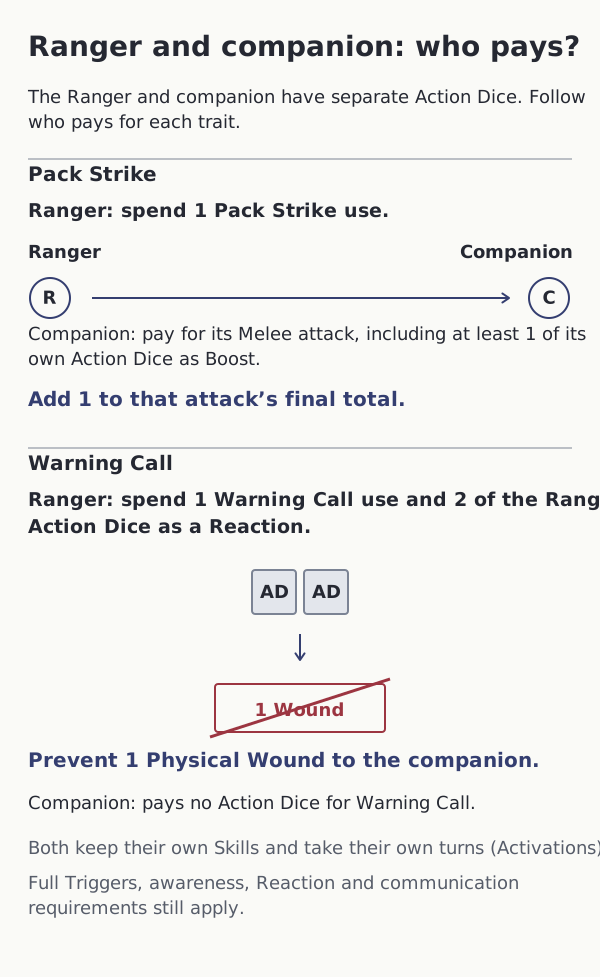

Read the diagram as text
The Ranger and companion have separate Action Dice, Skills and Activations. Each trait says which creature spends what.
- For Pack Strike, the Ranger spends one Pack Strike use. The companion pays its own Melee attack cost, including at least one of its own Action Dice for Boost. Add 1 to that attack’s final total.
- For Warning Call, the Ranger spends one Warning Call use and two of the Ranger’s own Action Dice as the Ranger’s Reaction.
- The companion spends no Action Dice for Warning Call, but must be aware of the danger and able to take Reactions. Prevent one Physical Wound from that source.
Result: The Ranger pays the two Action Dice for Warning Call. Pack Strike’s required attack and Boost dice belong to the companion.
- Both must be Active and able to carry out the effect. The Ranger must be aware and able to communicate within 6 m per Beastcraft level when declaring the trait.
- Declare Pack Strike as the companion commits its Melee attack, before either combatant rolls; if it starts the Exchange, declare before the target chooses a response. It can also enhance a Clash response. Follow ordinary attack requirements.
- Declare Warning Call after Wound Conversion and before applying the Physical Wounds. Use it only once for that batch. The companion must be aware of the danger and able to take Reactions.
- Pack Strike changes one attack’s final total after rerolls. It grants no extra attack.
Path of the Hunter
Path Skill: Survival. Learn what a quarry leaves behind, how the land shapes a pursuit and where a telling shot belongs.
Hunter traitsTrail EyeWayfinderVital Shot
3 traits
Trail Eye
Trigger: Before you or your companion makes a Survival check to follow a creature's tracks, declare Trail Eye. The creature making the check must Boost it with at least 1 of its own AD.
Cost: One use of Trail Eye.
Effect: Add +1 to that tracking check's total.
Example: Rain has washed across a trail. Your tracking total of 2 becomes 3 against Difficulty 2, enough to keep following it.
Wayfinder
Trigger: Before you or your companion makes a Survival check to navigate a route through the wilds, declare Wayfinder. The creature making the check must Boost it with at least 1 of its own AD.
Cost: One use of Wayfinder.
Effect: After Edge and the other applicable rerolls, reroll one remaining Miss at Survival level 1, or up to two at level 2 or higher. Use the Skill level of the creature making the check. Keep their new results.
Example: With Survival level 2, your navigation roll totals 1 and still has two Misses. Reroll them. Two Hits raise your total to 3; two Misses leave it at 1.
Vital Shot
Trigger: Commit a Physical Ranged attack that uses Agility for damage, and Boost it with at least 1 AD. You must understand the target creature's anatomy well enough to choose a vulnerable place. Declare Vital Shot before rolling; when you start the Exchange, declare it before the target chooses a response.
Cost: One use of Vital Shot.
Effect: If you win this Exchange, add +2 to the Strike Rating of that declared hit.
Example: Your weapon and Agility give Strike Rating 4. Vital Shot raises it to 6 when you win. With Hit Margin 1 against Protection 1, Wound Margin rises from 4 to 6: 3 Wounds instead of 2.
Path of the Strider
Path Skill: Athletics. Climb with a sure grip, cover ground efficiently and keep your pace through rough country.
Strider traitsSure GripFleet FootTireless Stride
3 traits
Sure Grip
Trigger: Before you make an Athletics check to climb a physical route, declare Sure Grip and Boost the check with at least 1 AD.
Cost: One use of Sure Grip.
Effect: After Edge and the other applicable rerolls, reroll one die still showing a Miss. Keep its new result.
Example: Your climb totals 1 against Difficulty 1. Reroll a remaining Miss. A Hit raises the total to 2, so you make it; another Miss leaves the failure unchanged.
Fleet Foot
Trigger: Once during your Activation, before you begin to Run.
Cost: One use of Fleet Foot.
Effect: Reduce your Run's base cost from 1 AD to 0.
Example: With Base Movement 12m, you can Run up to 24m. Fleet Foot lets you do so without spending the usual 1 AD.
Tireless Stride
Trigger: During your Activation, when you are about to spend Walk or Run movement on Difficult terrain.
Cost: One use of Tireless Stride.
Effect: For the rest of this Activation, Difficult terrain costs no extra movement from your normal Walk or Run allowance.
Example: Your Run gives you 24m of movement. Deep mud would normally let you cover only 12m. Tireless Stride lets you cover all 24m for the usual 1 AD.