
On this page
An ill wish. A listening spirit. A glimpse of what comes next.
You practise magic through life, spirit and fate. Your teacher might have been a village elder, a wandering witch or the wild itself. In Trance, you turn some of your own Action Dice into Magic Dice and use them to work changes upon the world.
Narrative Prompt: “Who or what first listened when you called: an elder, a witch, or the wild itself?”
Primant Paths
Each Path offers spells to learn and traits to improve them. Choose your spell and your trait separately.
Hexer · Influence
Weaken a creature, stir its fear or bend a small choice.
- Spells: Leeching Blight, Wither, Dread Whisper, Death's Hush, Unwilling Hand, Borrowed Voice.
- Traits: Bitter Word, Far Whisper, Hidden Thread.
Wildling · Survival
Shape the elements, call spirits, tend life and offer shelter.
- Spells: Elemental Lash, Shape Element, Call Wisp, Bind Totem, Tend Life, Green Ward.
- Traits: Primal Focus, Far Calling, Quiet Communion.
Seer · Insight
Read traces and warnings, turn a chance or shape an illusion.
- Spells: Read the Trace, Glimpse Ahead, Favour, Jinx, Phantom Shape, Veiled Face.
- Traits: Far Sight, Lasting Vision, Quiet Vision.
Learning Your Magic
Each Primant level, including level 1, gives you one new spell and one rank in a trait. Make these two choices separately:
- Learn one spell you do not already know. Choose any spell from a Path whose Skill you have trained to at least level 1.
- Add one trait rank. Choose a new trait at rank 1 or increase a trait you already have, within your rank limit. Its Path Skill must also be at least level 1.
Your spell and trait can come from different Paths. At Primant level 4, you know four spells and have four ranks across your traits.
Spells are your magical tools. Traits help you do more with those tools. Each spell has its own effect. Once learned, it stays in your repertoire. You can cast it whenever you meet its requirements; casting spends dice, not a trait use.
A trait adds a limited-use enhancement to a compatible spell you know in its Path. It cannot cast a spell on its own. More ranks give you more uses of that trait. When those uses run out, you can still cast your learned spells.
For example, at Primant level 1 you could learn Elemental Lash and choose Primal Focus at rank 1. At level 2, you could learn Call Wisp and raise Primal Focus to rank 2. You now know two spells and have two uses of Primal Focus. You could instead put that second rank into Far Calling; either way, you choose the new spell independently.
Learn your spell as part of that Class advance, with no separate rank or spell purchase. You need no purchased focus; a spell may name an ordinary object it uses.
A trained Path Skill counts as a Primant magic Skill once you know at least one spell from that Path. A trained Skill alone grants no spells or Trance capacity. If a Path Skill falls to level 0, keep its learned spells and trait ranks, but stop using that Path's magic until the Skill is trained again. Follow Magic when qualifying Skills change.
Read Class Traits for uses, recovery and Events. Character Development explains Class advances, Story Point costs and rank limits.
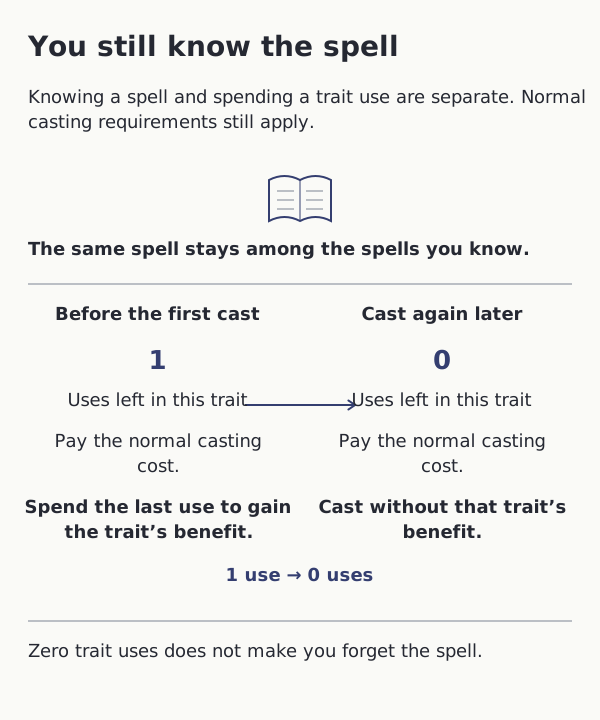
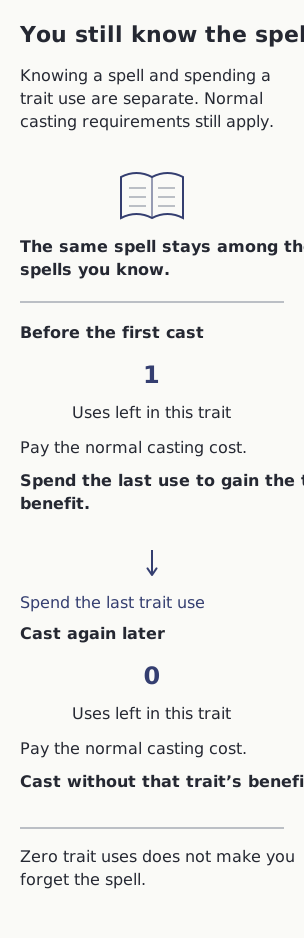

Read the diagram as text
You know a spell and have a trait that can help it. You meet both sets of requirements and have one trait use left. Knowing the spell and using the trait are separate.
- Keep the learned spell written among the spells you know. Record one use left in the trait that helps it.
- On the first cast, pay the normal casting dice and spend one trait use at its Trigger. This cast gets the trait’s benefit; the trait now has zero uses left.
- Keep the learned-spell entry unchanged. On a later cast, pay the normal casting dice again. You can cast the spell without the exhausted trait’s benefit.
Result: Zero uses left in a trait does not make you forget a learned spell.
- A trait use does not pay an Action Die or Magic Die cost.
- Trance, trained Path Skill, targeting and all other casting requirements apply to both casts.
- This shared example applies to Primant, Cleric and Mage. Advancement and trait ranks follow Character Development.
Casting Your Magic
You must be in Trance to cast any Primant spell. Follow Magic for casting costs, Boost and dice movement, and Trance Actions for entry and deepening. Spending a trait use enhances the spell; it does not pay for casting it.
Primant casting requires an audible word or a visible hand gesture. One is enough. You must perceive the target, see it and have a clear line of effect unless the spell expressly says otherwise. A blocking wall stops an ordinary cast. Touch means actual contact.
Initiating a spell is a Major Action and takes one proactive use of its Path Skill. Every spell makes a casting check with that Skill unless its entry names another. You can Boost the check. Each spell explains how to use the result. See Spell Timing for how short spells use turns and carry into a fight. Use Distance & Range in every Scene Mode. Changing Scene Mode preserves distance, elapsed time and effects already resolved.
Starting Kit
- Begin at Primant level 1.
- Share 3 Skill Levels between Influence, Insight and Survival. Give at least one level to two of them.
- Add your Origin's training, then check Skill caps. Influence cannot exceed Presence; Insight and Survival cannot exceed Cognition.
- Choose one spell and one trait at rank 1 independently. Each choice needs its Path Skill at level 1 or higher. Begin with one use of the trait.
- Take 120 Dritch for equipment. Add your Origin's money and owned gear separately.
Quick Starts
- Hexer — sap an opponent's recovery. Take Influence 2 and Insight 1; learn Leeching Blight and choose Bitter Word at rank 1. Buy Leather for 40 Dritch, a Quarterstaff for 5 and a Dagger for 5, leaving 70 Dritch of Class money. Bitter Word helps a boosted Leeching Blight take hold.
- Wildling — bring an element to the struggle. Take Survival 2 and Insight 1; learn Elemental Lash and choose Primal Focus at rank 1. The same kit leaves 70 Dritch of Class money. Keep Ready AD beside your MD so you can Boost an Elemental Lash and add its enhancement.
- Seer — uncover a useful glimpse. Take Insight 2 and Survival 1; learn Glimpse Ahead and choose Far Sight at rank 1. The same kit leaves 70 Dritch of Class money. Far Sight lets Glimpse Ahead reach a more distant visible target or route.
Combine a recipe with your Origin before checking Skill caps. If you already own an item, do not buy it again. Use the prices and profiles in Equipment.
Path of the HexerSpellsLeeching BlightWitherDread WhisperDeath's HushUnwilling HandBorrowed VoiceTraitsBitter WordFar WhisperHidden Thread
6 spells · 3 traits
Path Skill: Influence. Weaken a body, stir fear or bend a small choice.
Hexer spells reach 6m per Influence level.
If a spell allows active resistance, the target chooses after you commit your dice, before either roll. It must notice the casting, be able to take a Reaction and pay 1 AD plus any legal AD Boost. Otherwise, use its stated Readiness Score. Resistance grants no automatic Advantage and causes no harm. A tie resists the spell.
An unaware creature still has its stated Readiness. Insight resistance becomes target 0 if the creature is Unconscious or otherwise unable to resist mentally. Leeching Blight tests Athletics or Survival Readiness even while the creature is Unconscious, but no active response is possible. Wither tests Resilience even if the creature is unaware or Unconscious. These spells do not start Combat Exchanges; use these defences rather than the ordinary No Response rule.
Dread Whisper and Death's Hush last until the start of your next Activation, unless used up sooner. They also end if your Trance ends or the target leaves the range recorded at casting.
Leeching Blight lasts through the target's next ordinary start-turn Refresh. It ends sooner if your Trance ends or the target leaves its recorded range.
You can maintain one casting each of Leeching Blight, Dread Whisper and Death's Hush at a time. A successful new casting ends your previous casting of that spell; failure alone does not. A creature can bear only one of each, from any casters. Keep the stronger version, or the new one if equal; the other ends. Wither, Unwilling Hand and Borrowed Voice produce their result immediately, so ending your Trance does not undo that result.
Hexer Spells
Leeching Blight
Spell · Sickness. Choose one visible living creature in range. Draw the strength from its body. Roll Influence against the higher of its Athletics or Survival Readiness. It may instead resist actively with either Skill.
On success, subtract its resistance from your casting total. Look up that margin in Magic Conversion. The result is the number of AD that cannot refresh, rather than Wounds.
At the creature's next ordinary start-turn Refresh, it sets aside that many Used AD, or all its Used AD if it has fewer. Those dice remain Used; refresh or roll the other dice normally. The blight then ends, including if there were no Used AD to set aside. A later, separate effect can refresh those dice normally.
Example: Your casting total is 7 against resistance 2. The margin of 5 converts to 3. When the guard's turn begins with four Used AD, three stay Used and one refreshes.
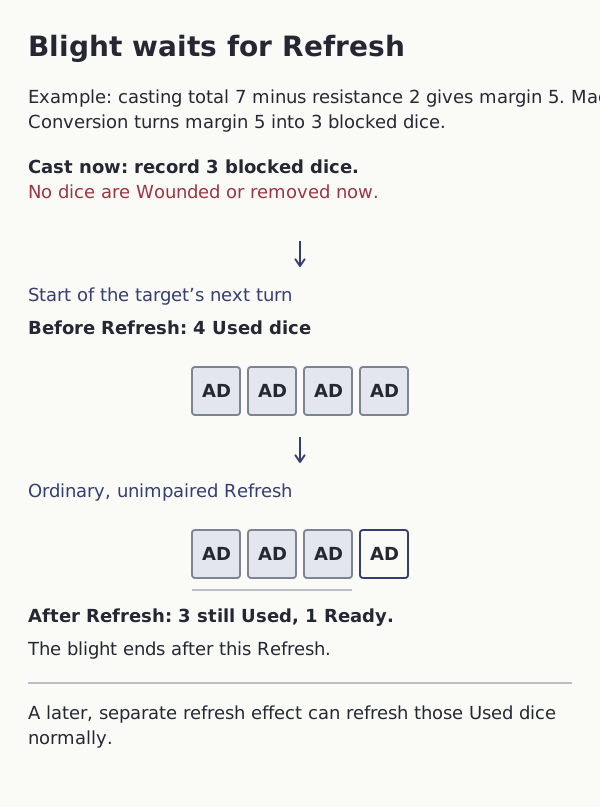
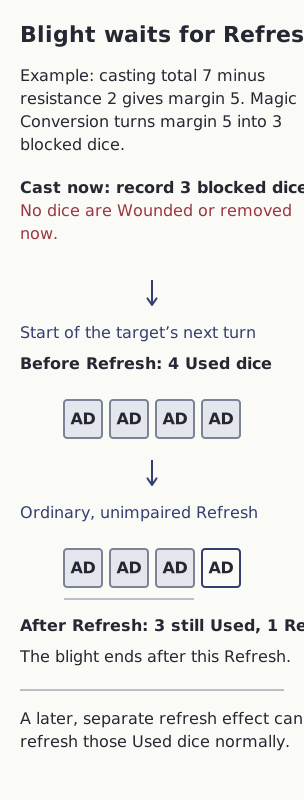

Read the diagram as text
This casting gives a margin of 5. The Magic Conversion table says it blocks 3 dice. The living target’s next Refresh is ordinary and unimpaired.
- Subtract resistance 2 from casting total 7 to get margin 5. Look up that margin in Magic Conversion: 3 Action Dice cannot refresh.
- Do not spend, remove or Wound any of the target’s dice when the spell is cast.
- At the start of the target’s next turn, it has four Used Action Dice. Set aside three of them; they stay Used. Its remaining die refreshes to Ready.
- The blight then ends. This example finishes with three Used Action Dice and one Ready Action Die.
Result: Leeching Blight delays three dice’s Refresh in this example; it does not inflict three Wounds.
- If the target has fewer Used dice, set aside only those it has. The blight ends even if there are none.
- If Refresh is impaired, resolve its normal roll for the other dice.
- It ends early if Trance ends, a Scene Reset occurs or the target leaves its recorded range. Outside an encounter, it lasts ten seconds.
- A later, separate refresh effect can refresh the dice normally.
Wither
Spell · Decay. Choose one visible creature, object or part of an object in range made from flesh or plant material. Rot flesh, splinter wood or crumble leather. Living bodies, dead flesh, wooden shields, leather armour and held or worn gear are valid targets. Metal and stone are not.
Against a creature, roll Influence against its Resilience score. On a hit, your Strike Rating is 1 + your full Presence, with no Damage Vital Cap. Calculate Wounds from your Hit Margin, Strike Rating and the target's Protection, using Combat. The harm is Supernatural (Necrotic). Apply those Wounds and any Continuation Check normally. Use this procedure for any part of a creature's body.
Against material, describe what you want to destroy. Before you commit dice, the Guide sets a Difficulty for the amount and toughness of that material: rotting through a rope is easier than crumbling a thick wooden door. If it is held or worn, use the higher of that Difficulty and its bearer's Resilience. Roll Influence; on success, the chosen material decays and breaks as declared. Damage to gear affects the gear; its bearer takes no Wounds from that casting.
Example: With Presence 3, your Strike Rating is 4. You roll 6 against a creature's Resilience 3, for a Hit Margin of 3. Against Protection 1, the Wound Margin is 6: 3 Wounds.
Dread Whisper
Spell · Fear. Choose one visible creature in range that can feel fear and can perceive you. Show it a brief omen of its own death at your hands. Roll Influence against its Insight Readiness; it may resist actively with Insight.
On success, its next attack against you has Disadvantage, then the spell ends. This can affect a weapon or spell attack, including a Clash attack. It does not affect a Full Guard or an attack against someone else. It neither forces movement nor prevents Boost.
Other Advantage and Disadvantage follow the normal Edge rules. This spell does not impose the Panicked or Unnerved Condition.
Example: A swordsman under Dread Whisper Clashes against you. That attack has Disadvantage. Once the attack roll is resolved, the spell has been used up, even if Advantage cancelled its Disadvantage.
Death's Hush
Spell · Fear. Choose one visible creature in range that can feel fear and has a voice. An omen of the grave catches in its throat. Roll Influence against its Insight Readiness; it may resist actively with Insight.
On success, its voice becomes a whisper that ordinary hearing cannot detect beyond 2m. It can still speak, take Actions and cast spells whose other requirements it meets. It may also make sounds with a bell, horn or another object normally. This changes only its voice; it does not silence an area or impose a Condition.
Example: A watchman fails to resist. Its shout cannot carry to a guard ten metres away, but it can still reach for the alarm bell and use it normally.
Unwilling Hand
Spell · Control. Choose one visible creature in range with a usable hand holding one unsecured object in that hand. The object must have Bulk 1 or less and must not also be held in another hand. Roll Influence against the creature's Insight Readiness; it may resist actively with Insight.
On success, that hand opens and releases the object. It falls from its current position under ordinary gravity. This is the spell's effect, not another Action or Reaction. It spends none of the target's AD and grants you no movement or handling of the object.
The spell cannot release a creature, remove worn or fastened gear, unload a weapon, make an attack or interrupt an Action already committed. The target may recover or use the dropped object later through ordinary actions.
Example: A guard holds a dagger in one hand. Your successful casting makes it fall where the guard stands. You have not caught it, moved it towards yourself or prevented the guard from picking it up.
Borrowed Voice
Spell · Control. Choose one visible creature in range that can speak a language you both know. State up to three words in that language before casting. Roll Influence against its Insight Readiness; it may resist actively with Insight.
On success, the creature says those exact words once, using its normal voice and no more than ordinary speaking volume. The utterance is the spell's effect and spends none of its AD. It grants neither creature another Action, check or resource. It cannot make the creature cast a spell, use a trait, choose an answer for you or reveal information you did not supply.
The target knows you forced the utterance and may speak normally afterwards. Listeners react through the normal fiction and Skills; the spell gives the words no authority or automatic credibility. It does not interrupt an Action already committed.
Example: You force a guard to say “I need help.” Someone nearby hears the guard's real voice. They decide how to respond normally, and the guard can immediately explain what happened.
Hexer Traits
Bitter Word
Trait.
Trigger: Declare a Hexer spell with a casting check and Boost it with at least 1 of your own AD. Declare this before the target chooses its resistance.
Cost: One use of Bitter Word.
Effect: Add +1 to your casting total.
Example: Your Death's Hush casting total is 1 against Insight Readiness 1. Bitter Word raises it to 2, so the spell succeeds.
Far Whisper
Trait.
Trigger: Declare a Hexer spell, before checking its range and paying for it.
Cost: One use of Far Whisper.
Effect: That casting reaches 12m per Influence level, instead of 6m. Use this greater range for keeping any ongoing effect too. Its other distances and targeting requirements stay the same.
Example: At Influence 2, you use Wither on an eligible exposed cord 20m away. Far Whisper gives this casting a range of 24m instead of 12m.
Path of the WildlingSpellsElemental LashShape ElementCall WispBind TotemTend LifeGreen WardTraitsPrimal FocusFar CallingQuiet Communion
6 spells · 3 traits
Path Skill: Survival. Work with the elements, invite spirits into the world and help living things endure. Your magic can strike, explore, warn, tend and shelter.
Wildling Spells
Elemental Lash
Spell · Attack. Send flame, frost or a burst of force at one visible creature within 6m per Survival level. Choose Elemental (Fire), Elemental (Cold) or Physical (Impact) when you declare the spell.
To attack, initiate a Ranged Exchange, using Survival for the casting check. Your casting cost replaces a weapon's Base Attack Cost. You need no weapon, ammunition or nearby supply of the element.
You can also cast Elemental Lash as a Clash response to a Melee or Ranged attack when the attacker is within range. Use Survival and the same casting cost.
When you initiate the Exchange, the defender can choose No Response, Acrobatics Full Guard or a legal Clash. Follow Combat for responses, payments, Edge, ties, cover and shooting while engaged in melee. There is no additional long-range band.
On a hit, your Strike Rating is 2 + your full Cognition, with no Damage Vital Cap. Apply Protection, Wound Conversion and Continuation normally. The chosen element adds no lasting Condition, fire, ice, movement or other effect. Only the winner of a Clash deals their attack's harm.
Shape Element
Spell · Practical tool. Choose a visible point within 6m per Survival level. Make a Survival casting check at Difficulty 1. On success, make one of these changes:
- Move up to 10 litres of loose earth, sand or water up to 3m, or reshape that amount where it lies.
- Light dry, unattended fuel with a flame no larger than your open hand, or extinguish one ordinary flame of that size.
- Send a brief breeze along a visible route up to 3m, strong enough to move loose paper, clear a small cloud of smoke or blow out a candle.
The whole change must stay within range and follow an open route. You cannot affect a creature, worn or held material, solid stone, magical fire or a larger blaze. You create no material and cannot move a load, force a mechanism, make an attack or impose a Condition. Loose material remains loose: a mound can fill a small hole, but cannot become a bridge or a wall that stands unsupported. Water runs and ordinary fire burns normally after the change.
Call Wisp
Spell · Spirit scout. Call a visible spirit no larger than your hand. It gives the light of a candle. Make a Survival casting check at Difficulty 1 to call or guide it.
If you have no wisp, success creates one beside you. On success, guide your wisp up to 6m along an open route and briefly see and hear from its destination as though you stood there. You can cast Call Wisp again to move your existing wisp up to another 6m and receive another view. Each cast pays its normal cost. A wisp can fly through an opening large enough for a hand. Its whole route must remain within 6m per Survival level of you.
You may guide it around a corner you cannot see; this is an exception to the usual sight requirement. It cannot pass through solid material or closed doors. The view uses normal sight and hearing, with the wisp's candlelight. It reveals no hidden creature or concealed fact automatically. If you are looking for something uncertain, use Observation for the casting check instead, with your Observation level for Boost. The cast still uses one proactive Survival use and no proactive Observation use. The Guide states the Difficulty before you pay. Success moves the wisp and reveals what you could notice from its destination. Failure leaves an existing wisp in place and gives no new view; if you have none, none appears. A new cast does not retry a settled search without new circumstances.
Between casts the wisp stays where you left it, giving light but sending no information. It has no separate turn, dice, attacks, hands or capacity to Assist. It cannot carry, block or restrain anything. A conscious creature within reach can scatter it with a Minor Action costing 1 AD, with no check. You can have one wisp at a time. It lasts ten minutes per Survival level from when it first appears. It fades sooner if your Trance ends or it leaves your range.
Bind Totem
Spell · Spirit lookout. Touch one unattended, nonliving object that fits in your hand and bind a watchful spirit to it. It need not be a purchased charm. Make a Survival casting check at Difficulty 1. On success, the spirit takes its place. You can have one bound totem at a time; a successful new casting releases the old spirit.
For up to eight hours, the spirit watches an area 1m from the object. The first living creature other than you to enter that area makes the totem call out once, as loudly as a person shouting. The magic then ends. The spirit senses presence, including an unseen creature, but cannot identify it or judge its intentions. A creature already inside the area when you cast does not trigger it unless it leaves and re-enters. Walls and closed barriers block its sensing.
The warning grants no automatic Action, response, attack or knowledge beyond the warning's location. Ordinary hearing determines who notices it. Moving or breaking the object ends the spell. It also ends if your Trance ends or you move farther than 6m per Survival level from it. The totem also ends when you begin a Rest.
Tend Life
Spell · Healing care. Choose one living creature within 6m per Survival level and describe how you draw on its own strength to help it recover. Make a Survival casting check at Difficulty 1, choosing one treatment before you roll:
- Immediate aid: On success, give an Unconscious or Critical creature the benefit of First Aid: Advantage on its next Recovery Roll. This does not restore Vitality, add Recovery Dice or affect a Last Gasp.
- Care before a Rest: On success, give a wounded creature the benefit of successful Medicine care for its next Rest: roll its Wounded dice with Advantage. That uninterrupted Rest must begin within one hour of the casting. If it does not, or the Rest is interrupted, the benefit ends.
The care is complete when the spell succeeds. It continues without your Trance and through Scene Resets until the named roll or Rest, so you can Rest too. It does not stack with other First Aid or Medicine care. Repeating the spell cannot accumulate Advantage, restore Vitality directly or treat the Deceased. Immediate aid ends when the target leaves Unconscious or Critical, just as First Aid does.
Green Ward
Spell · Protection. Wrap yourself or one willing creature within 6m per Survival level in a brief shelter of leaves, roots and watchful life. Make a Survival casting check at Difficulty 1. On success, look up your casting total in Magic Conversion: the result is the ward's Protection bonus. A creature unable to choose can receive the ward if it has not refused your help.
Against the next successful attack dealing Physical harm, add the ward's bonus to the target's Protection Rating before Wound Conversion. Then the ward ends, even if it prevented no Wounds. Keep its Protection bonus if that same attack is later recalculated; do not apply it to another attack. It does not change the attack or defence total, protect against other harm, or stop effects that cause Wounds without a Protection calculation.
You can keep one Green Ward at a time; a successful new casting ends your previous ward. A creature can have only one Green Ward. A willing recipient chooses whether to accept a replacement. If they cannot choose, keep the stronger ward, or the new one if equal; the other ends. The ward also ends at the start of your next Activation, when your Trance ends or if the target leaves 6m per Survival level from you. The leaves provide no cover or physical obstruction.
Wildling Traits
Primal Focus
Trait.
Trigger: Declare a Wildling spell with a casting check and Boost that check with at least 1 of your own AD. Declare Primal Focus before a defender chooses a response or any dice are rolled.
Cost: One use of Primal Focus.
Effect: Add +1 to that casting check's final total. This includes an Observation casting check made through Call Wisp.
Example: You also know Call Wisp. You Boost its Observation casting check with one of your AD. Your total of 1 against Difficulty 1 becomes 2, letting you notice the uncertain detail from the wisp's viewpoint.
Far Calling
Trait.
Trigger: Declare a Wildling spell, before choosing its target or route and paying its casting cost.
Cost: One use of Far Calling.
Effect: For that casting, change each distance from you written as 6m per Survival level to 12m per Survival level, including the distance at which an ongoing spell ends.
Touch still requires contact. A wisp still moves only 6m per cast, a totem still watches 1m around its object, and Shape Element still moves material or a breeze no farther than 3m.
Each new Call Wisp casting sets the wisp's range again. Without Far Calling, its whole route must fit the ordinary range before you can cast.
Example: With Survival 2, you touch a twig to cast Bind Totem. Far Calling lets you remain up to 24m away instead of 12m. It still watches only 1m around the twig and gives its ordinary audible warning.
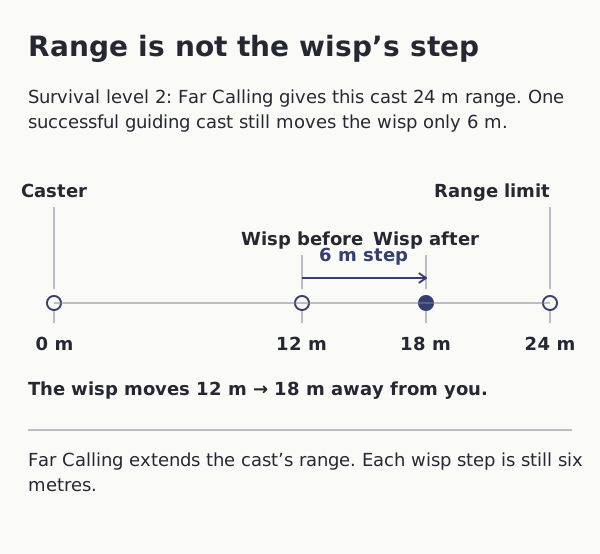
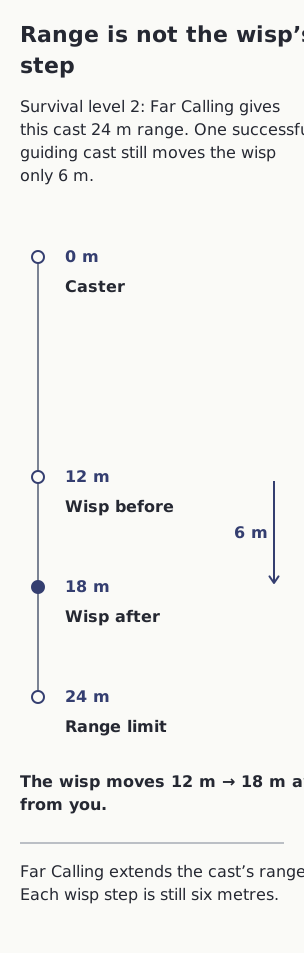
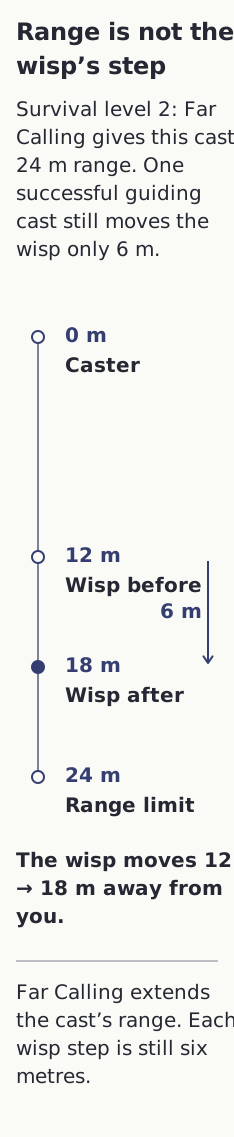
Read the diagram as text
In this example, your Survival Skill Level is 2. Ordinary range is 12 m; Far Calling gives this cast a range of 24 m. The wisp begins 12 m from you.
- Put the caster at 0 m and the existing wisp at 12 m on the same 0–24 m scale.
- Use Far Calling for the guiding cast. Its range is 24 m instead of the ordinary 12 m; pay the cast’s normal cost and the trait use.
- On success, guide the wisp 6 m along the open route, from 12 m to 18 m. The whole route lies within this cast’s enhanced range.
- Receive a brief view from its destination. Between casts, the wisp stays there but sends no information.
Result: A 24 m casting range does not allow a 24 m step. This successful cast moves the wisp 6 m.
- Every guiding cast pays normally and checks its whole route against that casting’s range.
- Without Far Calling, the whole route must fit ordinary 12 m range before casting. An illegal proposed cast does not reset the wisp or end the existing effect.
- A clear open route and the spell’s other limits still apply. This straight-line example is not an area template.
Quiet Communion
Trait.
Trigger: Declare a Wildling spell, before paying its casting cost.
Cost: One use of Quiet Communion.
Effect: Cast it without the audible word or visible hand gesture normally required by Primant magic. Its effects can still be seen or heard normally. You do not automatically become Hidden or remove a defender's legal response. Other requirements, including Touch, still apply.
Example: You also know Call Wisp. Quiet Communion lets you cast it without speaking or gesturing. The wisp still glows like a candle and gives only its normal view; the trait has not made the spirit invisible.
Path of the SeerSpellsRead the TraceGlimpse AheadFavourJinxPhantom ShapeVeiled FaceTraitsFar SightLasting VisionQuiet Vision
6 spells · 3 traits
Path Skill: Insight. You read traces left by the past, glimpse the next moment, turn a small chance and shape what people see.
Seer Spells
Read the Trace
Spell · Divination. Touch one object you could lift in two hands, or stand in a roughly one-metre patch of ground. Ask about the last creature that handled the object or passed through that patch during the past hour. Contact made only to cast this spell does not replace that event. Make an Insight casting check at Difficulty 1.
Choose one detail: the creature's visible appearance, the direction it left, one physical action it performed there, or one brief sound made during that contact. On success, you receive a short, truthful impression as though you had watched and listened from that spot. The impression lasts only long enough to give that detail. If there was no such contact during the hour, you learn that instead.
The trace cannot see through a covering, hear through a soundproof barrier, read thoughts, give an unknown name or translate a language you do not understand. A cloak may hide a face; it does not hide the fact that the creature wore a cloak. Explicit magic that conceals such traces still applies.
Reading the same contact again gives the same ordinary detail, not another answer. A different wording, another object involved in that same contact, another caster or a change of Scene Mode does not provide a fresh ordinary reading. A new contact or independently learned evidence that changes what can be identified permits one.
Glimpse Ahead
Spell · Prophecy. Name one action you intend to begin by your next Activation. Its immediate target or route must be visible and within 6m per Insight level, with a clear path for your magic. Make an Insight casting check at Difficulty 1.
Ask what hidden physical consequence of that action is already set by the present situation. On success, the Guide gives one brief, truthful warning or glimpse of the first such consequence within the action's first ten seconds. For example, opening a chest might release a concealed dart, or stepping onto a plank might break it. You can learn about that hidden cause even though you cannot currently see it.
The consequence must occur within the spell's range. The glimpse does not predict a die result, another creature's future choice or a new event that has not been set in motion. If the outcome depends on a check or choice, the Guide identifies that uncertainty instead of promising success or failure. A glimpse with no settled consequence is not a promise that the action is safe. Later changes can invalidate what you saw.
Changing the wording or a minor detail of the same plan does not reveal more. Further ordinary casts about that plan repeat the same information until an independently established fact or an actual change to the situation affects its consequence. Waiting for your dice to refresh, walking away and back, or changing Scene Mode does not count.
Favour
Spell · Fortune. Choose yourself or one willing creature you can see within 6m per Insight level, with a clear path for your magic. Name one Skill and one intended task, such as Survival to follow this trail. Make an Insight casting check at Difficulty 1. On success, look up your casting total in Magic Conversion: the result is the Favour's bonus.
The target adds that bonus to the final total of its next rolled check of that Skill for that task. Apply this after Edge and the check's other rerolls, before comparing the result. Favour then ends, whether or not that check succeeds. Favour cannot enhance a casting of Favour.
Favour ends at the start of your next Activation if it has not been used. It also ends if your Trance ends or the target leaves the spell's range.
You can maintain one Favour. A successful new casting ends yours already in place. A creature can have only one Favour: a willing new recipient chooses whether to replace an existing one. Several Favours cannot improve the same check. Favour and Jinx may both apply; add their signed modifiers together, then floor the check's final total at 0. Both end when that named check is made. If that same check is later recalculated, keep each recorded modifier once; this neither applies it again nor grants another trait activation.
Jinx
Spell · Misfortune. Choose one creature you can see within 6m per Insight level, with a clear path for your magic. Name a Skill before committing dice. Make an Insight casting check against the target's Insight Readiness Score. That score still applies if the target is unaware, incapacitated or out of Ready AD. An aware target able to respond may instead spend 1 Ready AD, plus any legal Insight Boost AD, to roll Insight as its Reaction. Use that roll instead of Readiness. The spell must exceed the chosen score or result; an equal result stops it.
On success, subtract the chosen resistance from your casting total and look up that margin in Magic Conversion. The result is the Jinx's penalty. Subtract it from the target's next rolled check of the named Skill, with a minimum final total of 0. Apply this after Edge and the check's other rerolls, before comparison. The Jinx then ends even if it made no difference. It changes neither the check's payment nor its number of dice. It does not create an attempt the target would not otherwise make.
The Jinx ends at the start of your next Activation if unused. It also ends if your Trance ends or the target leaves range.
You can maintain one Jinx, and a creature can be affected by only one. Resolve a new casting as follows:
- Failed casting: Your existing Jinx keeps running for its original remaining duration.
- Successful casting on a different creature: End your old Jinx before applying the new one. End it even if another caster's stronger Jinx prevents your new one from taking hold.
- Recipient already has a Jinx: Keep the stronger penalty. If the penalties are equal, keep the one with the earlier scheduled expiry. If those are equal too, keep the existing one.
- Discarded effect: It ends, including any trait used for that casting. Recasting cannot extend the Jinx retained or make penalties accumulate.
Apply Favour and Jinx together as described in Favour.
Phantom Shape
Spell · Illusion. Choose an empty place you can see within 6m per Insight level, with a clear path for your magic. Make an Insight casting check at Difficulty 1. On success, create one still, silent image of a creature or object that fits inside a two-metre cube. Decide its appearance when casting. It stays in that place for one minute.
The image can obscure sight through its outline, but it has no body, light, heat, sound, smell or force. It cannot stop movement or a projectile, supply physical cover or cause harm. It does not make a creature Hidden automatically; use the normal hiding and detection rules if someone takes advantage of the apparent concealment. You cannot make the image speak, move around, change its appearance or display writing you do not know how to produce.
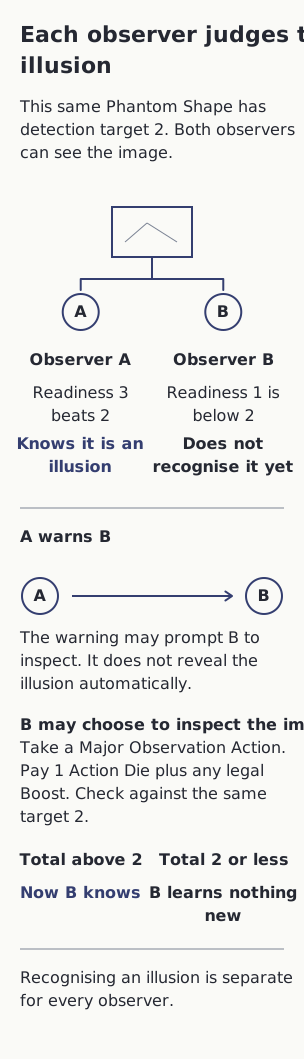
The image's detection target is your final casting total. At an observer's first meaningful view, the Guide compares their Observation Readiness with that target behind the screen. If their score exceeds it, they recognise the image as false. Otherwise they do not spot the illusion from that first view. They can still distrust it and choose their own actions.
To inspect it deliberately, a creature takes a Major Observation Action, paying 1 AD and any legal Boost AD, against that same target. Success reveals the image. An equal or lower result gives no new information. A failed inspection cannot be repeated on the same evidence; a new view of a previously hidden side or some other new clue may allow another. Merely paying again or moving back and forth does not. Physical contact immediately reveals the image's lack of substance to the creature making contact, without a separate detection check. Pay for any movement or other action needed to reach it normally.
An observer who recognises the image still sees where it appears, but can see through it. Their warning may give others a reason to inspect; it does not automatically change what others perceive.
You can maintain one Phantom Shape. A successful new casting replaces it. It also ends if your Trance ends or it leaves your range. Changing Scene Mode does not restart its minute.
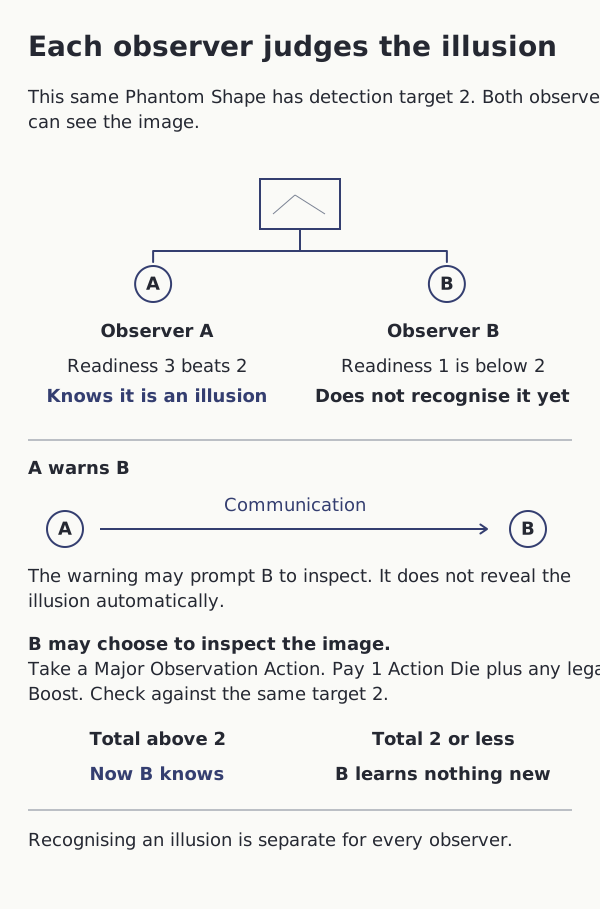

Read the diagram as text
The same Phantom Shape has detection target 2. At their first meaningful view, the Guide privately compares each observer’s Observation Readiness with 2.
- The image’s detection target is 2. Compare each observer separately with the same image.
- Observer A has Observation Readiness 3. Three is higher than two, so A knows it is an illusion and can see through it.
- Observer B has Observation Readiness 1. One is not higher than two, so B does not recognise it as an illusion yet. B is not compelled to trust it.
- A’s warning is communication only. It can give B a reason to inspect; it does not automatically change B’s perception.
- If B chooses to inspect, B pays for a Major Observation Action: 1 Action Die and any legal Boost. A final total above 2 reveals the illusion to B. A tie or lower gives B no new information.
Result: A’s recognition and warning do not automatically reveal the illusion to B.
- A failed inspection cannot be repeated on the same evidence. A new clue or previously hidden view may permit another attempt.
- Physical contact reveals the lack of substance to the toucher without a detection roll. Pay movement or action costs normally.
- Recognition does not end the spell or reveal it to everyone. The image supplies no physical cover or force.
- Veiled Face uses this detection procedure with its own detection target.
Veiled Face
Spell · Disguise. Choose yourself or one willing creature you can see within 6m per Insight level, with a clear path for your magic. Make an Insight casting check at Difficulty 1. On success, give the target one false facial appearance for ten minutes. It must fit the creature's actual head; it cannot alter their body, height, clothing, voice or movement. You may resemble someone whose face you have studied, but the disguise does not supply their memories, mannerisms or knowledge.
This is a visual disguise, not an instruction to believe or obey. Use ordinary Influence, Languages or other relevant checks when a lie, performance or document needs to be convincing. A familiar voice, a remembered scar elsewhere on the body or something the wearer says can reveal them without a magical contest.
Use Phantom Shape's detection procedure, with a detection target equal to your final Veiled Face casting total. A successful inspection reveals the false appearance to that observer. Touching the veiled face reveals the mismatch between the appearance and the real head to the creature making contact. The spell does not prevent someone identifying the wearer by other reliable evidence.
You can maintain one Veiled Face, and a creature can wear only one. A willing recipient chooses whether a new cast replaces one already present. The disguise ends if the recipient withdraws consent, your Trance ends or they leave range. Changing Scene Mode does not restart its duration. Recognising an illusion does not reveal every other spell or change anyone's desires.
Seer Traits
Far Sight
Trait.
Trigger: Declare a learned Seer spell that gives a range of 6m per Insight level, before paying for the casting.
Cost: One use of Far Sight.
Effect: For that casting, the written range becomes 12m per Insight level. Use that doubled range wherever the spell uses its caster's range, including to keep an ongoing spell in effect. Calculate it when you cast.
This changes distance only. It does not change touch, the patch or object used by Read the Trace, its one-hour history, an image's size or the time and kind of information a reading can reveal. You still need the spell's normal sight and clear magical path.
Example: You know Favour and have Insight 2. Far Sight lets you cast it on a willing ally 20m away, within its doubled 24m range. The Favour still aids only its named check and ends under its ordinary limits.
Lasting Vision
Trait.
Trigger: Declare Favour, Jinx, Phantom Shape or Veiled Face, if you have learned that spell, before paying for the casting.
Cost: One use of Lasting Vision.
Effect: Double that casting's ongoing duration:
- Favour or Jinx: until the start of your second Activation after the casting.
- Phantom Shape: two minutes.
- Veiled Face: twenty minutes.
The spell still ends early under its own ending conditions. It still affects the same number of checks or targets. This does not lengthen Read the Trace's history or Glimpse Ahead's planned-action window and glimpse: received information is immediate, not an ongoing spell.
Example: You cast Favour with Lasting Vision during your first Activation. If unused, it remains through your second Activation and expires at the start of your third. If the named check uses it sooner, it ends then.
Quiet Vision
Trait.
Trigger: Declare any learned Seer spell, before paying for the casting.
Cost: One use of Quiet Vision.
Effect: Cast that spell without an audible word or visible hand gesture. Its other requirements stay the same.
The trait does not hide you or the spell's visible effects, change a defence or prevent a valid response. A creature that does not notice your casting still has any fixed resistance the spell gives it.
Example: You create Phantom Shape without speaking or moving a hand. The image still appears normally. An observer can spot or inspect it through the spell's ordinary detection rules, and touching it still reveals its lack of substance.