
On this page
Steel remembers the hand that carries it. Armour remembers the blow.
Adventurers are shaped by what they carry. A sword changes how a warrior threatens space. A shield changes what an enemy can reach. Armour changes whether a clean hit becomes a wound. A tool kit changes what a clever character can attempt when the door is sealed, the bridge is broken, or the poison is already spreading.
Narateer treats equipment as practical, story-facing rules. Equipment should matter at the moment it changes the fiction. It should not slow play into accounting unless the burden, risk, or tactical choice is meaningful.
Gear is not a shopping list. It is a promise about what your character is ready to do.
What Is Equipment?
Equipment includes the weapons, armour, shields, tools, kits, supplies, and carried objects a character uses during play.
Equipment may define:
- Bulk, showing how difficult it is to carry, wear, wield, or transport.
- Cost, showing its relative purchase value.
- Weapon Damage, for attacks.
- Damage Vital Cap, limiting how much Vital force can be applied through a weapon.
- Physical Harm Type, such as Slashing, Piercing, or Impact.
- Base Attack Cost, the minimum AD committed to make an attack or exchange with the weapon before Boost.
- Reach Rating, showing how many Spaces away a melee weapon can reach in Tactical Mode and its relative reach in other Scene Modes.
- Range, showing a ranged weapon's Effective Range and Maximum Range in metres.
- Soak, reducing Wound Margin after a hit.
- Traits, giving special rules or fictional permissions.
Equipment Values
| Value | Meaning |
|---|---|
| Bulk | How difficult the item is to carry, wear, wield, or transport. |
| Cost | The item's approximate price in standard trade units. |
| Weapon Damage | The weapon's base contribution to Strike Rating. |
| Damage Vital Cap | The maximum value of the active Damage Vital that can be applied through the weapon. |
| Physical Harm Type | The formal Physical Type caused by the weapon or chosen attack. |
| Base Attack Cost | The minimum AD committed to make an attack or exchange with the weapon before Boost. Standard weapons cost 1 AD; weapons marked Heavy cost 2 AD. |
| Reach Rating | A melee weapon's relative reach. In Tactical Mode, the rating is the greatest number of Spaces away it can target. See Distance & Range. |
| Range | A ranged weapon's Effective Range / Maximum Range in metres. See Distance & Range. |
| Soak | Passive damage reduction, usually from body armour. |
| Traits | Special rules, qualities, or fictional permissions. |
Not every item uses every value.
A sword uses Weapon Damage. Armour uses Soak. A shield mainly uses Bulk, traits, fictional positioning, and cover. A rope mostly uses Bulk and fictional permission.
Bulk And Equipment
Equipment Bulk follows the rules in Bulk and Encumbrance.
Bulk covers how difficult an item is to carry, wear, wield, pack, drag, or transport. Heavy armour, large shields, packed gear, and awkward weapons do not need a separate speed value. Their burden is handled through Bulk and the character's encumbrance state.
Physical Harm Types
Physical weapons usually deal one or more of the Physical Types defined under Harm Domains And Types.
| Physical Harm Type | Meaning |
|---|---|
| Slashing | Cuts and tears from blades, edges, claws, and similar force. |
| Piercing | Punctures and penetration from points, arrows, bolts, spikes, and similar force. |
| Impact | Blunt blows, crushing, falls, collisions, pressure, and shockwaves. |
Many weapons can deal more than one Physical Harm Type. A sword may cut or thrust. A dagger may slash or stab. A halberd may cut with the blade, thrust with the point, or strike with force depending on its form.
Choose the active Physical Harm Type when declaring the attack. The table's Physical Harm Type heading establishes the Domain, so its entries use the short Type names; elsewhere, use the complete form, such as Physical (Slashing).
Weapons
Weapons are not only damage. They are reach, threat, leverage, timing, and fear.
A weapon defines how a character turns a successful attack into harm.
When a combatant wins an exchange and can deal damage, calculate Strike Rating. Compare the attack's chosen Damage Vital with the weapon's Damage Vital Cap. Use the lower number and add it to Weapon Damage.
Then calculate Wound Margin:
Wound Margin = Hit Margin + Strike Rating - Protection Rating
Weapon Damage represents the weapon's inherent lethality.
The active Damage Vital is the Vital permitted for the declared attack; see Choosing a Damage Vital.
The Damage Vital Cap limits how much of that Vital can be applied through that weapon.
Weapon Damage Scale
| Weapon Scale | Weapon Damage | Examples |
|---|---|---|
| Unarmed or harmless improvised strike | 0 | fist, shove, weak improvised blow |
| Small lethal weapon | 1 | dagger, light hammer, sling, throwing dart |
| Standard sidearm | 2 | arming sword, spear, mace, handaxe |
| Military weapon | 3 | longsword, battleaxe, falchion, warhammer |
| Heavy weapon | 4 | greatsword, halberd, heavy crossbow, maul |
Damage Vital Cap
A weapon's Damage Vital Cap limits the Vital value used in Strike Rating.
Compare your chosen Damage Vital with the cap. The lower number is the amount you add to Weapon Damage.
| Weapon Type | Typical Damage Vital Cap |
|---|---|
| Unarmed or tiny improvised weapon | 1 |
| Dagger or light weapon | 2 |
| Standard one-handed weapon | 3 |
| Military one-handed or versatile weapon | 4 |
| Heavy two-handed weapon | 5-6 |
| Siege, mounted, monstrous, or special weapon | Special |
Active Damage Vital
Your Damage Vital is the Vital your attack uses to calculate Strike Rating. Follow Choosing a Damage Vital to choose it when you declare the attack. The weapon's Damage Vital Cap limits the amount it adds.
Use the weapon's stated Hands, reach, range and equipment requirements. The ordinary catalogue has no minimum Strength gate. Weapon Damage, Bulk and Damage Vital Cap are not minimum Vital scores. Heavy still controls Melee Damage Vital choice; an ordinary Warbow shot uses Agility.
Shields
Armour takes the blow. A shield denies the blow a path.
Shields do not add to Strike Rating or Soak by default.
Shields matter through:
- fictional positioning;
- cover;
- reach and engagement;
- Class traits;
- traits;
- Guide rulings when the shield clearly changes what is possible.
Shields do not provide passive Soak by default because the attacker is usually trying to get around the shield and hit the person. Once a clean hit lands, armour and other protection decide how much harm gets through.
Find shield profiles in the Shield Table.
If a shield is on the character's back, hanging from a pack, dropped, or not positioned usefully, it does not help until brought back into the fiction.
Armour
Armour does not stop the enemy from touching you. It decides how much the touch matters.
Armour provides Soak.
Soak contributes to Protection Rating after an exchange is won against the wearer.
Protection Rating = armour Soak + other explicit modifiers, if any
Wound Margin = Hit Margin + Strike Rating - Protection Rating
Armour does not make the character harder to hit by default. Instead, it makes successful hits less damaging.
Find armour profiles in the Armour Table.
Only body armour provides default passive Soak.
Helms
Helms are not currently tracked as separate equipment.
For now, assume an armour set includes appropriate head protection for that armour type.
Development Note: Separate helm rules are unresolved. Helms may later become distinct equipment if the system gains called shots, location-based injuries, critical injury tables, or another clean reason to track head protection separately.
Armour Traits
Armour descriptions explain its material and construction. Padded cloth, mail links, overlapping plates and a complete harness can matter to the fiction. Their protection is already represented by the listed Soak.
These descriptions grant no additional resistance, Soak or reduction to Wounds. Apply an extra benefit only when an explicit rule states its trigger, amount, unit, timing and duration. A description alone does not activate another armour rule.
Weapon Table
Heavy applies only where it appears in Traits / Notes. A weapon's name, number of hands or Weapon Damage does not give it that marker. A Heavy Crossbow's ordinary shot uses Agility, following the projectile rule in Combat.
| Weapon | Weapon Damage | Damage Vital Cap | Physical Harm Type | Base Attack Cost | Hands | Reach Rating | Range (Effective / Maximum, m) | Bulk | Cost | Traits / Notes |
|---|---|---|---|---|---|---|---|---|---|---|
| Unarmed Strike | 0 | 1 | Impact | 1 | 1 | 1 | - | 0 | 0 | - |
| Dagger | 1 | 2 | Slashing / Piercing | 1 | 1 | 1 | 10 / 20 | 0 | 5 | Concealable |
| Throwing Dart | 1 | 2 | Piercing | 1 | 1 | - | 10 / 20 | 0 | 5 | Concealable |
| Throwing Knife | 1 | 2 | Slashing / Piercing | 1 | 1 | - | 10 / 20 | 0 | 5 | Concealable |
| Sling | 1 | 2 | Impact | 1 | 1 | - | 30 / 60 | 0 | 2 | Loading |
| Club | 1 | 2 | Impact | 1 | 1 | 1 | - | 1 | 1 | - |
| Light Hammer | 1 | 2 | Impact | 1 | 1 | 1 | 10 / 20 | 1 | 6 | - |
| Bow | 2 | 3 | Piercing | 1 | 2 | - | 60 / 120 | 1 | 50 | Loading |
| Warbow | 4 | 4 | Piercing | 1 | 2 | - | 120 / 240 | 2 | 160 | Loading |
| Hand Crossbow | 1 | 2 | Piercing | 1 | 1 | - | 30 / 60 | 1 | 120 | Loading |
| Arming Sword | 2 | 3 | Slashing / Piercing | 1 | 1 | 1 | - | 1 | 100 | - |
| Handaxe | 2 | 3 | Slashing | 1 | 1 | 1 | 16 / 30 | 1 | 10 | - |
| Battleaxe | 3 | 4 | Slashing | 1 | 1 | 1 | - | 1 | 40 | - |
| Dane Axe | 4 | 5 | Slashing | 2 | 2 | 2 | - | 2 | 60 | Heavy |
| Javelin | 2 | 3 | Piercing | 1 | 1 | 1 | 30 / 50 | 1 | 8 | - |
| Mace | 2 | 3 | Impact | 1 | 1 | 1 | - | 1 | 15 | - |
| Morningstar | 2 | 3 | Piercing / Impact | 1 | 1 | 1 | - | 1 | 20 | Armour-piercing |
| Rapier | 2 | 3 | Piercing / Slashing | 1 | 1 | 1 | - | 1 | 130 | Defensive |
| Spear | 2 | 3 | Piercing | 1 | Versatile | 2 | 20 / 40 | 1 | 10 | Set against charge |
| Trident | 2 | 3 | Piercing | 1 | Versatile | 1 | 16 / 30 | 1 | 30 | Set against charge |
| Quarterstaff | 1 | 3 | Impact | 1 | Versatile | 2 | - | 1 | 5 | Defensive |
| Falchion | 3 | 4 | Slashing | 1 | 1 | 1 | - | 1 | 80 | - |
| Longsword | 3 | 4 | Slashing / Piercing | 1 | Versatile | 1 | - | 1 | 120 | - |
| Messer | 3 | 4 | Slashing / Piercing | 1 | 1 | 1 | - | 1 | 80 | - |
| Scimitar | 3 | 4 | Slashing | 1 | 1 | 1 | - | 1 | 110 | - |
| War Pick | 3 | 4 | Piercing | 1 | 1 | 1 | - | 1 | 25 | Armour-piercing |
| Warhammer | 3 | 4 | Impact / Piercing | 1 | Versatile | 1 | - | 1 | 25 | Armour-piercing |
| Flail | 3 | 4 | Impact | 1 | 1 | 1 | - | 1 | 30 | Shield-bypass |
| Light Crossbow | 2 | 3 | Piercing | 1 | 2 | - | 80 / 160 | 2 | 140 | Loading |
| Heavy Crossbow | 4 | 4 | Piercing | 1 | 2 | - | 100 / 240 | 2 | 180 | Loading |
| Bardiche | 4 | 5 | Slashing / Piercing | 2 | 2 | 2 | - | 2 | 50 | Heavy, Set against charge |
| Billhook | 3 | 4 | Slashing / Piercing | 1 | 2 | 2 | - | 2 | 40 | Shield-bypass |
| Glaive | 3 | 5 | Slashing / Piercing | 1 | 2 | 2 | - | 2 | 50 | - |
| Greatsword | 4 | 6 | Slashing / Piercing | 2 | 2 | 2 | - | 2 | 150 | Defensive, Heavy |
| Halberd | 4 | 6 | Slashing / Piercing / Impact | 2 | 2 | 2 | - | 2 | 60 | Defensive, Heavy, Set against charge, Armour-piercing |
| Lance | 3 | 4 | Piercing | 1 | 1 mounted / 2 on foot | 3 | - | 2 | 50 | Mounted charge |
| Maul | 4 | 6 | Impact | 2 | 2 | 1 | - | 2 | 60 | Heavy |
| Partisan | 3 | 4 | Piercing / Slashing | 1 | 2 | 2 | - | 2 | 50 | Defensive, Set against charge |
| Pike | 2 | 4 | Piercing | 2 | 2 | 3 | - | 3 | 25 | Defensive, Heavy, Set against charge |
Hands and Weapon Requirements
Use the listed number of hands when attacking or making a Clash. Versatile permits one or two hands, with the same printed values unless another rule changes them. A Lance needs one hand while mounted or two hands on foot. Its Damage Vital Cap is 4 in either case; a mounted charge grants no automatic extra damage or cap.
There is no separate minimum Strength requirement in this catalogue. A Heavy weapon still uses its printed attack cost and the Heavy Melee Damage Vital rule. Loading weapons must be loaded and supplied with ammunition. Reach, room to use the weapon, a legal target and other established physical requirements still apply. Confirm them before commitment.
Ammunition Table
Buy ammunition in the bundles below. Cost is in Dritch; Bulk is for one bundle.
| Ammunition | Bundle | Cost | Bulk | Used by |
|---|---|---|---|---|
| Arrows | 20 | 2 | 0 | Bow, Warbow |
| Hand Crossbow Bolts | 20 | 3 | 0 | Hand Crossbow |
| Crossbow Bolts | 20 | 3 | 0 | Light Crossbow, Heavy Crossbow |
| Sling Bullets | 20 | 1 | 0 | Sling |
Armour Table
| Armour | Soak | Bulk | Cost | Traits / Notes |
|---|---|---|---|---|
| No Armour | 0 | 0 | 0 | - |
| Gambeson | 1 | 1 | 30 | Padded or reinforced layers |
| Leather | 1 | 1 | 40 | - |
| Studded Leather | 2 | 1 | 50 | - |
| Jack of Plates | 2 | 2 | 60 | Overlapping or rigid plates |
| Mail Hauberk | 3 | 2 | 180 | Linked, layered or reinforced protection |
| Scale Armour | 3 | 2 | 140 | Overlapping or rigid plates |
| Lamellar Armour | 3 | 2 | 130 | Linked, layered or reinforced protection |
| Brigandine | 3 | 2 | 160 | Padded or reinforced layers |
| Splint Armour | 4 | 3 | 190 | Linked, layered or reinforced protection |
| Plate Cuirass | 4 | 3 | 200 | Overlapping or rigid plates |
| Full Plate | 5 | 3 | 800 | Complete harness |
Shield Table
| Shield | Bulk | Cost | Traits / Notes |
|---|---|---|---|
| No Shield | 0 | 0 | - |
| Buckler | 1 | 10 | Small shield, parrying, close control |
| Targe | 1 | 25 | Compact shield |
| Rondache | 1 | 30 | Round shield |
| Kite Shield | 1 | 70 | Broad battlefield shield |
| Heater Shield | 1 | 75 | Standard serious shield |
| Pavise | 2 | 100 | Set cover |
Equipment And Combat Exchanges
When an exchange is won, equipment helps determine damage:
- Strike Rating: use the lower of the chosen Damage Vital and the weapon's Damage Vital Cap, then add Weapon Damage.
- Protection Rating: start with armour Soak, then apply any changes stated by other rules.
Follow Calculating Wounds for the full procedure.
Shields and defensive weapons may still matter through fiction, reach, cover, traits, positioning, and Class traits. They do not add a default extra defence pool to Combat Exchange.
Equipment Traits
Traits are short rules or permissions that make equipment distinctive.
| Trait | Meaning |
|---|---|
| Heavy | Marks a Heavy weapon. Its Melee attacks use the Heavy rule in Choosing a Damage Vital. |
| Light Weapon | Easy to draw, conceal, or use with quick movement. |
| Versatile | Can be used in one or two hands. |
| Set Against Charge | Describes a weapon suited to bracing against an approach; grants no automatic bonus. |
| Mounted Charge | Describes use from a charging mount; grants no automatic bonus. |
| Armour-Piercing | Describes a point or striking surface suited to armour; does not ignore Soak without an explicit rule. |
| Shield-Bypass | Describes ways to work around a shield; does not remove cover or grant a bonus without an explicit rule. |
| Cover | May provide the existing cover benefit when its actual position blocks the attack; use Combat Modifiers. |
| Defensive | Useful for parrying, controlling lines, threatening approach, or supporting Class traits. |
| Loading | Must be loaded before it can be fired or used for Ranged Clash. Firing leaves it unloaded whether the combatant wins or loses the exchange. |
Follow each trait's stated rule. Traits without a defined rule describe what the equipment may help you do, as the Guide confirms.
Loading Weapons
A weapon with the Loading trait must be loaded before it can be fired. Unless a weapon or special rule says otherwise, loading it is a Minor Action costing 1 AD before discounts and cost modifiers. Follow Paying Costs and Rolling Dice: an ordinary one-AD load costs 2 AD while Slowed, still with no roll. Quickload can reduce that one-AD cost to 0 before doubling, so it stays free. Loading requires no Skill Check and does not count as a proactive Ranged use.
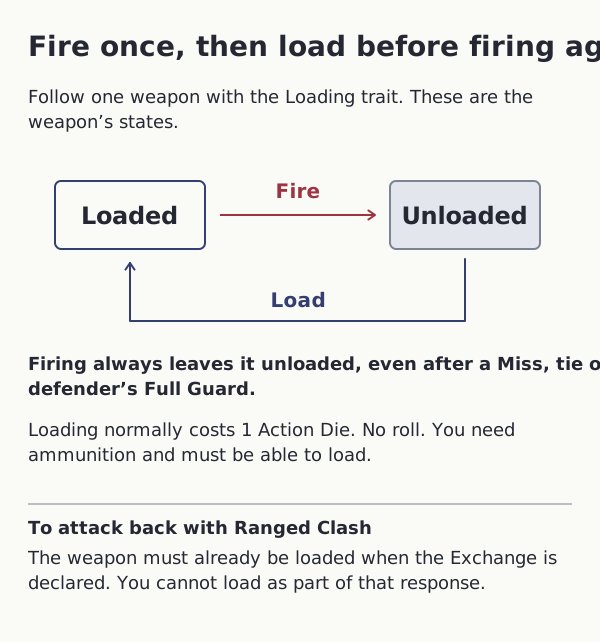
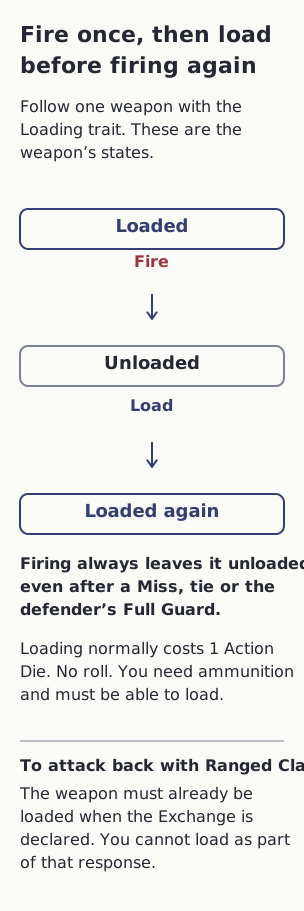
A loaded weapon remains loaded until it is fired, unloaded deliberately, or the fiction makes that state impossible. After it is fired, it becomes unloaded whether the attack wins, loses, is stopped by Full Guard, or ends in a tie.
A combatant may use a Loading weapon for Ranged Clash only if it is already loaded when the Ranged Exchange is declared.

Read the diagram as text
Follow one weapon with the Loading trait. Loaded and Unloaded are the weapon’s states.
- A loaded weapon may fire when the attack is otherwise legal. Pay the attack’s normal costs and meet its requirements.
- Firing leaves the weapon unloaded whether the attack wins, loses, misses, ties or is stopped by the defender’s Full Guard.
- Before firing again, load it. Loading is ordinarily a one-AD Minor Action before discounts and cost modifiers, with no roll. It requires ammunition and the weapon’s physical requirements.
- For Ranged Clash, check the state when the Ranged Exchange is declared. The weapon must already be loaded; loading cannot be inserted into that response.
Result: Every fired shot leaves the weapon unloaded. Reloading is a separate legal action, and Ranged Clash requires loaded state at declaration.
- Loading does not use up one of the Ranged actions you can start on your turn. Normal turn timing, attack limits, declarations, costs and response requirements still apply.
- An ordinary one-AD load costs two AD while Slowed, without adding a roll. Apply discounts first: Quickload can make that base cost zero, which stays zero when doubled.
- The weapon’s loaded/unloaded states are separate from its wielder’s Ready/Used AD states. A loaded weapon retains its state across turns until one of its stated ending events.
Example: Armour In A Combat Exchange
Brom carries an arming sword, a heater shield, and wears mail.
If Brom is hit, his mail contributes Protection Rating through Soak 3.
The heater shield may still shape the fiction, justify cover, or interact with traits and Class traits, but it is not part of a default extra defence formula.
Example: Full Plate Against A Weak Strike
A low-level attacker hits a knight in Full Plate.
The attacker has:
- Hit Margin 1.
- Active Damage Vital 2.
- Weapon Damage 2.
- Damage Vital Cap 3.
The Damage Vital is 2, below the cap of 3. Add all 2 points to Weapon Damage 2: 2 + 2 = Strike Rating 4.
Wound Margin:
Hit Margin 1 + Strike Rating 4 - Full Plate Soak 5 = 0
The attack lands, but it does not meaningfully wound the knight.
Example: Dagger In Strong Hands
A very strong character attacks with a dagger.
The attacker has:
- Strength 6.
- Dagger Weapon Damage 1.
- Dagger Damage Vital Cap 2.
Strength 6 is above the dagger's cap of 2, so use only 2 points of Strength. Add Weapon Damage 1: 1 + 2 = Strike Rating 3.
The character's strength matters, but the dagger cannot carry all of it. A small weapon remains dangerous, not absurd.
Tips
Players
Choose equipment that matches how you fight. Armour makes you harder to wound. A heavy weapon lets you apply more force. A light weapon gives flexibility, speed, and concealability. A shield shapes positioning, cover, and defensive fiction. Carrying everything makes you ready for anything until Bulk makes you slow.
Narateer Guides
Use equipment to support clear fictional choices. Do not punish players with hidden gear math. Tell them when their shield changes position or cover, when their armour absorbs the blow, and when a weapon's reach, weight, or form changes the scene.
Keep traits simple until they matter.
Summary
- Equipment: Equipment includes weapons, armour, shields, tools, supplies, and carried objects.
- Carried Bulk: Equipment Bulk follows the Bulk and Encumbrance rules.
- Weapon Damage: Weapons provide Weapon Damage.
- Armour Soak: Armour provides passive Soak.
- Shields: Shields matter through positioning, cover, traits, Class traits, and fiction.
- Helms: Helms are included in armour sets for now and have no separate mechanics.
- Strike Rating: For Strike Rating, use the lower of the chosen Damage Vital and the weapon's cap, then add Weapon Damage.
- Wound Margin: Wound Margin = Hit Margin + Strike Rating - Protection Rating.
- Vital cap: Damage Vital Cap limits how much Vital can be applied through a weapon.
- Equipment traits: Traits make equipment distinct but can remain descriptive until used by the Guide or another rule.
- Loading: Loading a Loading weapon is normally a 1 AD Minor Action. It must already be loaded to be used for Ranged Clash.
- Bulk: Bulk measures how difficult equipment is to carry, wear, wield, or transport.