
On this page
Find the route. Choose the moment. Change the detail that matters.
A Rogue makes an opening through movement, concealment or a precise touch. You might cross a crumbling roof, leave a watcher searching the wrong shadows, or put a knife exactly where it will hurt. Your Skills make these attempts possible. Your traits develop particular ways of making them count.
Narrative Prompt: “What door was closed to you, and what did you learn opening it?”
Rogue Paths
Daredevil · Acrobatics
Keep your footing, evade a weapon and risk a last chance when a dangerous manoeuvre goes wrong.
- Traits: Sure Footing, False Step, Last Chance.
Phantom · Stealth
Choose an attack from concealment, move quietly between hiding places and make yourself harder to find.
- Traits: Ambush, Quiet Step, False Trail.
Viper · Finesse
Place a knife precisely, interfere with a mechanism and put a small object where it needs to be.
- Traits: Exact Cut, Fine Work, Fast Hands.
Read Class Traits to learn how to use your traits. To gain Class levels and trait ranks after creation, see Character Development.
Starting Kit
When you start as a Rogue:
- Begin at Rogue level 1.
- Share 3 Skill Levels between Acrobatics, Stealth and Finesse. Put at least one level into two of these Skills.
- Add the Skill Levels from your Origin. Your final level in each of these three Skills cannot exceed your Agility. Check the Linked Vitals of any other Skills your Origin grants too.
- Choose one trait at rank 1 from a Path whose Skill you have trained. You start with one use of that trait.
- Take 120 Dritch and buy your equipment. Add any money or equipment from your Origin separately.
Quick Starts
- Daredevil — find a way through. Take two levels in Acrobatics and one in Stealth. Choose Sure Footing at rank 1. A Dagger costs 5 Dritch and Leather 40. You spend 45 Dritch, leaving 75. Before crossing a dangerous route, declare Sure Footing and Boost your Acrobatics check.
- Phantom — slip out of sight. Take two levels in Stealth and one in Acrobatics. Choose False Trail at rank 1. Buy a Dagger and Leather for 45 Dritch, leaving 75. Describe how you hide and the false clue you leave, then declare False Trail with your boosted Hide check.
- Viper — place the knife. Take two levels in Finesse and one in Acrobatics. Choose Exact Cut at rank 1. The Guardian of the Mists Origin gives you a level in Melee, so you can Boost your dagger attacks. Buy a Dagger and Leather for 45 Dritch, leaving 75. When a boosted dagger attack wins, decide whether to use Exact Cut after finding its Wound Margin.
These are starting suggestions. Change them to suit your character. Add your Origin's training before checking your Skill limits: two Acrobatics levels from Rogue and one from your Origin need Agility 3. Find other purchases in Equipment.
Path of the Daredevil
Path Skill: Acrobatics. Keep your balance, turn aside from danger and trust your nerve when a risky move goes wrong.
Daredevil traitsSure FootingFalse StepLast Chance
3 traits
Sure Footing
Trigger: Before an Acrobatics check to keep your balance or cross a physical route, declare Sure Footing. Boost the check with at least 1 AD.
This must be a separate balance or route check, not an attack or Full Guard.
Cost: One use of Sure Footing.
Effect: Add +1 to your check total.
Example: Your balance check totals 1 against Difficulty 1. Sure Footing raises your total to 2, so you succeed.
False Step
Trigger: When an enemy starts a Melee Exchange against you, choose Full Guard. If you can physically evade the attack, declare False Step as you commit your response. Boost it with at least 1 AD, before either of you rolls.
Cost: One use of False Step.
Effect: Use Acrobatics instead of Melee for this Full Guard's roll and Boost limit.
Example: You have Melee level 1 and Acrobatics level 3. False Step lets you use Acrobatics for this Full Guard, so you can Boost it with up to 3 AD instead of 1.
Last Chance
Trigger: Your boosted Acrobatics check to cross a route or avoid a physical hazard would fail, after Edge, rerolls and modifiers. Before resolving the failure, declare Last Chance if one of your dice still shows a Miss.
The check must be outside a Combat Exchange. Before the original roll, the Guide must have established that failure could cause Physical Wounds.
Cost: One use of Last Chance.
Effect: Reroll one Miss. Keep its new result. Use Last Chance only once for this check.
If the check finally fails, add 1 Wound to the hazard's Physical harm after Protection and Wound Conversion, but before Wound prevention and application. Use the hazard's Physical Type.
Example: Your leap totals 1 against Difficulty 1. Reroll a Miss: a Hit raises your total to 2 and saves the leap. Another Miss leaves you falling. If that fall would normally cause 2 Wounds, it causes 3 before Wound prevention.

Read the diagram as text
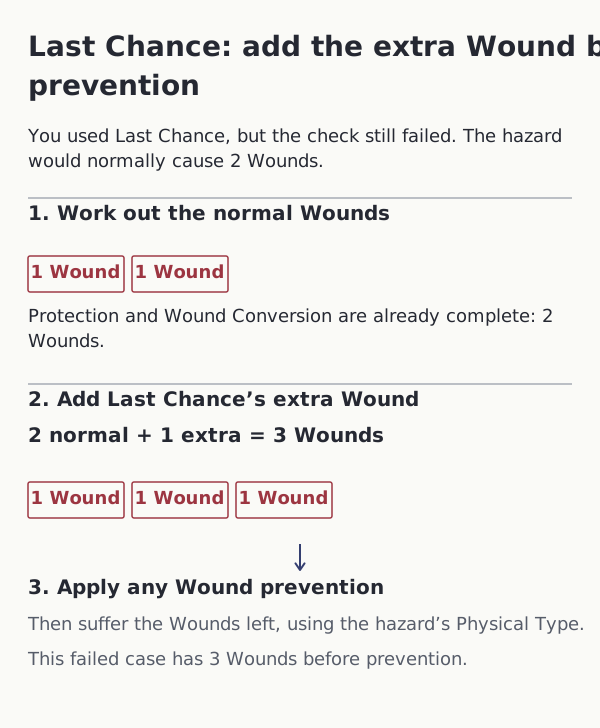
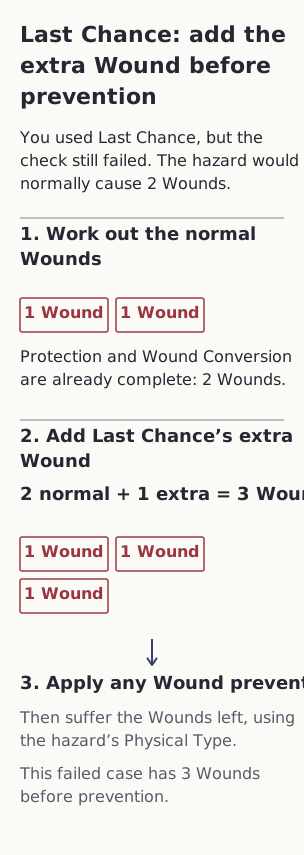
You used Last Chance, but the check still failed. This hazard would normally cause 2 Wounds.
- After normal Protection and Wound Conversion, this hazard would cause 2 Wounds.
- Add Last Chance’s extra Wound: 2 + 1 = 3.
- Apply any Wound prevention, then suffer the Wounds left, using the hazard’s Physical Type.
Result: Last Chance makes the normal two Wounds into three before prevention. Prevention may then reduce them.
- Before the original roll, the Guide must establish that failure could cause Physical Wounds. Last Chance requires a boosted Acrobatics check to cross a route or avoid a physical hazard, outside a Combat Exchange.
- After Edge, rerolls and modifiers, the check must still be about to fail with a Miss remaining. Before resolving failure, spend one Last Chance use to reroll one Miss and keep its replacement. Use it only once for this check.
- If the final check succeeds, resolve its ordinary successful outcome. One Hit on a die does not necessarily make the whole check succeed.
- Last Chance has no separate Action Die or Reaction cost. This picture illustrates only the final failed case.
Path of the Phantom
Path Skill: Stealth. Use concealment, quiet movement and misleading traces to choose when others can find you.
Phantom traitsAmbushQuiet StepFalse Trail
3 traits
Ambush
Trigger: During your Activation, start a Melee or Ranged Exchange against a creature you are hidden from. Boost your attack with at least 1 AD and declare Ambush before the target chooses a response.
Cost: One use of Ambush.
Effect: Add +1 to your attack total if you remain hidden from the target until you roll. Being revealed before the roll loses the bonus.
Example: You throw a dagger from hiding. Your attack total of 2 becomes 3. If the target's Clash total is 2, you win by 1.
Quiet Step
Trigger: Once during your Activation, while hidden from at least one observer, declare Quiet Step before moving. Choose one continuous concealed stretch of your normal Walk or Run. You must have movement left.
Cost: One use of Quiet Step.
Effect: For up to 6m of that stretch, moving while hidden costs no extra movement. Use your existing movement allowance.
The stretch ends when you reach 6m, take another Action, finish your Activation or are no longer hidden from any observer. A Reaction pauses your movement; its consequences may end the stretch. Any unused distance is lost.
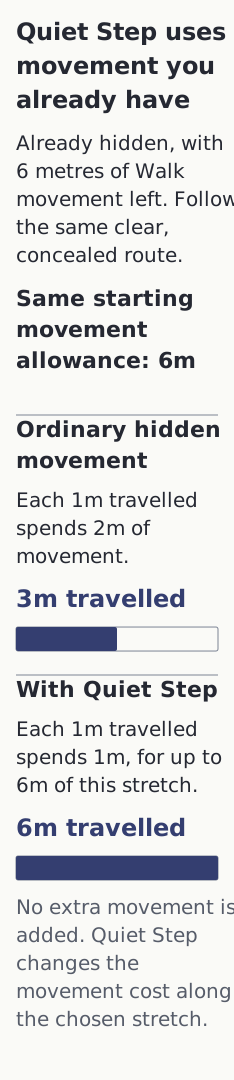
Example: You have 6m of Walk movement left. Quiet Step lets you sneak 6m along a clear, concealed route instead of the usual 3m. Difficult terrain still uses twice as much movement.
Read the diagram as text
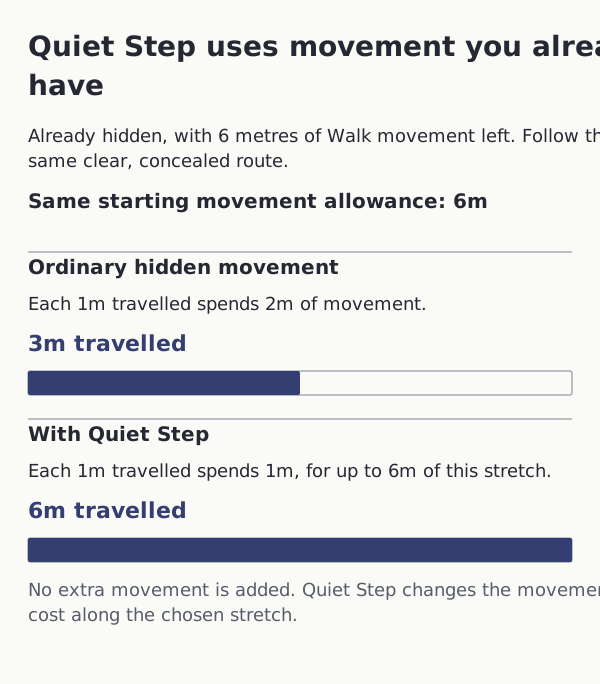
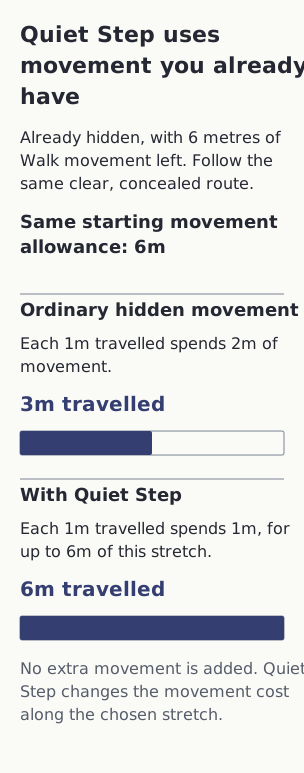
You are already hidden, have 6 m of Walk movement left, and follow a clear, concealed route.
- Start already hidden from at least one observer, with 6 m of Walk movement left on a clear, continuous, concealed route.
- Ordinary hidden movement spends 2 m of movement for each 1 m travelled. The 6 m allowance covers 3 m.
- Declare Quiet Step before moving. For up to 6 m of the chosen stretch, each 1 m travelled spends 1 m of movement. The same allowance covers 6 m.
Result: With Quiet Step, you travel 6 m instead of 3 m along this route. Your movement allowance has not increased.
- Spend one Quiet Step use. Declare it once during your Activation, before moving, while hidden from at least one observer and with movement left. Choose a continuous concealed stretch of your normal Walk or Run.
- The stretch ends when you reach 6 m.
- It also ends if you take another Action or finish your Activation.
- It ends when no observer still counts you as hidden. You can continue while you remain hidden from at least one observer.
- A Reaction pauses movement; its consequences may end the stretch. Any unused Quiet Step distance is lost.
- Difficult terrain still costs twice as much movement. Ordinary movement and Opportunity Attack rules still apply.
False Trail
Trigger: Before a new Hide check, describe a false clue or camouflage that helps hide your presence or location. Declare False Trail and Boost the Stealth check with at least 1 AD.
Cost: One use of False Trail.
Effect: Add +1 to your Hide total. Record the improved total as your Hide result.
Example: You roll 1 against a guard with Observation Readiness 1. False Trail raises your total to 2, so you hide from that guard. Your recorded Hide total is now 2.
Path of the Viper
Path Skill: Finesse. Use a precise hand to place a cut, change a mechanism or move a small object at the right moment.
Viper traitsExact CutFine WorkFast Hands
3 traits
Exact Cut
Trigger: After your boosted Melee attack with a Dagger wins, check its normal Wound Margin. If it is at least 1, you may declare Exact Cut before Wound Conversion. The attack must have struck anatomy you can reach and understand.
Cost: One use of Exact Cut.
Effect: Add +2 to that attack's Wound Margin.
Apply the bonus only to this hit on your declared target.
Example: Your dagger hit has Wound Margin 4, which would cause 2 Wounds. Exact Cut raises the margin to 6, causing 3 Wounds instead.
Fine Work
Trigger: Before a Finesse check to interfere with an existing nonmagical mechanism, choose a control or fastening you have identified and can reach. Agree on your method, required tools, target and consequences with the Guide. Declare Fine Work and Boost the check with at least 1 AD.
Cost: One use of Fine Work.
Effect: Add +1 to your check total.
Example: You have found an alarm's exposed spring and explain how you will jam it. Your Finesse total of 1 becomes 2 against Difficulty 1, so your plan succeeds.
Fast Hands
Trigger: Once during your Activation, before a Minor Action that normally costs 1 AD to draw, stow or pass one object. Choose an object within reach that fits in one usable hand: something you carry, something unattended, or something a willing holder offers.
Cost: One use of Fast Hands.
Effect: Reduce that handling Action's base cost from 1 AD to 0.
Example: You need to sheathe your dagger under pressure, which takes a 1-AD Minor Action. Fast Hands lets you do it for 0 AD.