
On this page
Intent becomes consequence.
An Action is how a character deliberately changes the fiction. Describe what your character wants and how they try to achieve it. The Guide then confirms what the fiction permits, whether dice are needed, and which rule resolves the attempt.
What Is an Action?
An Action is a discrete attempt that the rules treat as a use of a character's effort. An Action may be proactive because the character initiates it, or reactive because a rule allows it in response to a specific Trigger.
Ordinary speech and rules language are not always identical. A player may describe several movements, gestures, or words, but the Guide identifies which parts—if any—are separate mechanical Actions. Movement may already be covered by the character's chosen movement mode, and an Exchange Response occurs within an existing Combat Exchange rather than creating another Action.
Every declared Action should make two things clear:
- Intent: What does the character want to change?
- Method: How are they trying to change it?
Principle: State intent and method first. Procedure and cost follow from what the character actually does.
Declaring an Action
- The Guide presents the situation. Describe the relevant opportunities, obstacles, threats, and stakes.
- The player declares intent and method. First person ("I leap the gap") and third person ("Selka leaps the gap") are equally valid.
- The Guide confirms the ruling. Establish whether the attempt is possible, which procedure applies, and what must be committed before the player spends dice or resolves the outcome.
If the declaration is unclear, ask what the character wants to achieve and how they are doing it. Do not make the player guess a hidden procedure before describing their character's approach.
Resolving an Action
Once intent and method are clear, check for a specific procedure first:
- Specific procedure: If another rule governs the attempt, use that rule. Common examples include a Combat Exchange, a movement mode, spellcasting, equipment, or a Class trait. That procedure supplies its own requirements and may include a Skill Check.
If no specific procedure applies, use the first path that fits:
- Automatic outcome: If the result is already certain and no meaningful uncertainty remains, the Guide narrates what happens. This may be success or an obvious consequence of the declared method.
- Impossible as declared: If the method cannot achieve the intent in the current fiction, the Guide identifies the obstacle. The player may revise the declaration before committing dice or other resources.
- Skill Check: If the attempt is risky, dramatic, contested, or meaningfully uncertain, follow Resolving an Active Skill Check.
Guide Principle: Roll when both success and failure can matter. If the outcome is settled, say what happens and keep play moving.
Changing Scene Mode
Changing Scene Mode does not resolve an Action. It changes how the scene is represented and how much positional detail play requires. The Guide may shift Scene Mode before resolving an attempt, but must preserve the declared intent and any outcomes already established. See Shifting Scene Modes.
Action Tiers and Costs
Action Tiers provide a general cost for an Action that has no more specific rule. Judge the whole attempt by the effort, attention, and time it demands in the current fiction rather than measuring each small motion separately.
| Action Tier | General Cost | Use When | Typical Examples |
|---|---|---|---|
| Trivial Action | 0 AD | The attempt is immediate, unopposed, and requires no roll. | Speak briefly, release a held object, open an unresisted door. |
| Minor Action | 1 AD | The attempt requires meaningful effort or attention but no Skill Check. | Load a Loading weapon, pull a stiff lever, secure ordinary gear under pressure. |
| Major Action | Stated cost; otherwise at least 1 AD | The attempt requires a Skill Check or another substantial procedure. | Make a Skill Check, initiate a Combat Exchange, Sprint, or cast a spell identified as a Major Action. |
A specific rule always takes precedence over the general Action tiers. It may set the Action Tier, Base Cost, required dice, permitted Boost, timing, or other restrictions. Do not charge separately for activity already covered by that procedure: a movement mode pays for its normal movement, a weapon's Base Attack Cost pays to initiate its Combat Exchange, and a spell's Casting Cost pays for its casting.
A generic Action resolved with a Skill Check is a Major Action and requires at least 1 AD unless a specific rule says otherwise. A similar intent may have a different tier when the method or circumstances change. Opening an unbarred door is Trivial; hauling open a heavy but unopposed door may be Minor; forcing a barred door under pressure may require a Major Athletics Skill Check.
Several Trivial Actions that together demand meaningful time, effort, or attention may be treated as one Minor Action. The Guide states this before the player commits to the sequence.
Paying Costs and Rolling Dice
The dice you pay and the dice you roll are not always the same. Follow the attempt's rule to determine its roll, including any legal Boost and explicitly granted bonus dice. Apply cost modifiers to its payment. Extra AD paid only to cover an increased cost are spent, but are not rolled and do not count as Boost.
- Choose the attempt and Boost. Identify the required roll dice, any legal Boost dice and any explicitly granted bonus dice.
- Apply discounts. Apply each discount only to the cost it modifies: the base cost, Boost or a particular additional fee.
- Apply cost modifiers. While Slowed, double the resulting AD payment, including AD Boost and additional AD fees. A cost of 0 AD stays 0. MD payments and trait uses do not change.
- Confirm affordability. You need enough Ready dice for the entire modified payment. If you cannot afford it, choose a smaller legal Boost or another legal option before committing. An illegal declaration spends nothing.
- Pay and resolve. Commit the full payment at the attempt's usual timing, then resolve its ordinary roll, if any. AD paid only for an increased cost add no dice to that roll.
Keep every die committed to the payment unavailable for further spending. After resolution, spent AD become Used under the normal procedure. If Wounds or another part of resolution already moved a die, keep that result; never move it back or return it twice. This needs no extra dice state.
Apply each modifier once to each payment. For example, an Opportunity Attack pays its modified attack cost once; being both a Reaction and an attack does not double it again. Modify a later trait's own payment when its Trigger occurs, without charging the attack again. A higher payment does not increase healing, refresh amounts or other fixed effects.
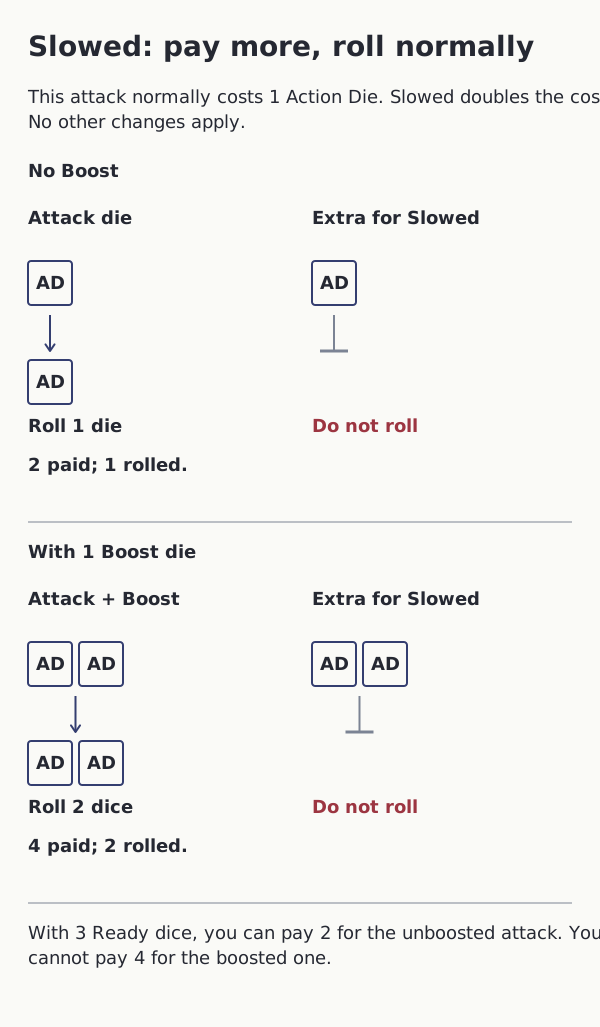
Example: While Slowed, a base-one attack with no Boost costs 2 AD and rolls 1 die. It has Boost 0. With Boost 1, it costs 4 AD and rolls 2 dice. With only 3 Ready AD, you can afford the first choice, but not the second.

Read the diagram as text
This attack normally costs 1 Action Die. Slowed doubles its cost. No other discounts, fees, cost changes or roll-die changes apply to these examples.
- This attack normally costs one Action Die. Choose how many Boost dice to add, within your Skill limit. Apply applicable discounts first, then Slowed doubles the resulting Action Dice payment.
- With no Boost, pay two Action Dice: one for the attack and one extra for Slowed. Roll only the attack’s one die.
- With one Boost die, pay four Action Dice: one for the attack, one genuine Boost die and two extra for Slowed. Roll only the attack die and genuine Boost die: two dice.
- The extra Action Dice paid for Slowed are not rolled and are not Boost. In this ordinary example, all paid dice become Used after resolution.
- With only three Ready Action Dice, the unboosted attack is affordable but the four-die payment is not.
Result: The Slowed attack with one Boost die pays four Action Dice but rolls two dice.
- Choose a smaller legal Boost or another legal option before committing if the full payment is unaffordable. An illegal declaration spends nothing.
- These are payment roles, not new dice states. Paid dice remain unavailable until resolution; never move a die twice if resolution has already moved it.
- Slowed also modifies additional Action Die fees, but not Magic Dice payments or trait uses. Zero Action Dice stays zero.
- Apply each modifier once per payment. Increased payment grants no extra Boost, healing, Refresh or other fixed effect.
Actions During Your Activation
Your turn is your chance to act; the Actions you take during it form your Activation. Follow Combat to enter a fight, choose who goes next and take turns. An Exchange Response or Reaction during another character's turn does not use your own turn.
Narateer does not grant a fixed allotment such as one Major Action and one Minor Action. During your activation, you may initiate any legal mix of Actions you can afford, subject to:
- your available Ready AD and any other required resources;
- one chosen movement mode per turn;
- the proactive-use limit of each Skill you initiate; and
- restrictions imposed by the fiction, conditions, equipment, or specific rules.
Action Tiers establish costs, not action slots. Keeping AD Ready instead of spending it preserves your ability to pay AD costs for later Exchange Responses or Reactions.
Common Actions
Describe what you want to achieve and how your character tries to do it. These common Actions explain how familiar attempts work. You can try other things whenever the situation allows.
An Action’s name does not always determine its cost. Opening an unlocked door may be Trivial. Forcing a barred door under pressure may require an Athletics Skill Check. The Guide confirms the rule and cost before you spend resources.
Follow a specific rule when one applies. Pay for each attempt once. The printed costs below are before discounts and modifiers; follow Paying Costs and Rolling Dice.
Attack
To harm a creature with a weapon or an unarmed attack, initiate a Melee or Ranged Exchange. Follow Combat for costs, Exchange Responses and damage.
Describe other combat goals clearly. You might try to disarm someone, push them away from a doorway or hold them still.
If no specific rule covers the attempt, the Guide names the Skill, target and possible results before you commit dice. Success achieves the agreed result. It does not also deal Wounds unless a rule says so.
Cast a Spell
Follow the spell’s requirements and the rules in Magic. Its Casting Cost pays for the casting. Do not add another cost simply because casting is an Action.
The spell’s visible, audible and other effects determine what nearby creatures can notice.
Move
Choose Walk, Run or Sprint and follow Movement.
You may divide your ordinary movement around other Actions when the route and situation allow. Continuing that movement does not restore movement already spent or make you pay its cost again.
Terrain, Conditions and specific rules may limit movement or increase its cost.
Assist
Describe something you do that could help another character’s Skill Check.
Assist is a Reaction. Declare it after the Guide confirms the originating Skill and target, but before that character commits dice. Follow Assist in Skill Checks for its requirements, cost and result.
Help that requires a separate task must first complete that task. Opening a gate for an ally has its own result. It does not also grant Advantage automatically.
Hide
Hide to conceal your presence or location from creatures that might notice you. Describe where you hide and how you avoid giving yourself away.
You hide from particular creatures. You may be hidden from a guard outside a doorway while someone inside the room can see you clearly.
When You Can Hide
You need something that prevents the creature from clearly seeing or otherwise locating you. This might be a solid barrier, thick foliage, darkness or a suitable distraction.
Consider the creature’s other senses. Darkness does not silence footsteps, and a wall does not hide shouting. You cannot Hide from a creature that clearly perceives your position. You must first change the situation.
Being out of sight does not always hide your location. Someone who watched you step behind a pillar still knows where you went.
Making the Check
When there is a meaningful chance of detection, make a Stealth Skill Check with a base cost of 1 AD and any legal Boost. Follow Skill Checks for payment and rolling.
Make one roll for the attempt. Compare your final total separately against each creature that could notice you:
- Not actively looking for you: Compare against its Observation Readiness Score.
- Actively looking for you: The creature makes an Observation Skill Check. Compare against its final total instead of its Readiness Score.
A creature actively looking must be searching a place or following clues that could reveal you. Being alert or knowing that danger is nearby does not by itself count as an active search.
An active Observation check has a base cost of 1 AD plus any legal Boost. Apply each character’s own cost modifiers. If both sides roll for the same attempt, both commit their full payments before either rolls.
You become hidden from each creature whose score or total you exceed. A tie or lower total means you fail to hide from that creature. You may succeed against some creatures and fail against others.
Record your final Stealth total while you remain hidden. Later attempts to find you use this result.
Failure does not let a creature see through a solid wall. It notices only what its senses could reveal, such as your arrival, footsteps or last position.
If there is no meaningful chance of detection, no check is needed. If a creature later has a chance to notice you, resolve the uncertain Hide attempt then.

Read the diagram as text
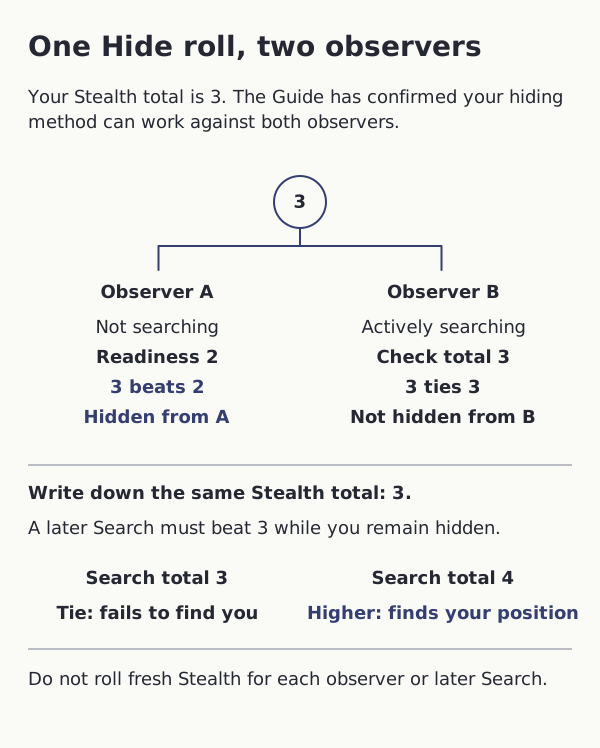
You rolled a Stealth total of 3 while trying to hide from these two observers. The Guide has confirmed that your hiding method can work against both.
- The Guide confirms a plausible hiding method that can prevent both observers from clearly locating you. Pay normally and resolve one Stealth check; its final total is 3.
- Observer A is not actively searching, so compare against Observation Readiness 2. Your 3 exceeds 2: you are hidden from A.
- Observer B is actively searching a relevant place or clues and rolls Observation total 3. Your 3 ties that 3: you fail to hide from B.
- Write down the original Stealth total 3 while you remain hidden. Do not roll fresh Stealth for each observer or for a later Search.
- A later legal Search against the already-hidden character must exceed the stored 3. A Search total of 3 fails for the searcher; a total of 4 finds your position for that observer.
Result: You are hidden from A only. Keep the original total 3 as the target for later searches while hidden.
- Being alert is not itself an active search. Readiness and an active Observation check are different forms of opposition.
- If both sides roll for the same Hide attempt, both commit their full payments before either rolls.
- Hidden is relative to each observer. Finding you reveals your position to that observer, not automatically everyone.
- Failed Hide does not permit seeing through walls. Observers learn only what their senses could reveal; clear perception reveals your position without a roll.
- Normal movement, reveal, targeting and unchanged-evidence restrictions still apply. Three is a check total, not a single die face.
What Being Hidden Does
A creature you are hidden from cannot locate you precisely enough to target you directly. It may still know you are nearby, remember your last position or affect an area that includes you.
Hiding does not make you physically invisible. Cover, visibility and other senses still matter. Follow Combat when an attack involves an unseen creature.
You remain hidden until something reveals you. Starting or ending an Activation does not itself end hiding.
Moving While Hidden
You may Walk or Run while remaining hidden. Follow a continuous legal route that keeps you concealed from the relevant creature.
Each metre travelled while hidden costs twice its normal movement cost. This uses your ordinary movement allowance. It grants no extra movement.
Apply terrain costs too. Moving 1m through Difficult terrain normally costs 2m of movement. While hidden, that same metre costs 4m.
You cannot use ordinary Sprint movement while remaining hidden.
Moving along a suitable concealed route does not itself require another Stealth check. Keep your recorded Hide result.
If a new creature could notice you, compare that result against its Observation Readiness Score. If it is actively searching, it makes an Observation Skill Check as described under Search.
Example: You have 12m of Walk movement left. You can sneak 6m along an ordinary concealed route, or 3m through Difficult terrain.
Being Revealed
You are no longer hidden from a creature when it clearly perceives your position or finds you with Search.
Stepping into clear view reveals you immediately. A sound or other clue also reveals you if it clearly identifies your position. If the clue only creates a chance of discovery, the Guide resolves that uncertainty through Observation.
Making an attack, including a Clash or Opportunity Attack, reveals your position to its target after the Exchange resolves. If your approach exposes you before the attack, you are revealed at that earlier point. Other creatures notice whatever their senses allow. For an Invisible creature, revealing a position does not end the effect making it invisible; follow unseen attacks for targeting and later attacks.
Casting, speaking or using equipment may reveal you through the sounds, movements or other effects they produce. The Guide explains an obvious revealing consequence before you commit to the Action.
Once revealed, you must create suitable circumstances and Hide again to conceal yourself from that creature.
Search
Search when you deliberately examine a place, object or set of clues. Describe what you inspect and how you inspect it.
The Guide confirms what the attempt covers. A Search does not automatically inspect a whole room, open sealed compartments or let you see through barriers.
If your method would certainly find something, the Guide describes it without a roll. If discovery is uncertain and the result matters, make an Observation Skill Check with a base cost of 1 AD and any legal Boost. Follow Skill Checks for payment and rolling.
For a concealed object or clue, the Guide sets the target based on how it is hidden and how you search.
Finding something does not always explain it. Observation might reveal a strange powder, while Alchemy identifies what it does.
Finding a Hidden Creature
You must search a place or examine clues that could reveal the creature’s current position.
If the creature is already hidden, compare your final Observation total against its recorded Hide total. You locate it if your total is higher. A tie or lower total fails.
If the creature is attempting to Hide during your search, resolve its Stealth check against your Observation check as described under Hide. Use one Observation roll for that search attempt; do not roll again for the same contest.
Finding a creature reveals its position to you. Other creatures learn what they can perceive or what you communicate.
When a Search Fails
A failed Search does not prove that nothing is there. The Guide explains what failure risks before you commit dice.
Repeating the same search without changing anything does not grant another roll. A different method, new evidence or a meaningful further investment of time may allow another attempt.
Use Equipment or the Environment
Describe what you use and what you want to happen.
Follow any specific equipment rule first. Otherwise, use the general Action tiers. A simple, immediate interaction may be Trivial. Substantial effort may be Minor. A risky or contested attempt may require a Skill Check.
Moving an object, opening a passage or changing your surroundings can create an opportunity without granting a numerical bonus.
Attempt Something Else
You may negotiate, distract, climb, repair, investigate or try something else that fits the situation.
State your goal and method. The Guide checks for a specific procedure first. If none applies, the Guide decides whether the result is certain, the attempt is impossible as described or a Skill Check is needed.
Before you commit resources, establish what success achieves and what failure risks.
Proactive Skill Uses
During your activation, each Skill limits how many times you may proactively initiate it:
Proactive Skill Uses = Skill Level + 1
Minimum = 1 proactive use, even at SL 0.
Each proactive Action that uses a Skill consumes one use of that Skill. An Action that uses no Skill consumes no proactive Skill use, although it may still cost AD. Exchange Responses and Reactions are not proactive Actions and do not consume these uses.
For example, a character with Melee SL 2 may proactively initiate Melee up to three times during their activation. They could shove, feint, and initiate a Combat Exchange as three separate uses, provided they can pay every required cost and the fiction permits each attempt.
See Character Skills for the complete Skill Level table.

Read the diagram as text
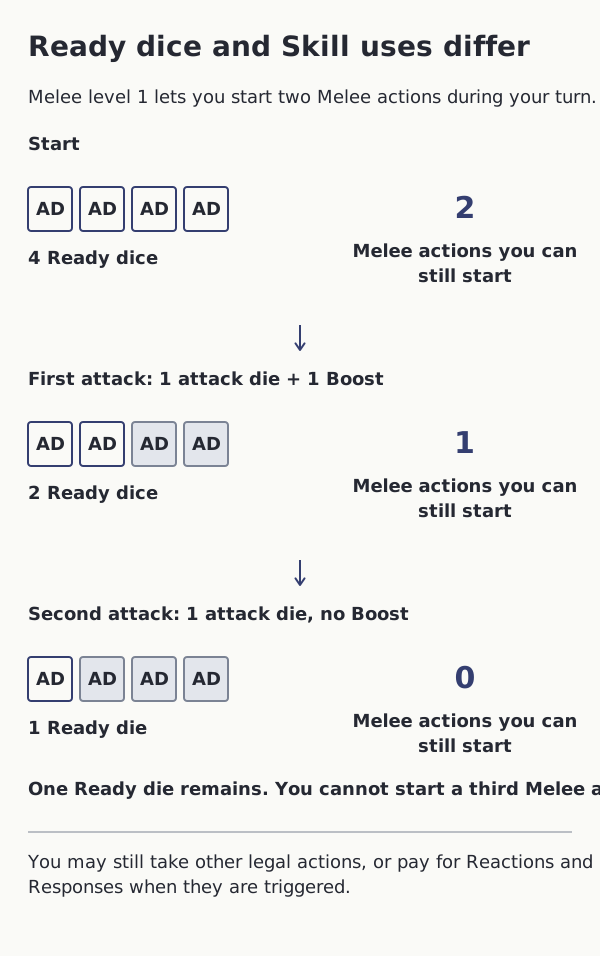
With Melee Skill Level 1, you may start at most two Melee actions during your turn. These are proactive uses. Only the four Ready dice you can spend are shown below.
- Begin with four Ready Action Dice and Melee Skill Level 1. The separate proactive Melee-use counter is two.
- Start a Melee attack with base cost one and Boost one. Spend two Action Dice and one Melee use. Two Ready dice and one Melee use remain.
- Start a second Melee attack with base cost one and no Boost. Spend one Action Die and the final Melee use. One Ready die and zero Melee uses remain.
- Do not start a third Melee Action this turn. The Ready die does not replace a proactive use.
- Other legal actions remain possible. A triggered, eligible and affordable Reaction or Exchange Response does not consume a proactive Skill use.
Result: The Ready-dice counter goes 4 → 2 → 1 while the Melee-use counter goes 2 → 1 → 0. Both limits matter.
- You can start an action using each Skill up to Skill Level + 1 times on your turn, with at least one use. Each action you start uses one of those uses, whether it succeeds or fails.
- Responses still need their normal Trigger, awareness, position and full payment. Their counters do not reset during a response.
- There is no fixed allotment of Major or Minor action slots. This example uses ordinary costs and excludes Slowed or other changes.
Boosting an Action
Boosting applies to any Skill Check, whether it is made as a proactive Action, Reaction, or response. Choose extra Boost AD up to the Skill Level being tested, then calculate and commit the full modified payment before rolling. AD paid only for an increased cost are not Boost dice. Follow Paying Costs and Rolling Dice.
Actions, Exchange Responses, and Reactions
| Procedure | What It Is | Proactive Skill Use? | Cost |
|---|---|---|---|
| Proactive Action | A separate Action the character initiates to pursue an intent. | Yes, if it uses a Skill. | The Action Tier or specific procedure. |
| Exchange Response | A choice made as the responder within an existing Combat Exchange. | No. | The chosen Response's cost. |
| Reaction | A separate Action permitted in response to an explicit Trigger. | No. | The Reaction's stated cost. |
All three procedures follow Paying Costs and Rolling Dice. An Exchange Response is not exempt from Slowed: Full Guard and Clash pay their modified AD costs. This changes neither their category nor their proactive-use accounting.
Reactions
A Reaction may occur whenever its Trigger occurs, including during your own activation. A Reaction does not count against a proactive Skill-use limit.
A Reaction is available only when a rule explicitly identifies it as one and its full Trigger is satisfied. Follow the exact timing and cost stated by that rule. The resources named by that rule, along with awareness, positioning, and the fiction, limit whether the Reaction can be taken.
For Class traits, the Trigger names the exact Event that permits the trait. A trait that only modifies its triggering Event is not a Reaction unless its rule explicitly says otherwise.
An Opportunity Attack is a Reaction to a completed movement step within melee reach. Follow its written timing and cost.
Exchange Responses Are Not Reactions
When another combatant with Tempo initiates a Combat Exchange against you, choosing No Response, Full Guard, or Clash is an Exchange Response within that same Exchange. You are participating as its responder; you are not taking a separate Action or Reaction.
An Exchange Response is not prevented by a rule that says you cannot take Reactions. For example, Stunned does not remove Full Guard or Clash through its Reaction restriction; the condition's other effects still apply normally.
A Class trait declared as part of Full Guard or Clash modifies that Exchange Response. It remains a Response unless it explicitly creates a separate Reaction. A trait that triggers after the Exchange resolves may create a Reaction if its rule says so.
Summary
- Declare intent: Declare the character's intent and method before choosing procedure or cost.
- Choose a procedure: Use the specific procedure that governs an Action. Otherwise, resolve it automatically, reject it as impossible as declared, or make a Skill Check.
- Specific procedures: Specific procedures override the general Action Tiers and are paid only once.
- Pay the cost: Action Tiers set costs, not fixed action slots. Apply discounts before cost modifiers and afford the full payment. Extra AD paid only for an increased cost grant no roll dice and are not Boost.
- Proactive uses: During your activation, proactive uses of each Skill equal SL + 1, minimum 1.
- Boost: Any Skill Check may be Boosted within the tested Skill Level unless its rule says otherwise.
- Responses and Reactions: Exchange Responses belong to their Combat Exchange. Reactions are separate triggered Actions and may occur during or outside your activation.