
On this page
A hand upon a wound. A voice beside a grave. A prayer that burns.
The gods were broken in the Sundering. You carry something of their presence into the world: mercy, a duty to the dead or a fire that demands an answer. In Trance, you turn some of your own Action Dice into Magic Dice and shape that devotion into spells.
Narrative Prompt: “Which broken god’s presence do you carry, and what does it ask of you?”
Cleric Paths
Each Path offers spells to learn and traits to improve them. Choose your spell and your trait separately.
Shepherd · Medicine
Mend wounds, cleanse afflictions, shelter others and steady a frightened mind.
- Spells: Restoring Light, Cleansing Touch, Shield of Grace, Burden of Mercy, Soothing Word, Aura of Resolve.
- Traits: Restoring Grace, Distant Mercy, Steady Prayer.
Charnel Prophet · Occult
Hear the dead, tend undead bodies, bind a servant and wield deathly force.
- Spells: Whisper to the Dead, Funeral Seal, Bonebound Servant, Mend the Dead, Sever the Binding, Grave Lance.
- Traits: Echoing Invocation, Far Communion, Final Authority.
Devouring Flame · Influence
Strike with divine fire, brand a foe, draw a foe’s wrath and speak with terrible authority.
- Spells: Judgement Flame, Brand of Flame, Challenge of Flame, Consecrate Weapon, Righteous Command, Oath of Truth.
- Traits: Kindled Judgement, Searing Conviction, Wrath Undenied.
Learning Your Magic
Each Cleric level, including level 1, gives you one new spell and one rank in a trait. Make these two choices separately:
- Learn one spell you do not already know. Choose from any Path whose Skill you have trained to at least level 1.
- Add one trait rank. Choose a new trait at rank 1 or increase a trait you already have, within your rank limit. Its Path Skill must also be at least level 1.
Your spell and trait can come from different Paths. At Cleric level 4, you know four spells and have four ranks across your traits.
Spells are your magical tools. Traits help you do more with those tools. Once learned, a spell stays in your repertoire. You can cast it whenever you meet its requirements; casting spends dice, not a trait use. More ranks give you more uses of a trait. When those uses run out, you can still cast your learned spells.
For example, at Cleric level 1 you could learn Restoring Light and choose Restoring Grace at rank 1. At level 2, learn Shield of Grace and raise Restoring Grace to rank 2. You now know two spells and have two uses of Restoring Grace. You could instead choose Distant Mercy at rank 1; either way, the new spell is a separate choice.
A trained Path Skill counts as a Cleric magic Skill once you know a spell from that Path. If it falls to level 0, keep its spells and trait ranks, but stop using that Path's magic until you restore the training. Follow Magic when qualifying Skills change.
Read Class Traits for uses, recovery and Events, and Character Development for advancement costs and ranked-trait limits.
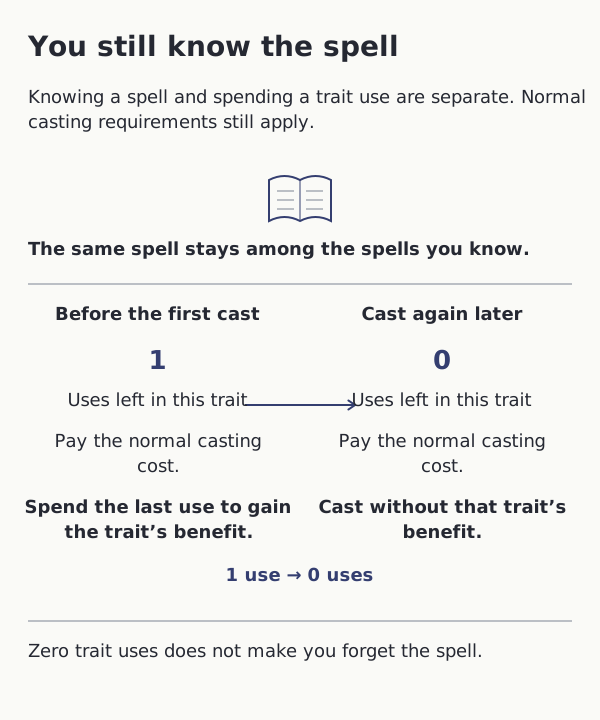

Read the diagram as text
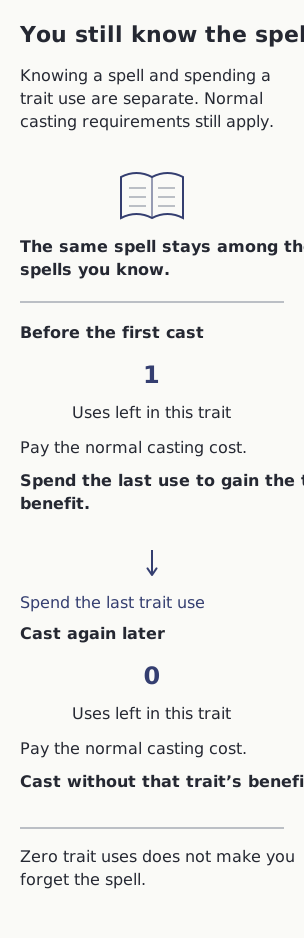
You know a spell and have a trait that can help it. You meet both sets of requirements and have one trait use left. Knowing the spell and using the trait are separate.
- Keep the learned spell written among the spells you know. Record one use left in the trait that helps it.
- On the first cast, pay the normal casting dice and spend one trait use at its Trigger. This cast gets the trait’s benefit; the trait now has zero uses left.
- Keep the learned-spell entry unchanged. On a later cast, pay the normal casting dice again. You can cast the spell without the exhausted trait’s benefit.
Result: Zero uses left in a trait does not make you forget a learned spell.
- A trait use does not pay an Action Die or Magic Die cost.
- Trance, trained Path Skill, targeting and all other casting requirements apply to both casts.
- This shared example applies to Primant, Cleric and Mage. Advancement and trait ranks follow Character Development.
Casting Your Magic
You must be in Trance to cast any Cleric spell. Follow Magic for casting costs, Boost and dice movement, and Trance Actions for entry and deepening. You use the shared Magic Pool.
Cleric casting requires an audible prayer or a visible hand sign. One is enough. You need no purchased holy focus. A spell may require something real to work upon, such as a corpse.
You must see the target and have a clear line of effect unless the entry says otherwise. Touch means actual contact. Unless a spell gives another procedure, cast it as a Major Action, using one proactive use of its Path Skill. Every spell makes a casting check, which you can Boost. A tie or lower result fails.
See Spell Timing for how short spells use turns and carry into a fight. Use Distance & Range in every Scene Mode. Changing Scene Mode preserves positions, elapsed time and effects already resolved.
Starting Kit
- Begin at Cleric level 1.
- Share 3 Skill Levels between Medicine, Occult and Influence. Give at least one level to two of them.
- Add your Origin's training, then check Skill caps. Medicine and Occult cannot exceed Cognition; Influence cannot exceed Presence.
- Choose one spell and one trait at rank 1 independently. Each choice needs its Path Skill at level 1 or higher. Begin with one use of the trait.
- Take 120 Dritch for equipment. Add your Origin's money and owned gear separately.
Quick Starts
- Shepherd — bring someone back into the struggle. Take Medicine 2 and Influence 1; learn Restoring Light and choose Restoring Grace at rank 1. Buy Leather for 40 Dritch and a Mace for 15, leaving 65 Dritch of Class money. Restoring Grace can strengthen a boosted healing cast.
- Charnel Prophet — let a dead witness speak. Take Occult 2 and Influence 1; learn Whisper to the Dead and choose Echoing Invocation at rank 1. Buy Leather for 40 Dritch, a Quarterstaff for 5 and a Dagger for 5, leaving 70 Dritch. Echoing Invocation lets you reroll a Miss in your casting check. Find remains through play; this kit grants no corpse.
- Devouring Flame — answer a threat with divine fire. Take Influence 2 and Medicine 1; learn Judgement Flame and choose Kindled Judgement at rank 1. The Leather, Quarterstaff and Dagger kit leaves 70 Dritch. Keep Ready AD beside your MD so you can Boost the attack and kindle it.
Combine a recipe with your Origin before checking Skill caps. If you already own an item, do not buy it again. Use the prices and profiles in Equipment.
Path of the ShepherdSpellsRestoring LightCleansing TouchShield of GraceBurden of MercySoothing WordAura of ResolveTraitsRestoring GraceDistant MercySteady Prayer
6 spells · 3 traits
Path Skill: Medicine. You work upon the body and mind, bringing relief where an ordinary touch cannot reach quickly enough.
Shepherd spells that name a distance reach 6m per Medicine level. Instant healing and cleansing remain after your Trance ends. Follow Magical Healing for collapse states and waking Prone.
Shepherd Spells
Restoring Light
Spell · Healing. Touch one willing creature, including yourself, or a creature unable to consent that has not refused your aid. It must not be Deceased. Make a Medicine casting check at Difficulty 1.
On success, look up your casting total in Magic Conversion. Restore that many points of Vitality through magical healing. Each point normally returns one Wounded AD to Ready; use Death & Recovery's special procedure for a Critical or Dying creature. Healing stops at the target's maximum Vitality.
Example: Your total is 5, which converts to 3 points of healing. For a Dying ally, the first sets Vitality to 0. The other two bring them to 2 Vitality and return two Wounded AD to Ready. They wake Prone.
Cleansing Touch
Spell · Cleansing. Touch one willing creature, or one unable to consent that has not refused aid. Choose one source of Lingering Harm affecting it. The Difficulty is the number of Wounds that source would cause at its next tick, with a minimum of 1. Make a Medicine casting check against that Difficulty.
On success, end that source of Lingering Harm. This can cleanse a poison, close continuing bleeding or remove a harmful magical residue. It does not heal Wounds already suffered. Remove an external cause too if it would impose the harm again: a creature still standing in fire can start burning again.
Example: A venom causes two Wounds at each tick. Your total of 3 exceeds Difficulty 2 and ends that source. A separate bleeding wound remains until treated.
Shield of Grace
Spell · Protection. Choose yourself or one willing creature in range. You may protect a creature unable to consent that has not refused your aid. Make a Medicine casting check at Difficulty 1. On success, look up your casting total in Magic Conversion: the result is the shield's Protection bonus.
Against the next successful attack on the recipient, add that bonus to its Protection Rating before Wound Conversion, whatever the attack's Harm Domain. Then the shield ends, even if the attack caused no Wounds. It does not alter a hit or protect against Wounds that bypass the attack's Protection calculation. If that attack is recalculated, retain this bonus once.
You can maintain one Shield of Grace, and a creature can have only one. A successful new casting replaces yours. A willing recipient chooses whether to replace a shield from another caster; if unable to choose, keep the stronger, or the new one if equal. This bonus does not add to another spell's Protection bonus: use the greater one.
The shield ends at the start of your next Activation. It also ends if your Trance ends or the recipient leaves range.
Example: A hit would have Wound Margin 5. Your shield's bonus of 2 lowers it to 3, changing three Wounds to two. The shield is then spent.
Burden of Mercy
Spell · Intercession. Cast this as a Reaction when another creature in range would suffer Wounds from one attack. Act after other harm adjustments, before those Wounds are applied. You must be aware of the hit and able to react. Pay the normal casting cost and make a Medicine casting check at Difficulty 1.
On success, look up your casting total in Magic Conversion. Move up to that many of the attack's Wounds from the recipient to yourself; choose how many, up to the Wounds still incoming. The other creature suffers the remainder. Your transferred Wounds have the attack's Harm classification and bypass your Protection. Apply Wounds and any Continuation Check to each creature for its final share.
Transferred Wounds cannot be transferred again. Only one Burden of Mercy may alter the same attack's batch of Wounds. Resolve competing offers in the participant order from Resolving Traits Together; only the first legal offer pays. This spell cannot take its own costs, another offering or harm you already suffered.
Example: An ally would suffer three Wounds. Your total of 3 permits you to take up to two. You take two and the ally takes one; your armour does not reduce those two again.
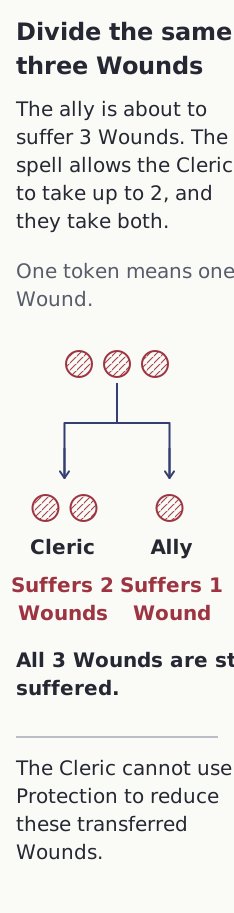
Read the diagram as text
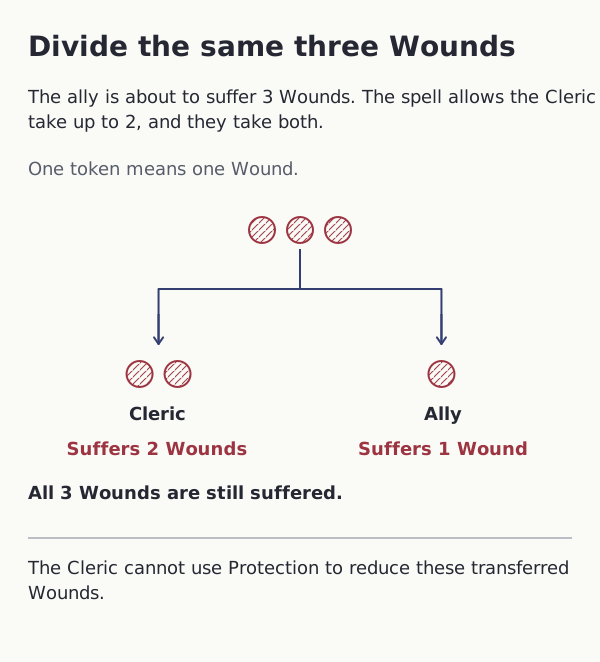
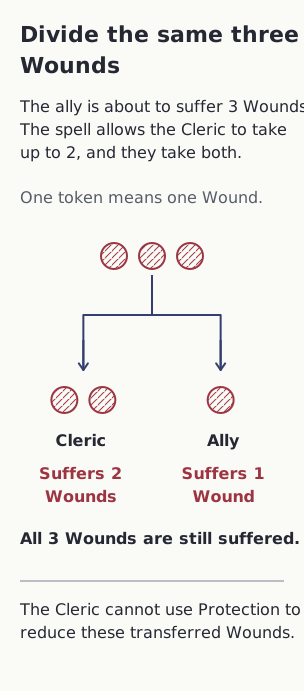
After other harm adjustments, an ally has 3 Wounds incoming from one attack. The spell lets the Cleric take up to 2 Wounds. The Cleric chooses to take both.
- Resolve other harm adjustments first. Before the attack’s three Wounds are applied, the Cleric casts Burden of Mercy as a Reaction.
- The Cleric’s Medicine casting total of 3 beats Difficulty 1. Magic Conversion permits taking up to two Wounds.
- The Cleric chooses to take both permitted Wounds. Move two of the three identical Wound tokens to the Cleric and leave one with the ally.
- Apply two Wounds to the Cleric and one to the ally. Do not reduce the transferred Wounds with the Cleric’s Protection.
Result: The Cleric suffers 2 Wounds and the ally suffers 1. No Wound is removed or copied.
- Transferred Wounds retain the attack’s Harm classification and cannot be transferred again.
- Apply any Continuation Check normally to each creature’s final share.
- Trance, awareness, ability to react, range and normal casting costs still apply.
- Only one Burden of Mercy can alter the same attack’s Wounds. Competing offers follow participant order; only the first legal offer pays.
Soothing Word
Spell · Mercy. Choose yourself or one willing creature in range that can hear your prayer. Name one effect currently making it Unnerved or Panicked. Make a Medicine casting check at Difficulty 1.
On success, end that instance of the Condition. Another source can still impose its own Condition; you have not silenced the fear's source or made the recipient immune to future fear. The spell changes no memories, loyalties or decisions. A source that continuously imposes the Condition can impose it again while the creature remains exposed.
Example: You settle an ally's panic after a terrifying apparition has passed. They can act without that Panicked effect. A separate curse making them Unnerved remains.
Aura of Resolve
Spell · Courage. Choose yourself or one willing creature in range and make a Medicine casting check at Difficulty 1. On success, the recipient has Advantage on rolled Skill Checks to resist fear or control of its mind or decisions until the start of your next Activation.
It still pays for any active resistance and uses the Skill its defence calls for. The aura changes no fixed Readiness score and gives no extra check against an effect that permits none. It does not end a Condition already in place.
You can keep one Aura of Resolve. A successful new casting ends your previous aura. A creature can have one; a willing recipient chooses whether to accept a replacement. It also ends if your Trance ends or the recipient leaves range.
Example: A foe tries to frighten your protected ally. The ally pays for the permitted Insight resistance and rolls it with Advantage. If they choose their fixed Insight Readiness instead, the aura adds nothing to that score.
Shepherd Traits
Restoring Grace
Trait.
Trigger: Declare a Shepherd spell and Boost its casting check with at least 1 of your own AD, before rolling.
Cost: One use of Restoring Grace.
Effect: Add +1 to that casting check's final total.
Example: Restoring Light's total of 2 becomes 3. Magic Conversion changes its healing from one point to two.
Distant Mercy
Trait.
Trigger: Declare a Shepherd spell, before choosing its target and committing dice.
Cost: One use of Distant Mercy.
Effect: For this casting and its ongoing effect, add 6m to the spell's target range. A touch spell instead reaches 6m. This changes how far away you can choose and keep its target, without enlarging an area or removing another requirement.
Example: With Medicine 2, Shield of Grace normally reaches 12m; Distant Mercy extends it to 18m. Restoring Light instead reaches 6m, replacing touch.
Steady Prayer
Trait.
Trigger: Declare a Shepherd spell and Boost its casting check with at least 1 of your own AD, before rolling.
Cost: One use of Steady Prayer.
Effect: You have Advantage on that casting check.
Example: You Boost Cleansing Touch, then use Steady Prayer. Resolve its casting check with Advantage against the harm source's Difficulty.
Path of the Charnel ProphetSpellsWhisper to the DeadFuneral SealBonebound ServantMend the DeadSever the BindingGrave LanceTraitsEchoing InvocationFar CommunionFinal Authority
6 spells · 3 traits
Path Skill: Occult. You work with a dead body's memory, give its remains another task and recognise the bindings that should be broken.
Charnel Prophet spells that name a distance reach 6m per Occult level. Binding a corpse does not call its former owner back to life or give you their Skills and secrets.
Charnel Prophet Spells
Whisper to the Dead
Spell · Communion. Choose the remains of one dead creature in range that could understand and remember in life. A recognisable skull or substantial remains are enough; they need no spell mouth. Name one subject you want to ask about, then make an Occult casting check at Difficulty 1, or against a Funeral Seal protecting the remains, if higher.
On success, look up your casting total in Magic Conversion. Ask that many short questions about the subject. You receive brief words or sensory impressions from the creature's memories. The answers report what it believed or perceived in life, including an honest lack of knowledge. They reveal no later events, future choices or truths it never knew, and do not translate an unknown language.
Ask the questions during this casting. Repeating a question, rewording it or using another caster gives the same remembered answer. New evidence can make a genuinely different question possible. A different subject needs another casting. Follow Magic's scene-pressure rules rather than treating repeated casts as a free conversation outside time.
Example: Your total of 3 permits two questions about the courier's last journey. You learn which gate they used and whom they met there. They cannot identify an unseen killer simply because they are dead.
Funeral Seal
Spell · Funeral ward. Touch the remains of one dead creature and make an Occult casting check at Difficulty 1. On success, record your final total as the seal strength. For eight hours, a spell attempting to animate those remains, question their memory, possess them or bind their deceased spirit through them must exceed that strength with its casting check. Use the greater of the seal and the spell's ordinary target number, not two checks.
You may let one declared casting through your own seal when you are aware of it. Otherwise it resists your magic too. A casting that gets through resolves normally and ends the seal. The seal does not undo an existing animation, protect a living body or prevent physical damage to the remains.
You can keep one Funeral Seal. A successful new one ends yours already in place before applying the new seal. On remains protected by another caster, keep only the greater seal strength; equal strengths keep the earlier expiry. A discarded seal ends. The seal continues through lost Trance, distance, Scene Resets and your Rest. Moving the remains does not end it.
Example: A seal strength of 4 stops a raising check of 4. A later check of 5 gets through and ends the seal before the animation takes effect.
Bonebound Servant
Spell · Animation. Choose a largely intact, roughly human-sized corpse or skeleton in range that is not already animated. The Guide confirms its injuries before you pay. Make an Occult casting check at Difficulty 1, or against its Funeral Seal if higher. Success animates it for one hour per Occult level; record your casting total as its binding strength.
Keep the cast's base MD committed in your Magic Pool under Ongoing Effects. It cannot be spent or refreshed. If it becomes Wounded or leaves your pool, the animation ends. Otherwise it stays committed through a Scene Reset. When the animation ends, return it to Used AD unless another effect has already moved it.
Servant Profile
| Vitals | Vitality / AD | Movement | Protection |
|---|---|---|---|
| Cognition 1, Presence 1, Resilience 1, Agility 2, Strength 1 | 4 | 11m | 0 |
The servant uses this profile, without its former memories or abilities. Melee, Acrobatics, Athletics and Observation are level 1; other Skills are level 0. Its bone-hand attack costs 1 AD, reaches 1m and deals Physical (Impact) harm: Weapon Damage 1 + Strength 1, with Damage Vital Cap 1, gives Strike Rating 2. You may give it real equipment.
It uses its own AD under ordinary creature rules and cannot grant Synergy. A word or sign it perceives gives one simple task as a 0 AD Trivial Action; the task continues until completed, replaced or impossible. It uses its own senses and acts immediately after your Activation, even if you cannot act. Allow one servant Activation and start-turn Refresh per Round, even if you replace the servant or two fights join. If it starts the fight or enters separately, follow Companions and Servants for its place in the order.
You can animate one servant; a successful replacement ends the old animation. An undamaged new body has four Ready AD. Keep each body's injuries and dice states: reanimation neither heals nor refreshes it, and inert remains take no turns. At 0 Vitality it falls inert without Recovery Rolls or Last Gasp; repair it with Mend the Dead before reanimating it. Ordinary healing cannot repair this body. It needs no breath or food and is immune to Bleeding, Poison and Disease.
The body also falls inert when the duration expires, your Trance ends, it leaves this spell's range or you dismiss it as a 0 AD Trivial Action on your Activation. Changing Scene Mode preserves its turns and dice states.
Example: With Occult 2, the servant can carry supplies for two hours while you hold its MD and remain in Trance. It uses its own AD if danger interrupts.
Mend the Dead
Spell · Undead healing. Touch one willing undead creature, or the repairable remains of an undead body, and make an Occult casting check at Difficulty 1. The Guide confirms that enough of an inert body remains to repair it before you pay.
On success, look up your casting total in Magic Conversion. Restore that many points of Vitality, returning Wounded AD to Ready up to the creature's own maximum. Apply its healing and collapse rules, including a Necrokin's magical-healing reduction. This does not restore a living nature, revive the Deceased or restart an ended animation. Repairing an inert servant leaves it inert until animated again; Used dice do not refresh.
Example: An undead guard has 2 of its maximum 6 Vitality. Your total of 5 repairs three Wounds, bringing it to 5 Vitality. It need not be your servant.
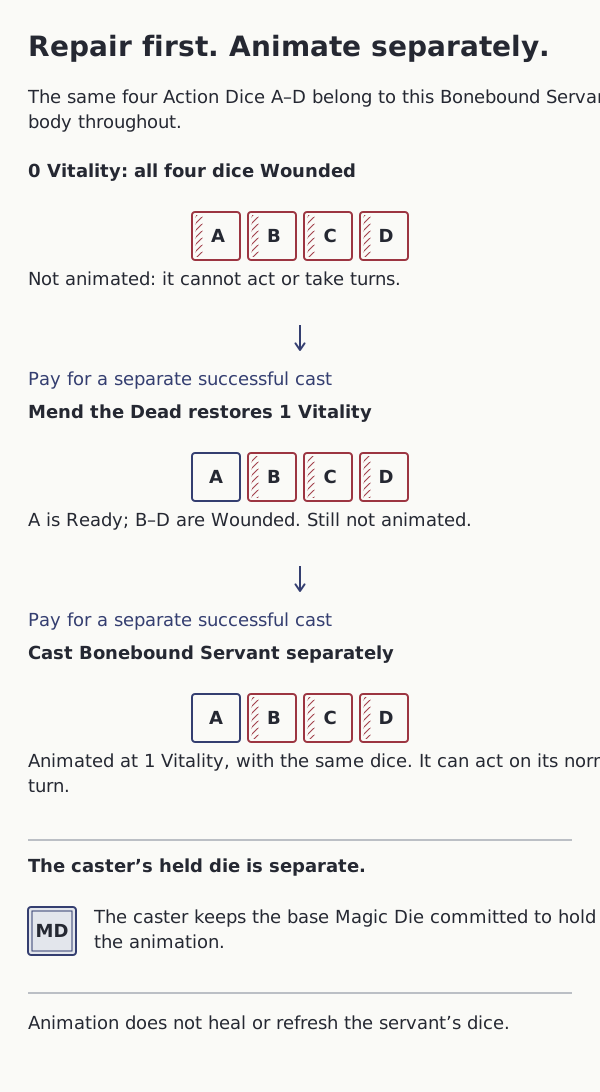

Read the diagram as text
The same four Action Dice, labelled A–D, belong to this repairable Bonebound Servant body throughout. It begins at 0 Vitality with all four dice Wounded.
- At 0 Vitality, the Bonebound Servant body is inert: it is not animated, cannot act and takes no turns. Its four Action Dice A–D are Wounded.
- Pay for and successfully cast Mend the Dead to restore one Vitality. Die A returns to Ready; B, C and D remain Wounded.
- The repaired body remains inert. A separate successful Bonebound Servant casting, with its own payment, is required to animate it.
- After animation, the servant still has one Ready Action Die, three Wounded Action Dice and one Vitality. The caster holds the animation’s base Magic Die committed separately.
Result: Repair restores Vitality; animation lets the servant act. The second spell does not heal or refresh its dice.
- Any Used dice also keep their state when the body is reanimated.
- Allow one servant turn and one start-turn Refresh per Round, including across replacements. Animation grants neither an extra turn nor another Refresh in the same Round.
- Both spells retain their normal requirements and separate costs.
- This is a Bonebound Servant body, not revival of a Deceased character or a Necrokin healing example.
Sever the Binding
Spell · Sever animation. Choose one undead creature in range, including an animated corpse, dead spirit or Necrokin. Its animation may come from a spell, curse, ritual or another source. Make an Occult casting check against its Cognition + Resilience. Use the creature's current Core Vital Scores, not its Readiness, remaining Vitality or its creator's abilities.
On success, permanently end its animation. Move its remaining unwounded AD and MD to Wounded AD, set its Vitality to 0 and mark it Deceased, without Recovery Rolls or Last Gasp. Armour does not resist this spell. Any rule the creature already has for returning after death still applies. A tie or lower result leaves it unaffected.
Example: A skeleton with Cognition 1 and Resilience 1 has target 2; your total of 3 severs its animation. A lich with Cognition 8 and Resilience 6 has target 14. The same cast fails against it, regardless of whether its animation began as a spell or a curse.
Grave Lance
Spell · Attack. Strike one visible creature in range with a lance of deathly force. Initiate a Ranged Exchange, using Occult and the ordinary casting cost in place of a weapon's Base Attack Cost. You can also use it as a Clash response to a Melee or Ranged attack when the attacker is in range.
On a hit, deal Supernatural (Necrotic) harm with Strike Rating 1 + your full Cognition, with no Damage Vital Cap. Follow Combat for responses, cover, Edge, Protection, Wound Conversion and Continuation. There is no additional long-range band; only the winner of a Clash deals the attack's harm.
Example: Cognition 3 gives Strike Rating 4. A Hit Margin of 2 against Protection 1 gives Wound Margin 5: three Wounds.
Charnel Prophet Traits
Echoing Invocation
Trait.
Trigger: After Edge and the other rerolls of a Charnel Prophet casting check, at least one die is a Miss.
Cost: One use of Echoing Invocation.
Effect: Reroll one remaining Miss. Keep its new result.
Example: Your Funeral Seal check has one Hit and one Miss. Echoing Invocation rerolls the Miss into a Critical Hit, raising the seal strength from 1 to 3.
Far Communion
Trait.
Trigger: Declare a Charnel Prophet spell, before choosing its target and committing dice.
Cost: One use of Far Communion.
Effect: For this casting and its ongoing effect, add 6m to the spell's target range. A touch spell instead reaches 6m. This changes how far away you can choose and keep its target, without enlarging an area or removing another requirement.
Example: With Occult 3, Sever the Binding reaches 24m instead of 18m. Mend the Dead can instead reach an undead ally 6m away.
Final Authority
Trait.
Trigger: Declare a Charnel Prophet spell and Boost its casting check with at least 1 of your own AD, before rolling.
Cost: One use of Final Authority.
Effect: Add +1 to that casting check's final total.
Example: An undead creature has Cognition 2 and Resilience 2, so Sever the Binding must beat 4. Your casting total is 4. Final Authority raises it to 5 and severs the binding.
Path of the Devouring FlameSpellsJudgement FlameBrand of FlameChallenge of FlameConsecrate WeaponRighteous CommandOath of TruthTraitsKindled JudgementSearing ConvictionWrath Undenied
6 spells · 3 traits
Path Skill: Influence. Your declarations carry divine force. You can strike, mark a threat, draw danger away from others or make an oath visible.
Devouring Flame spells that name a distance reach 6m per Influence level.
Brand of Flame, Challenge of Flame and Righteous Command allow active resistance. After you commit your dice, before either roll, an aware target able to react may pay 1 AD plus any legal Insight Boost AD to roll Insight instead of using its Insight Readiness. An unaware or unresponsive target still has its Readiness. These three spells do not start Combat Exchanges or use No Response's target 0. A tie resists them. A creature unable to think or understand has target 0 for a mental contest, but must still meet each spell's eligibility.
Devouring Flame Spells
Judgement Flame
Spell · Attack. Strike one visible creature in range with divine fire. Choose Elemental (Fire) or Supernatural (Radiant) when casting. Initiate a Ranged Exchange, using Influence for the casting check and the ordinary casting cost in place of a weapon's Base Attack Cost. You need no weapon, ammunition or nearby flame.
You can also cast it as a Clash response to a Melee or Ranged attack when the attacker is in range. Use Influence and the same casting cost.
When you initiate, the target may choose No Response, Acrobatics Full Guard or a legal Clash. Follow Combat for Edge, ties, cover and shooting while engaged in melee. There is no additional long-range band.
On a hit, your Strike Rating is 2 + your full Presence, with no Damage Vital Cap. Apply Protection, Wound Conversion and Continuation normally. This attack does not impose ongoing burning. Only the winner of a Clash deals the attack's harm.
Example: With Presence 3, your Strike Rating is 5. A Hit Margin of 2 against Protection 1 gives Wound Margin 6: three Wounds.
Brand of Flame
Spell · Judgement. Choose one visible creature in range and make an Influence casting check against its Insight Readiness, or its active Insight resistance. On success, look up your winning margin in Magic Conversion. A visible divine brand marks the creature; record the result as the brand strength.
The next time you hit it with an attack, add the brand strength to that attack's Strike Rating, then end the brand. Use the attack's original Harm classification. The brand itself causes no Wounds and grants no attack. If the hit is recalculated, retain its recorded bonus once.
You can keep one Brand of Flame. A successful new one ends your previous brand; failure leaves it in place. A creature can bear only one: keep the greater strength, or the earlier expiry if equal. A discarded brand ends. The brand ends at the end of your next Activation if unused. It also ends if your Trance ends or the target leaves range.
Example: Your casting total is 4 against resistance 1. The margin of 3 gives brand strength 2. Your next successful mace attack against that creature adds 2 to its Strike Rating.
Challenge of Flame
Spell · Challenge. Choose one visible creature in range that can hear and understand your challenge. Make an Influence casting check against its Insight Readiness, or its active Insight resistance.
On success, a flame burns above your brow. The creature's next weapon or spell attack against a creature has Disadvantage unless you are one of that attack's targets. The challenge ends after that attack roll resolves, whichever target it chose. This includes a Clash attack; a Full Guard does not use up the challenge.
Keep the base MD committed while the challenge lasts. The challenge ends at the end of your next Activation if unused. It also ends if your Trance ends or the creature leaves range. A successful new challenge from you replaces yours already on that creature.
Example: A swordsman is closing on your wounded companion. Your casting total of 2 beats its Insight Readiness of 1. It can attack your companion with Disadvantage, or attack you without that penalty. Once it makes that attack, your committed MD becomes Used AD and the challenge ends.
Consecrate Weapon
Spell · Consecration. Touch one weapon you are wielding and make an Influence casting check at Difficulty 1. On success, your next attack with that weapon uses Weapon Damage + your full Presence as its Strike Rating, with no Damage Vital Cap, and deals Supernatural (Radiant) harm. It still uses the weapon's ordinary attack Skill, Base Attack Cost, reach, ammunition and other requirements.
The consecration is spent on that attack, whether it hits or misses. It can apply to a legal Clash. It ends at the end of your next Activation if unused. It also ends if you stop wielding the weapon or your Trance ends. You can consecrate one weapon at a time; a successful new casting replaces your earlier one. The weapon grants nobody else this benefit.
Example: With Presence 3, you consecrate a Mace with Weapon Damage 2. Your next attack uses Strike Rating 5 and Radiant harm, but you still roll Melee and pay for the mace attack normally.
Righteous Command
Spell · Command. Choose one visible creature in range that can hear you, understands your words, is not Prone and can kneel or lie down where it stands. Command it to kneel, then make an Influence casting check against its Insight Readiness, or its active Insight resistance.
On success, the creature immediately becomes Prone. This is the spell's effect, not an Action paid for by the target. It can stand later through the ordinary rules. The command does not end its turn or force worship, agreement or another decision.
Example: A guard fails to resist and drops Prone. Your nearby ally gains the normal benefit when attacking them in melee. The guard may later spend 1 AD to stand.
Oath of Truth
Spell · Oath. Choose yourself or one willing creature in range that understands the agreement. Agree on one named subject, such as who entered a room. Make an Influence casting check at Difficulty 1. On success, a small steady light rests on the speaker's brow for ten minutes. Whenever they deliberately make a false statement about that subject, a brief visible flame appears around their lips.
The flame causes no harm. It reveals deliberate deception, not an unknown fact: an honest mistake does not trigger it, and silence is allowed. The spell neither forces an answer nor makes a statement objectively true. Ordinary sight determines who sees the sign.
You can maintain one oath. A successful new casting ends yours already in place. A creature can carry one such oath and chooses whether to replace it. It ends if its subject withdraws consent, your Trance ends or the subject leaves range. The brow's light fades whenever the oath ends, so an observer who can see it can tell whether the oath still holds.
Example: A willing witness says nobody entered, despite remembering a visitor. The flame shows the lie. If they genuinely failed to notice that visitor, the same statement produces no flame.
Devouring Flame Traits
Kindled Judgement
Trait.
Trigger: Declare a Devouring Flame spell and Boost its casting check with at least 1 of your own AD, before a defender chooses a response or resistance.
Cost: One use of Kindled Judgement.
Effect: Roll one extra die in that casting check. It is a bonus roll die, not another AD or MD and not part of your Boost limit.
Example: You commit one MD for Judgement Flame and Boost with one AD. Kindled Judgement lets you roll three dice while spending only the two you committed.
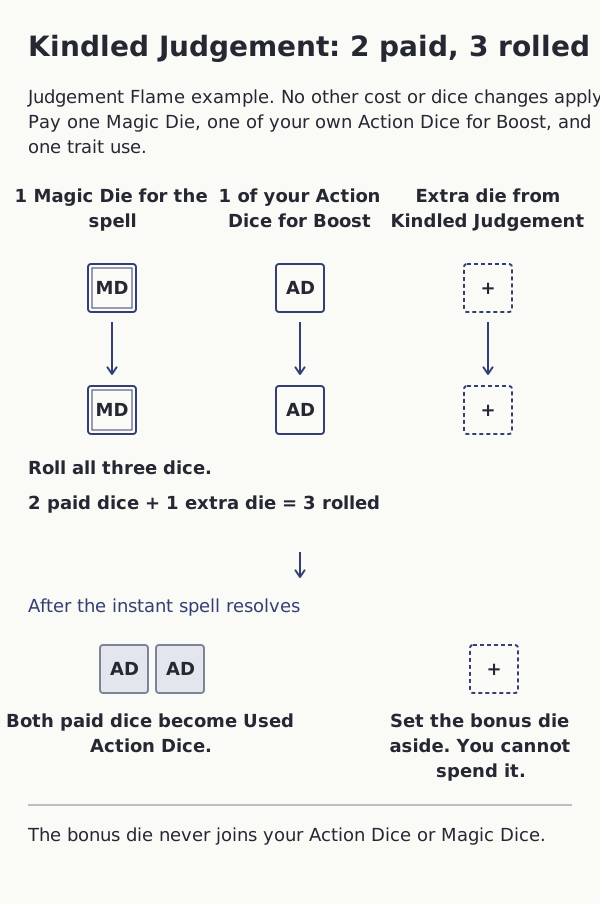
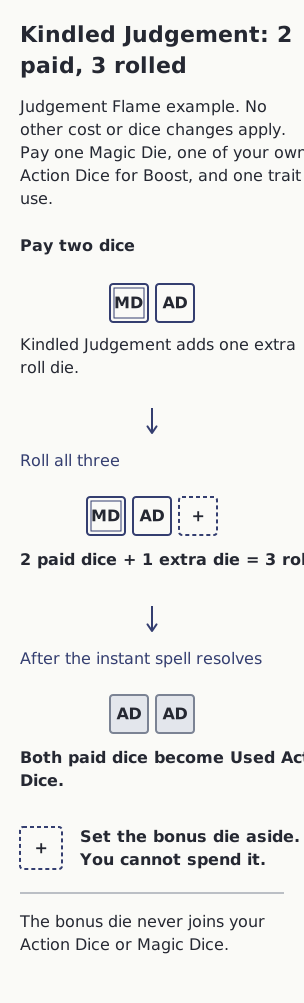

Read the diagram as text
This instant Judgement Flame cast has no other cost changes or dice-moving effects. Kindled Judgement requires at least one of the Cleric’s own Action Dice as Boost and one trait use.
- Pay one base Magic Die and one of the Cleric’s own Action Dice as genuine Boost.
- Declare Kindled Judgement at its Trigger, before the defender chooses a response or resistance, and spend one use of the trait.
- Add one extra die to this casting roll. Roll three dice: the paid Magic Die, the paid Boost Action Die and the extra die.
- Resolve the instant spell, harm and any Continuation Check. In this ordinary example, both paid dice become Used Action Dice, including the paid Magic Die.
- Set the bonus die aside. It never joins the Cleric’s Action Dice or Magic Dice and cannot be spent.
Result: Two body dice were paid. Three dice were rolled. Only the two paid dice become Used Action Dice.
- The bonus is not another Boost die and does not count against the Boost limit.
- The extra die cannot satisfy the own-Action-Die Boost requirement or pay the trait use.
- Trance, trained Path Skill, a legal target and normal casting requirements still apply.
- If resolution has already Wounded or otherwise moved a paid die, keep that result instead of moving it again.
Searing Conviction
Trait.
Trigger: Finish resolving a Devouring Flame spell that you Boosted with at least 1 of your own AD, including any harm and Continuation Check. You have at least one Used AD.
Cost: One use of Searing Conviction.
Effect: Return one of your Used AD to Ready. This can be a die spent on that casting; it does not return a Wounded die or a Magic Die.
Example: You spend two AD and one MD on a boosted Brand of Flame. After resolving the spell, Searing Conviction returns one of those Used AD to Ready, whether the brand succeeded or failed.
Wrath Undenied
Trait.
Trigger: After all casting rerolls, your Devouring Flame casting check's final total equals its target number and would fail. You Boosted that check with at least 1 of your own AD.
Cost: One use of Wrath Undenied.
Effect: Add +1 to that casting total and resolve it again. In a Clash, use it only when that increase makes your attack win; it cannot turn a winning enemy attack into a new spell after harm has been applied.
Example: Your boosted Righteous Command totals 3 against the target's resistance 3. Wrath Undenied raises your total to 4, so the command succeeds.